All species › Passerines › Tyrant flycatchers and allies › Rufous-lored Tyrannulet
Rufous-lored Tyrannulet | Phylloscartes flaviventris
Geelbuiklooftiran | Orejerito amarillo | Borboletinha-amarela
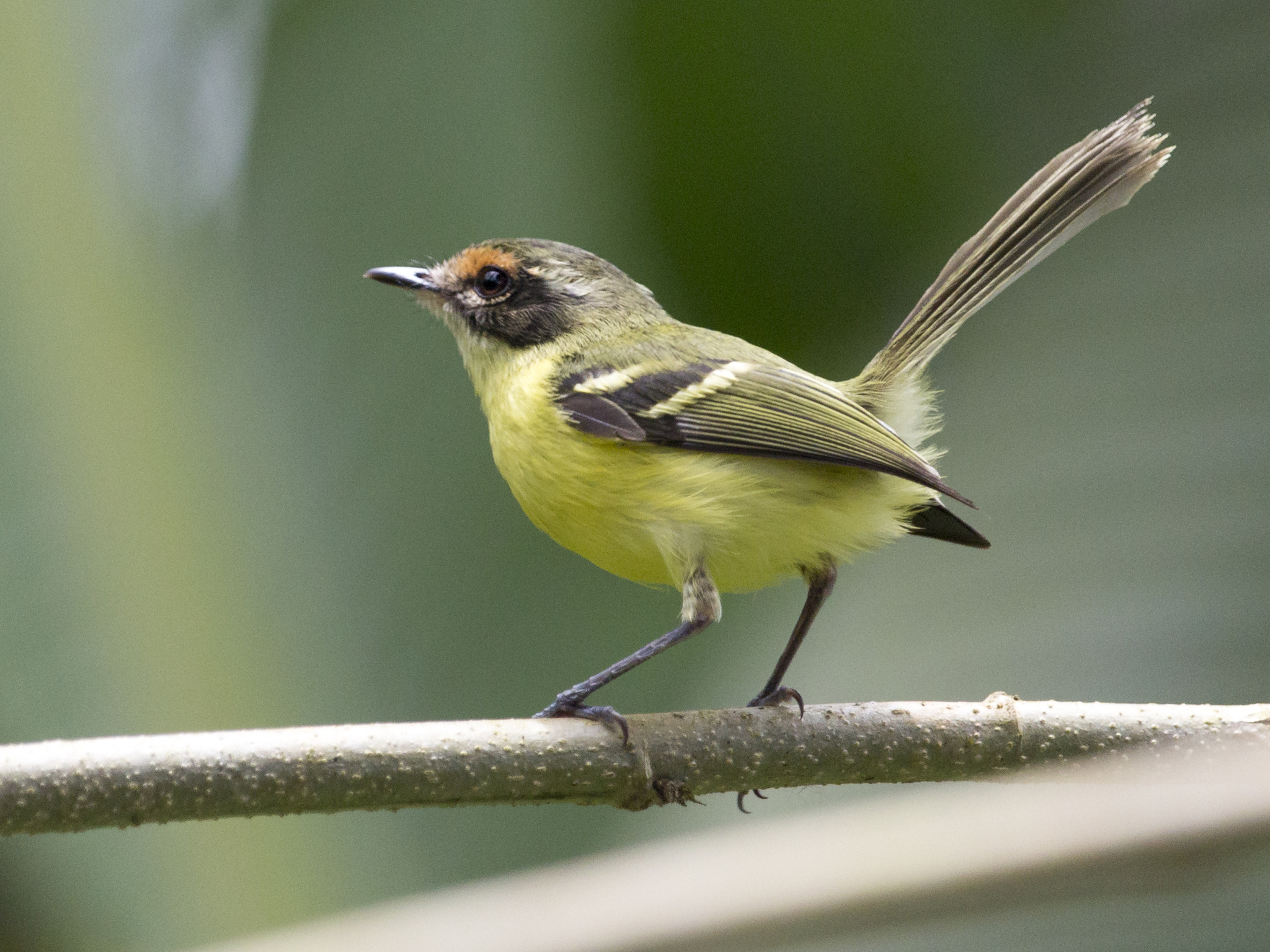
The Rufous-lored Tyrannulet is a small olive and bright yellow tyrant flycatcher that lives only in the mountains of northern Venezuela. It occurs in the coastal range and in Yaracuy, not in the Andes or the Serranía de Perijá. The rufous forehead and the black crescent around the ear-coverts mark the head.
Voice
While foraging, a quick call of one to four notes, described as a high, thin, jangling teep-teep-teep, and a sputtering te'te'skeek!. Few recordings exist.
Recording: Nick Athanas — CC BY-NC-SA 3.0 · xeno-canto
Identification
12 cm, with a long, pointed black bill. The forehead is rufous; this colour runs to above the eye and turns yellow behind it. The lores and a narrow moustache are blackish, there is a rufous arc below the eye, and a black crescent encloses the yellowish ear-coverts. The crown is pearly grey, the upperparts bright olive-green. The wings are blackish, with bright yellow edges and two broad yellow wing-bars. The underparts are entirely bright yellow. The sexes are alike.
Confusion species
Venezuelan Bristle Tyrant Pogonotriccus venezuelanus lives in the same forests and also has a dark crescent on the ear-coverts, but has no rufous on the face and perches more upright. Venezuelan Tyrannulet Zimmerius petersi has a short, stubby bill and no facial pattern. Yellow Tyrannulet Capsiempis flaveola has a yellow eyebrow and stays low in shrubbery.
Habitat
Humid to wet evergreen montane forest, mainly in the upper tropical zone between about 300 and 1000 m, probably also higher in cloud forest. It mostly keeps to the forest interior, also at edges. It forages actively from the mid-storey to the canopy, perches horizontally, sometimes with the tail slightly cocked, and makes short sallies or briefly hovers to pick insects from leaves and twigs. Usually in pairs or family groups, often in mixed flocks. Nothing is known about its breeding.
Where the bird is most at home, classified by the vegetation units of Amazonia and the Guianas.

Range and movements
Only in Venezuela: the mountains of Yaracuy, the coastal range from western Carabobo through Aragua to the Capital District, and inland in Miranda and at Guatopo on the Miranda–Guárico border. Not in the Andes of Mérida and Táchira and not in the Serranía de Perijá. Not south of the Orinoco and not in Brazil or the Guianas; does not occur outside the guide area.
- Resident
- dark = core range, pale = thinly spread
How and when to look
Follow mixed flocks on the lower slopes of Henri Pittier or at Guatopo, between 400 and 1000 m; look for the rufous forehead and the entirely yellow underparts.
Conservation status
Near Threatened. Its range is small and fragmented, and forest on the lower slopes of the coastal range is being cleared for agriculture and building. Part of the range lies in national parks such as Henri Pittier and Guatopo.
Scientific name
Phylloscartes flaviventris | (Hartert, 1897)
Hartert described the species in 1897 as Leptotriccus flaviventris; because it was later moved to another genus, the author and year stand in brackets. The genus Phylloscartes was introduced in 1860 by Cabanis & Heine. Phylloscartes is Greek, from phullon 'leaf' and skairō 'to skip, to dance', after its restless foraging among foliage. flaviventris is Latin, from flavus 'yellow' and venter 'belly', after the yellow underparts. The specimen the first description was based on came from Mérida, Venezuela.