All species › Nightjars › Nightjars and nighthawks › Rufous Nightjar
Rufous Nightjar | Antrostomus rufus
Rosse nachtzwaluw | Chotacabras rojizo | João-corta-pau
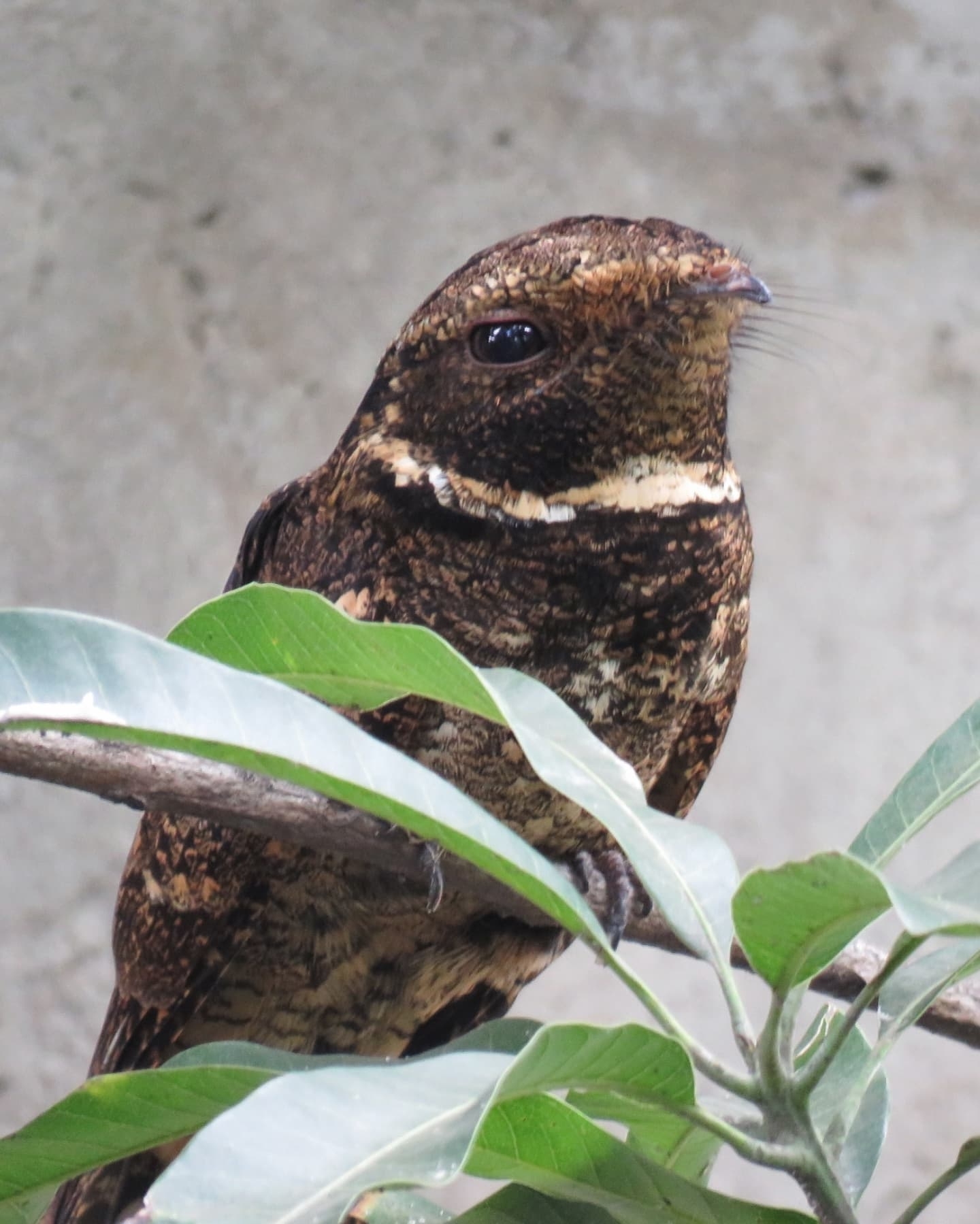
Rufous Nightjar is a large, almost entirely rufous-brown nightjar of dry and semi-humid forest in tropical South America. Its rhythmic song is repeated at dusk from a branch above a forest trail. In the guide area it is widespread but patchily distributed, from northern Venezuela and the Guianas to southern Brazil.
Voice
A quick, rhythmic series chuk, wick-wick-weeoo, repeated many times from a perch up to about 20 m high, mainly at dusk and in moonlight in the breeding season.
Recording: JAYRSON ARAUJO DE OLIVEIRA — CC BY-NC-SA 4.0 · xeno-canto
Identification
25–30 cm, with a large head and a long, rounded tail. The plumage is warm rufous-brown, with dark brown streaks on the upperparts and dark spots and bars on the wings, without white in the wing. There is a buff band on the nape and a white band below the throat. The male has large white patches at the tips of the three outer pairs of tail feathers; in the female the tail tips are pale buff.
Confusion species
Silky-tailed Nightjar Antrostomus sericocaudatus is darker and lives in the interior of humid forest, with a whistled song. Pauraque Nyctidromus albicollis is smaller and greyer, with a white wing band in the male, and often sits on trails and roads. Spot-tailed Nightjar Antiurus maculicaudus is much smaller, with a black crown and pale supercilium, and lives in wet grassland.
Habitat
Dry and semi-humid forest, cerradão, gallery forest, forest edges, scrub and savanna with woodland patches, from the dry forest of northern Venezuela and the Caatinga to humid lowland forest, locally into the hills. It catches insects in sallies from a perch. By day it rests on the forest floor; the eggs are laid without a nest on the ground among the leaves.
Where the bird is most at home, classified by the vegetation units of Amazonia and the Guianas.





Range and movements
In Venezuela mainly in the north, in dry forest of the coast and low hills and in the Llanos, and locally south of the Orinoco. In Guyana, Suriname and French Guiana scarce and local, in savannas with woodland patches and along forest edges. In Brazil widespread but patchy, from drier forests in Amazonia through the Cerrado, the Caatinga and the Pantanal to the Atlantic Forest and the south. Outside the guide area from Costa Rica and Panama through Colombia to Ecuador, Peru, Bolivia, Paraguay and northern Argentina, and on Trinidad.
- Resident
- dark = core range, pale = thinly spread
How and when to look
Listen at dusk along forest edges in dry forest or cerradão for the rhythmic song. Singing birds often sit on a branch above the trail and can be found with a torch.
Conservation status
Least Concern. The species has a large range; locally, conversion of dry forest and cerrado to farmland reduces its habitat.
Scientific name
Antrostomus rufus | (Boddaert, 1783)
Boddaert described the species in 1783 as Caprimulgus rufus; because it was later moved to another genus, the author and year stand in brackets. The genus Antrostomus was introduced in 1838 by Bonaparte. Antrostomus is Greek, from antron 'cave' and stoma 'mouth': 'cave-mouth', after the enormous gape. rufus is Latin for 'red, rufous', after the warm rufous plumage. The specimen the first description was based on came from Cayenne, French Guiana.