All species › Passerines › Antbirds › Rufous-rumped Antwren
Rufous-rumped Antwren | Euchrepomis callinota
Grijswangmiersluiper | Hormiguerito lomirrufo | Zidedê-de-sobre-ruivo
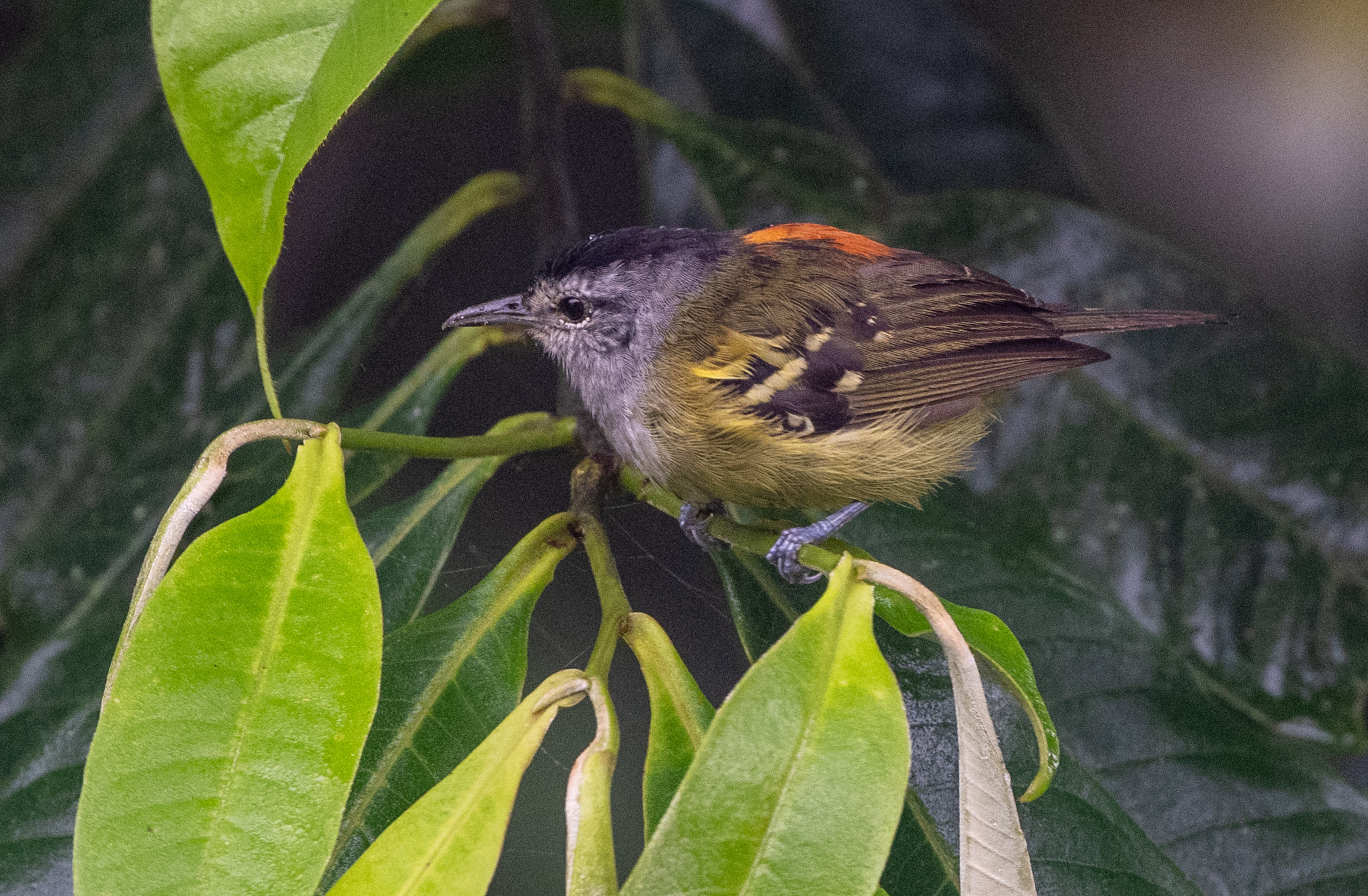
The Rufous-rumped Antwren is a small, slender antwren with a fairly long tail and a rufous rump, living almost only in the canopy of humid hill and montane forest. In shape and behaviour it recalls a vireo or a warbler more than an antbird. In the guide area it has two separate ranges: western Venezuela and the interior of the Guianas.
Voice
A fast, high series of notes that accelerates into a rapid twitter or trill and rises slightly. Calls are short, high tsi and ti notes.
Recording: rudy gelis — CC BY-NC-SA 4.0 · xeno-canto
Identification
10–11 cm, slender, with a thin, pointed bill and a fairly long tail. The male has a black crown and nape, a pale grey face with a narrow pale eyebrow and a dark eye-line, an olive-green mantle and a bright rufous lower back and rump. The wings are dark with two pale wing bars. Throat and breast are pale grey, the belly pale yellow. The female has an olive-brown instead of black crown and greyish-olive sides of the head.
Confusion species
Ash-winged Antwren Euchrepomis spodioptila of the lowlands of southern Venezuela, the Guianas and northern Brazil has a grey instead of olive-green mantle and whitish underparts without yellow. Rufous-margined Antwren Herpsilochmus rufimarginatus has rufous edges to the flight feathers and no rufous rump. Small warblers and vireos in the same mixed flocks lack the combination of rufous rump, wing bars and black crown.
Habitat
Canopy, interior and edges of humid foothill and montane forest; in the Venezuelan Andes and Perijá mainly between about 800 and 2000 m, in the Guianas also lower in hill forest. It gleans small arthropods from leaves and twigs, usually in pairs and often with mixed flocks of tanagers and other small birds.
Where the bird is most at home, classified by the vegetation units of Amazonia and the Guianas.



Range and movements
Venezuela: in the Serranía de Perijá and locally on the slopes of the Andes. Guyana, Suriname and French Guiana: locally in hill and montane forest in the interior, with few records. Not established with certainty in Brazil. Outside the guide area in Costa Rica and Panama and along the Andes from Colombia to central Peru.
- Resident
- dark = core range, pale = thinly spread
How and when to look
Search mixed flocks in the canopy of cloud forest and foothill forest in Perijá or the Venezuelan Andes, ideally from a road or slope overlooking the treetops. In birds high in the canopy the rufous rump shows as they fly from branch to branch.
Conservation status
Least Concern. Scarce and local in the guide area, and little noticed because it lives in the canopy; vulnerable to clearance of montane and hill forest.
Scientific name
Euchrepomis callinota | (Sclater, 1855) (GBIF: Terenura callinota)
Sclater described the species in 1855 as Formicivora callinota; because it was later moved to another genus, the author and year stand in brackets. The genus Euchrepomis was introduced in 2012 by Bravo, Remsen, Whitney & Brumfield. Euchrepomis is Greek, from eukhrōs 'bright-coloured' and epōmis 'point of the shoulder', after the bright yellow or orange-rufous lesser coverts of the males. callinota is Greek, from kallos 'beauty' and -nōtos '-backed', after the rufous rump. The specimen the first description was based on came from Bogotá, Colombia.