All species › Passerines › Antbirds › Russet Antshrike
Russet Antshrike | Thamnistes anabatinus
Rosse mierklauwier | Batará café | Choca-parda
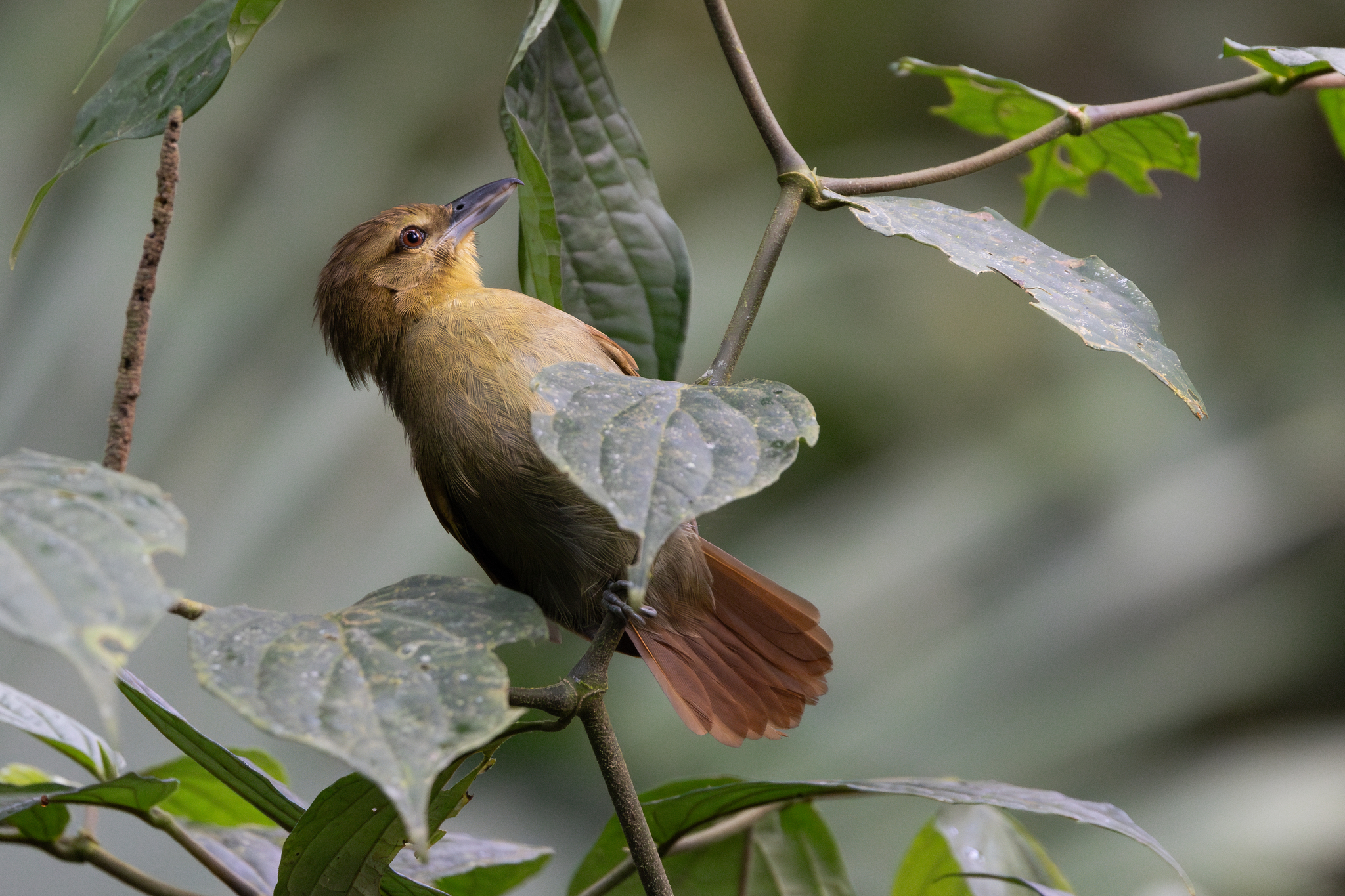
The Russet Antshrike is a stocky, olive-brown antshrike with rufous wings and tail and a heavy hooked bill. It lives high in the forest and nearly always travels with mixed flocks, behaving more like a foliage-gleaner than a typical antshrike. In the guide area it occurs only in western Venezuela, in the Serranía de Perijá and at the foot of the Andes.
Voice
The song is a short series of high, thin whistles that fall slightly, often preceded by a softer, lower note. The call is a thin, hissing tsip or tsip-tsip.
Recording: Juan Freile — CC BY-NC-SA 4.0 · converted to mono · xeno-canto
Identification
14–15 cm, stocky, with a heavy bill hooked at the tip. Upperparts olive-brown to rufous-brown, wings and tail brighter cinnamon. A pale buff eyebrow and a dark eye-line. Underparts plain pale buffy olive, the throat paler. The male has an orange-rufous patch between the shoulders that shows only when excited; the female lacks it. Otherwise the sexes are alike.
Confusion species
Foliage-gleaners such as Buff-fronted Foliage-gleaner Dendroma rufa are similarly brown but have a slimmer bill without an obvious hook and a bolder face pattern. The female Plain Antvireo Dysithamnus mentalis has a rufous crown but is smaller and lives lower in the forest.
Habitat
Canopy and upper middle levels of humid foothill and lower montane forest and adjacent tall second growth, in Venezuela at about 300 to 1400 m. It searches for arthropods among leaves, dead leaves, vines and moss, nearly always with mixed flocks. The nest is a deep pouch of leaves high in a tree.
Where the bird is most at home, classified by the vegetation units of Amazonia and the Guianas.

Range and movements
Venezuela: in the Serranía de Perijá in Zulia and locally on the slopes of the Andes in Táchira and adjacent states. Elsewhere in the guide area at most exceptional. Outside the guide area from southern Mexico through Central America to Colombia, Ecuador and the far north of Peru.
- Resident
- dark = core range, pale = thinly spread
How and when to look
Look for mixed flocks in the canopy of humid foothill forest in Perijá or at the foot of the Andes in Táchira, preferably from a road or slope overlooking the treetops. Watch for a rufous-brown bird probing dead leaves.
Conservation status
Least Concern. Local and little known in Venezuela; the forest of Perijá and the lower Andean slopes is being lost to logging and agriculture.
Scientific name
Thamnistes anabatinus | Sclater & Salvin, 1860
Sclater & Salvin described the species in 1860 and placed it straight away in the genus where it still stands. He introduced the genus Thamnistes in that same work. Thamnistes is Greek, from thamnos 'bush' and -istēs 'one who does': 'bush-dweller'. anabatinus refers to the foliage-gleaner genus Anabates (Greek anabatēs 'climber') with Latin -inus 'resembling'. The specimen the first description was based on came from Verapaz, Guatemala.