All species › Passerines › Tanagers and allies › Rufous-rumped Seedeater
Rufous-rumped Seedeater | Sporophila hypochroma
Roodstuitdikbekje | Capuchino de lomo rufo | Caboclinho-de-sobre-ferrugem
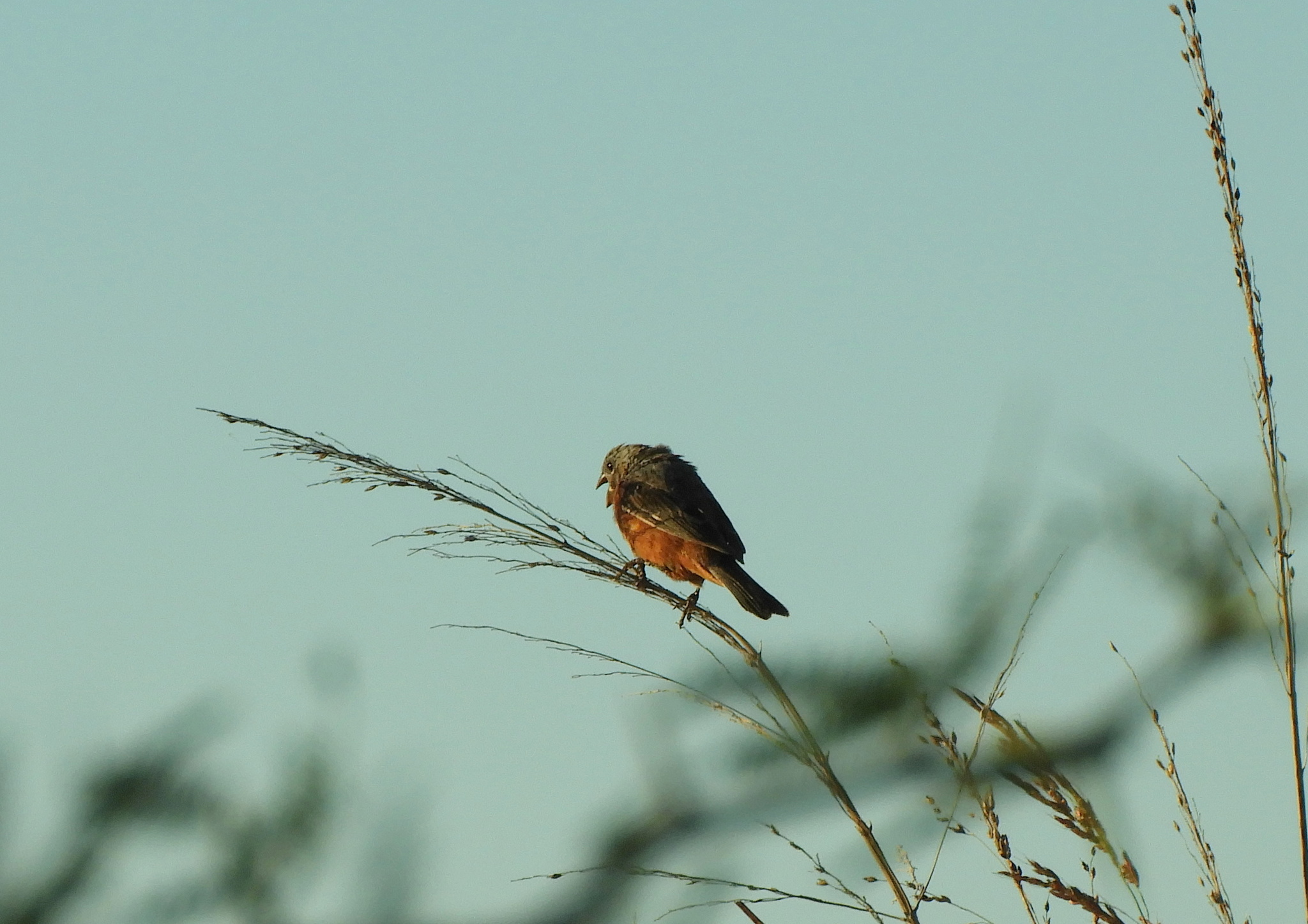
The Rufous-rumped Seedeater is a scarce capuchino of wet grasslands in the interior of South America. The male is grey above and deep rufous from throat to undertail and on the rump. It breeds mainly in Argentina, Paraguay and Bolivia and winters in the Cerrado.
Voice
The song is a clear series of whistled notes, short phrases and trills, similar to that of Tawny-bellied Seedeater. The call is a soft, nasal tchew.
Recording: Capovilla Pablo H — CC BY-SA 4.0 · converted to mono · xeno-canto
Identification
10 cm, with a short, thick, dark bill. The male has a dark blue-grey crown, nape and back, and dark wings with a white wing speculum. Cheeks, throat, the entire underparts and the rump are uniformly deep rufous to chestnut. The female is light brown above and buffy brown below. Young males at first resemble the female.
Confusion species
Tawny-bellied Seedeater Sporophila hypoxantha is paler, tawny-cinnamon below, with a paler grey back. Chestnut Seedeater Sporophila cinnamomea also has a chestnut back; only the crown is grey. Dark-throated Seedeater Sporophila ruficollis has a dark throat and paler underparts. Chestnut-bellied Seedeater Sporophila castaneiventris of Amazonia is blue-grey with only a chestnut stripe down the centre of the underparts. Females often cannot be separated with certainty in the field.
Habitat
Seasonally flooded grassland, marsh edges and wet savanna with tall grass; in winter also in wet grassland, veredas and open cerrado. From the lowlands up to about 1000 m. It feeds mainly on grass seeds, outside the breeding season in flocks with other capuchinos. The nest is a small cup placed low in grass or shrubs.
Where the bird is most at home, classified by the vegetation units of Amazonia and the Guianas.




Range and movements
Brazil: in the austral summer scarce in the southwest, mainly in Mato Grosso do Sul and the Pantanal, where it breeds locally; in winter in the Cerrado of Mato Grosso and Goiás. The wintering area is only partly known. Absent from Venezuela, Guyana, Suriname and French Guiana. Outside the guide area it breeds in eastern Bolivia, Paraguay and north-eastern Argentina.
- Resident
- Summer visitor (c. Apr–Sep)
- Winter visitor (c. Oct–Mar)
- Passage (Mar–Apr, Oct–Nov)
- dark = core range, pale = thinly spread
How and when to look
In winter, look in mixed capuchino flocks in the grasslands of Emas National Park for males with a dark grey back and uniformly rufous underparts. In summer in wet grasslands of the southern Pantanal.
Conservation status
Near Threatened. The population is small and declining through the loss of natural grassland in the breeding and wintering areas and through trapping for the cage-bird trade.
Scientific name
Sporophila hypochroma | Todd, 1915
Todd described the species in 1915 and placed it straight away in the genus where it still stands. The genus Sporophila was introduced in 1844 by Cabanis. Sporophila is Greek, from sporos 'seed' and philos 'lover': 'seed-lover'. hypochroma is Greek, from hupo 'below' and khrōma 'colour', after the coloured (rufous) underparts. The specimen the first description was based on came from Buena Vista, Santa Cruz, Bolivia.