All species › Swifts › Hummingbirds › Rufous-shafted Woodstar
Rufous-shafted Woodstar | Chaetocercus jourdanii
Jourdans boself | Estrellita de Jourdan | Estrelinha-de-haste-ruiva
The Rufous-shafted Woodstar is a small hummingbird of northern South America, which in the guide area occurs in the mountains of northern and western Venezuela. The English name refers to the rufous shafts of the male's tail feathers. Like other woodstars it hovers in front of small flowers with a buzzing, bee-like flight.
Voice
Usually silent. Short, dry tsip notes; the wings make a soft buzzing sound.
No recording with a suitable Creative Commons licence is available for this species yet.
Identification
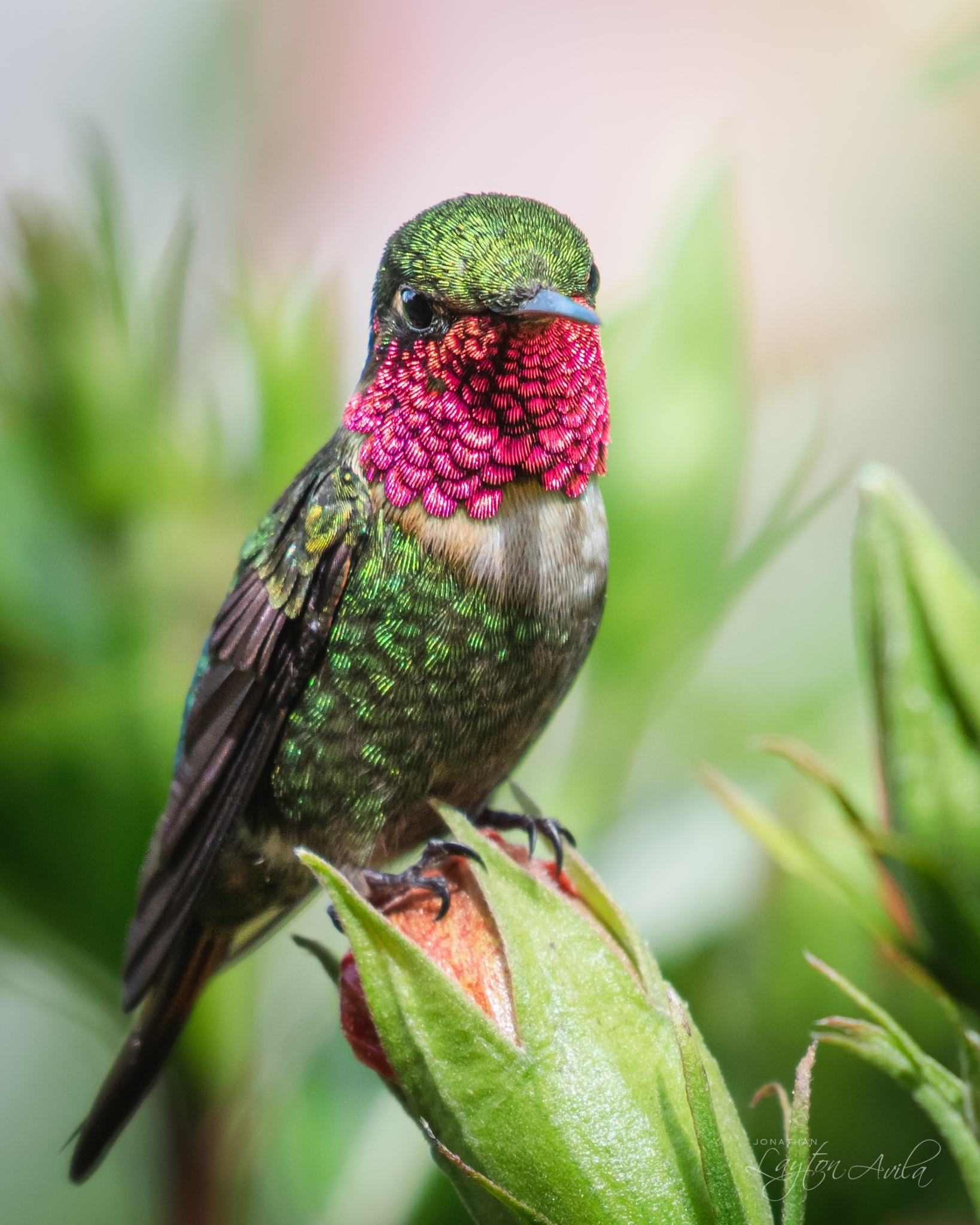
7 cm, with a short, straight black bill. The male is green above, with a glittering rose-purple throat, a white spot behind the eye and a white band across the breast. The rest of the underparts are green, with a white patch on the side of the rump. The short, forked tail is dark, with rufous shafts and inner webs. The female is green above and cinnamon to buff below, with a dark ear patch and a rufous tail with a black band.
Confusion species
Gorgeted Woodstar Chaetocercus heliodor is smaller, the male without a white breast band and with elongated side points to the throat; it lives only in the Andes. The male Amethyst Woodstar Calliphlox amethystina has a long, deeply forked tail without rufous. The female closely resembles those of the other woodstars.
Habitat
Edges of humid montane forest, clearings, shrubby slopes, coffee plantations and gardens, roughly between 1000 and 3000 m, locally lower. It takes nectar at small flowers in shrubs and trees and catches small insects. The nest is a small cup of plant down on a branch.
Where the bird is most at home, classified by the vegetation units of Amazonia and the Guianas.



Range and movements
In Venezuela in the Serranía de Perijá, the Andes, the coastal range from Carabobo to Miranda and the eastern mountains to the Paria Peninsula. Not in Brazil or the Guianas. Outside the guide area in northeastern Colombia and on Trinidad.
- Resident
- dark = core range, pale = thinly spread
How and when to look
At flowering shrubs and trees on forest edges, in coffee plantations and in gardens in the uplands, such as in Henri Pittier, at Colonia Tovar and on the slopes around Mérida. Watch the male when it spreads its tail: the rufous shafts then show.
Conservation status
Least Concern. The species tolerates forest edges, plantations and gardens.
Scientific name
Chaetocercus jourdanii | (Bourcier, 1839)
Bourcier described the species in 1839 as Ornismya Jourdanii; because it was later moved to another genus, the author and year stand in brackets. The genus Chaetocercus was introduced in 1855 by Gray. Chaetocercus is Greek, from khaitē 'long flowing hair' and kerkos 'tail', after the male's hair-thin outer tail feathers. jourdanii probably honours the French zoologist and comparative anatomist Claude Jourdan (1803–1873), curator of the natural history museum in Lyon. The specimen the first description was based on came from Trinidad.