All species › Passerines › Tyrant flycatchers and allies › Rufous-sided Scrub Tyrant
Rufous-sided Scrub Tyrant | Euscarthmus rufomarginatus
Geelbuikdwergtiran | Tiranuelo flanquirrufo | Maria-corruíra
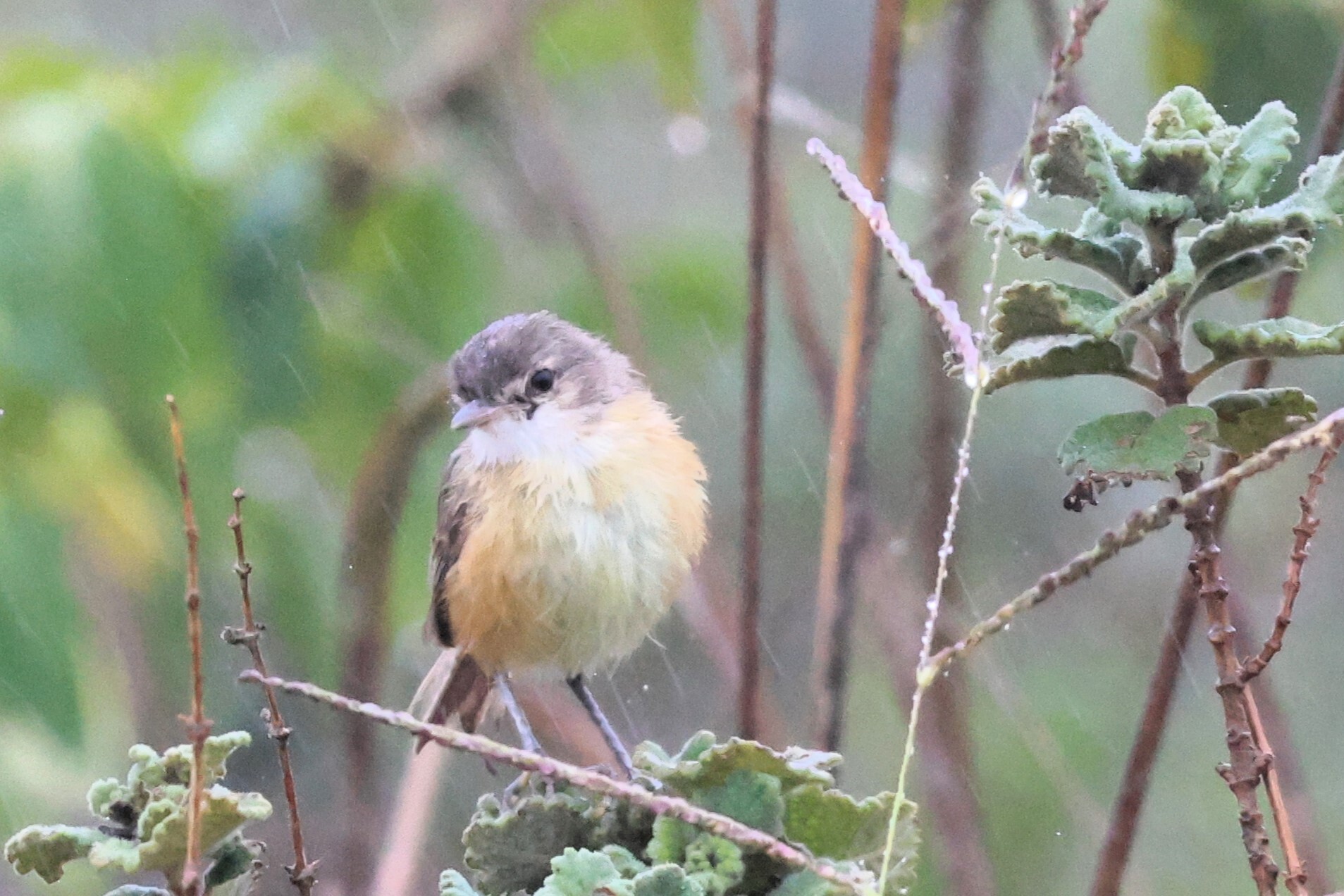
Rufous-sided Scrub Tyrant is a small, brown tyrant with buff-orange flanks that lives in open, natural grassland with low shrubs in the cerrado. It is very local and disappears where the grassland is ploughed or heavily grazed. Its dry, rattling song comes from low grass and shrubs.
Voice
A sustained, toneless, fast and dry rattle, often from a low shrub. When alarmed, buzzy trills and a squeaky, rattling chatter.
Recording: Tulio Dornas — CC BY-NC-SA 4.0 · xeno-canto
Identification
10–11 cm, with a short, pointed bill. Crown brown, with a small, partly hidden cinnamon-rufous patch. A whitish brow and eye-ring in a pale brown face. Upperparts brown, wings darker brown, with buff tips to the coverts that form two wing-bars. Throat white, underparts pale yellow, with warm buff-orange breast sides, flanks and undertail coverts. Sexes alike.
Confusion species
Fulvous-crowned Scrub Tyrant Euscarthmus meloryphus is whiter below, without buff-orange flanks, and lives in dry scrub and along forest edges. Sharp-tailed Grass Tyrant Culicivora caudacuta shares the same grassland, but has a streaked crown and a long, pointed tail. Bearded Tachuri Polystictus pectoralis is warmer buff, and the male has a black-speckled throat.
Habitat
Open, natural grassland with scattered shrubs (campo sujo and campo limpo), campo rupestre and savanna, also damp grassland near veredas, from near sea level to about 1000 m. It searches for insects low in grass and shrubs. It avoids heavily grazed, burnt or ploughed grassland. Little is known about the nest.
Where the bird is most at home, classified by the vegetation units of Amazonia and the Guianas.




Range and movements
Brazil: in the cerrado of the centre, roughly from Maranhão, Tocantins and western Bahia through Goiás, the Federal District and Minas Gerais to Mato Grosso, Mato Grosso do Sul and northern São Paulo; also locally in savanna areas within Amazonia, including Amapá. Suriname: in the Sipaliwini savanna in the south. Only a few records are known from Guyana. Absent from Venezuela and French Guiana. Outside the guide area in northern and eastern Bolivia and in extreme northeastern Paraguay.
- Resident
- dark = core range, pale = thinly spread
How and when to look
Search well-preserved cerrado grassland with low shrubs, for example in national parks such as Emas, Chapada dos Veadeiros and Serra da Canastra. Listen in the early morning for the dry rattle; the bird then sometimes perches briefly on top of a shrub.
Conservation status
Least Concern, but rare and very local; the population is probably decreasing. Conversion of cerrado grassland to cropland and pasture is the main threat.
Scientific name
Euscarthmus rufomarginatus | (Pelzeln, 1868)
Pelzeln described the species in 1868 as Hapalocercus rufomarginatus; because it was later moved to another genus, the author and year stand in brackets. The genus Euscarthmus was introduced in 1831 by Wied-Neuwied. Euscarthmus is Greek euskarthmos 'high-leaping', from eu 'good' and skarthmos 'leaping', after the lively hops of these pygmy-tyrants. rufomarginatus is Latin for 'rufous-edged', from rufus 'rufous' and marginatus 'bordered', after the rufous flanks. The specimen the first description was based on came from northern São Paulo, Brazil.