All species › Passerines › Ovenbirds and woodcreepers › Rufous Spinetail
Rufous Spinetail | Synallaxis unirufa
Roeststekelstaart | Pijuí rufo | João-ruivo
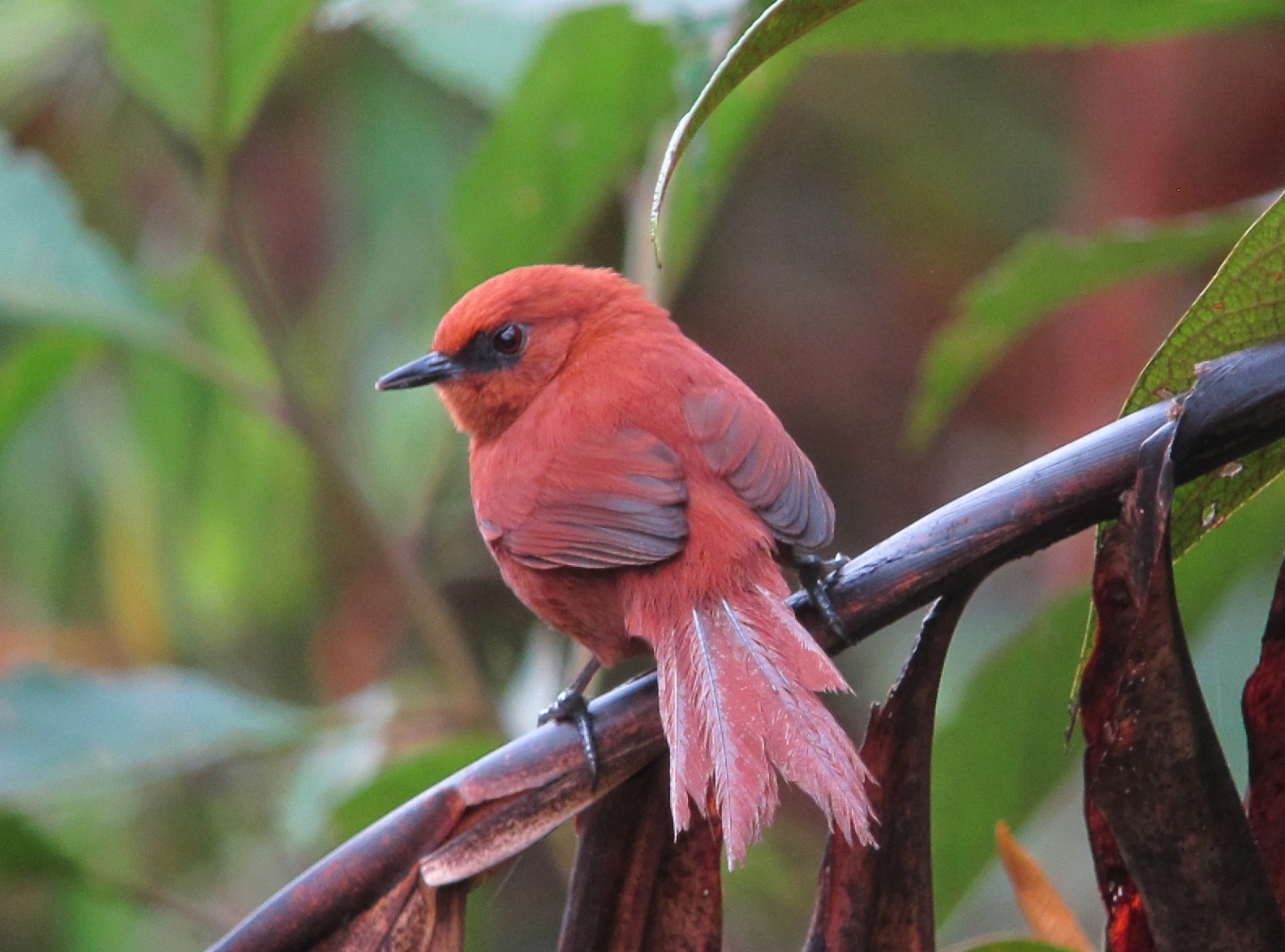
The Rufous Spinetail is one of the larger spinetails and is almost entirely bright rufous. In the guide area it lives only in the undergrowth of montane forest in the Venezuelan Andes and the Serranía de Perijá, often in bamboo of the genus Chusquea. Its nasal song is heard mainly in the morning from dense cover.
Voice
The song is a series of two or three nasal notes, the first often shorter, repeated for long periods at intervals of one to two seconds, usually from cover. The call is a short, upslurred note, sometimes doubled.
Recording: Juan Freile — CC BY-NC-SA 4.0 · converted to mono · xeno-canto
Identification
16–18 cm, with a long, graduated, rufous tail. The plumage is almost entirely bright rufous, the underparts slightly paler; the forehead is somewhat paler and the lores blackish. The form of the Andes from Trujillo to Táchira has faintly visible black feather bases on the throat; the Perijá form has a faint pale eyebrow and no black on the throat. The sexes are alike. Juveniles are browner above and paler below.
Confusion species
Azara's Spinetail Synallaxis azarae of the same mountains has an olive-brown back, a grey-brown forehead and a grey breast with a dark throat patch. Rufous Wren Cinnycerthia unirufa is also entirely rufous and lives in the same bamboo, but has a shorter, finely barred tail and barred wings and moves about in small groups. White-Browed Spinetail Hellmayrea gularis is smaller, with a white eyebrow and a white throat. Black-Throated Spinetail Synallaxis castanea has a black throat and lives only in the coastal range.
Habitat
Undergrowth and edges of humid montane forest, cloud forest and elfin forest, with a preference for bamboo of the genus Chusquea, mostly between 1700 and 3200 m, locally lower. It forages in pairs and sometimes joins mixed flocks, gleaning arthropods from leaves and twigs in dense growth, usually up to 2 m. Little is known about its breeding.
Where the bird is most at home, classified by the vegetation units of Amazonia and the Guianas.

Range and movements
Venezuela: in the Andes of Trujillo, Mérida and Táchira and, as a separate form, in the Serranía de Perijá on the Colombian border. Absent from the rest of the guide area. Outside the guide area in the Andes of Colombia, Ecuador and Peru.
- Resident
- dark = core range, pale = thinly spread
How and when to look
In bamboo and undergrowth along forest trails above about 2000 m in Mérida, for example in Sierra Nevada National Park. Listen in the morning for the repeated nasal notes; the bird stays in dense growth and is often seen best where a trail passes through bamboo.
Conservation status
Least Concern (IUCN). Common in undisturbed montane forest; habitat is lost locally to clearance for farming.
Scientific name
Synallaxis unirufa | de Lafresnaye, 1843
De Lafresnaye described the species in 1843 and placed it straight away in the genus where it still stands. The genus Synallaxis was introduced in 1818 by Vieillot. Synallaxis is Greek, from sunallaxis 'exchange'; why Vieillot chose the name is unclear. unirufa is Latin, from unus 'one' and rufus 'rufous': 'uniformly rufous', after the almost entirely rufous plumage. The specimen the first description was based on came from Bogotá, Colombia.