All species › Passerines › Ovenbirds and woodcreepers › Rufous-tailed Xenops
Rufous-tailed Xenops | Microxenops milleri
Roodstaartxenops | Xenops colirrufo | Bico-virado-da-copa
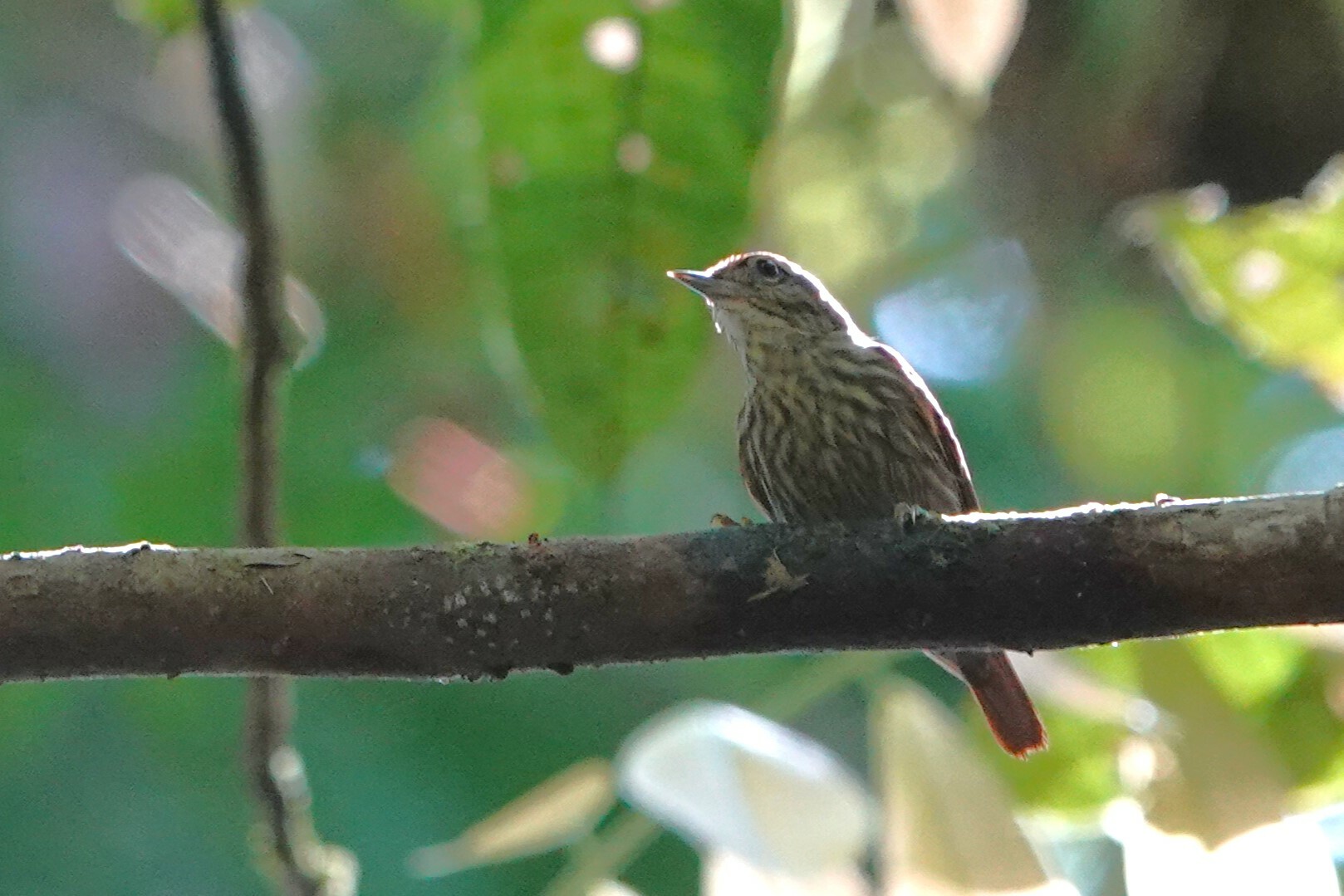
Rufous-tailed Xenops is a small, streaked ovenbird of the highest crowns of Amazonian forest, with a straight, pointed bill and a plain rufous tail. It is the only species in the genus Microxenops and differs from the true xenops in its straight bill and lack of a white malar stripe. It lives almost exclusively in mixed canopy flocks.
Voice
The song is a short, high, fast series of thin notes; the call is a sharp, high tseet. The voice is little studied and resembles that of other small canopy ovenbirds.
Recording: Jerome Fischer — CC BY-NC-SA 4.0 · xeno-canto
Identification
11 cm, with a straight, pointed, fairly short bill. Crown and back are dark olive-brown with pale buff streaks; the supercilium is pale buff. Rump and tail are plain rufous. Throat and underparts are pale buff to olive-brown with pale streaks, mainly on the breast. There is no white malar stripe and no black in the tail. The sexes are alike.
Confusion species
Slender-billed Xenops Xenops tenuirostris has a slightly upturned bill, a silvery white malar stripe and black in the tail. Amazonian Plain Xenops Xenops genibarbis is plain brown above and has an upturned wedge-shaped bill and a white malar stripe. Foliage-gleaners of the genus Philydor are larger and unstreaked or less streaked.
Habitat
Canopy of tall humid lowland forest, mainly terra firme, also white-sand forest and higher várzea; mostly below 600 m. It searches the outer crowns along thin branches, dead leaves and small epiphytes for insects, often with mixed flocks of tanagers and other canopy birds. The nest is poorly known; presumably in a cavity.
Where the bird is most at home, classified by the vegetation units of Amazonia and the Guianas.



Range and movements
Patchy and local throughout Amazonia. Brazil: north and south of the Amazon, east to Amapá and eastern Pará. Venezuela: south of the Orinoco in Amazonas and Bolívar. Guyana, Suriname and French Guiana: scattered through the forested region. Outside the guide area in southeastern Colombia, eastern Ecuador and Peru and northern Bolivia.
- Resident
- dark = core range, pale = thinly spread
How and when to look
The species lives high in the crowns; a canopy tower or an opening on a hill with a view over the canopy gives the best chance. In mixed flocks of tanagers and other canopy birds, look for a small streaked bird with a rufous tail searching along thin branches.
Conservation status
Least Concern (IUCN). The species has a large range in largely intact forest, but occurs at low density everywhere. Deforestation affects it in the south and east of Brazilian Amazonia.
Scientific name
Microxenops milleri | Chapman, 1914 (GBIF: Xenops milleri)
Chapman described the species in 1914 and placed it straight away in the genus where it still stands. He introduced the genus Microxenops in that same work. Microxenops is Greek, from mikros 'little' and the genus Xenops: 'little xenops'. milleri honours the US collector Leo E. Miller (1887–1952), who collected in tropical America in 1910–1917. The specimen the first description was based on came from foot of Cerro Duida, Amazonas, Venezuela.