All species › Passerines › Ovenbirds and woodcreepers › Rusty-backed Spinetail
Rusty-backed Spinetail | Cranioleuca vulpina
Roodrugstekelstaart | Curutié vulpino | Arredio-do-rio
The Rusty-backed Spinetail is a rufous spinetail of riverside scrub and gallery forest in the interior of Brazil and the llanos of Venezuela. Pairs climb like a creeper along branches and vines close to water. It closely resembles Parker's Spinetail of the river islands in western Amazonia, which was long treated as the same species.
Voice
A fast, rattling series of high notes that accelerates towards the end, often given by both partners in duet. The call is a sharp, short chip.
Recording: JAYRSON ARAUJO DE OLIVEIRA — CC BY-NC-SA 4.0 · xeno-canto
Identification
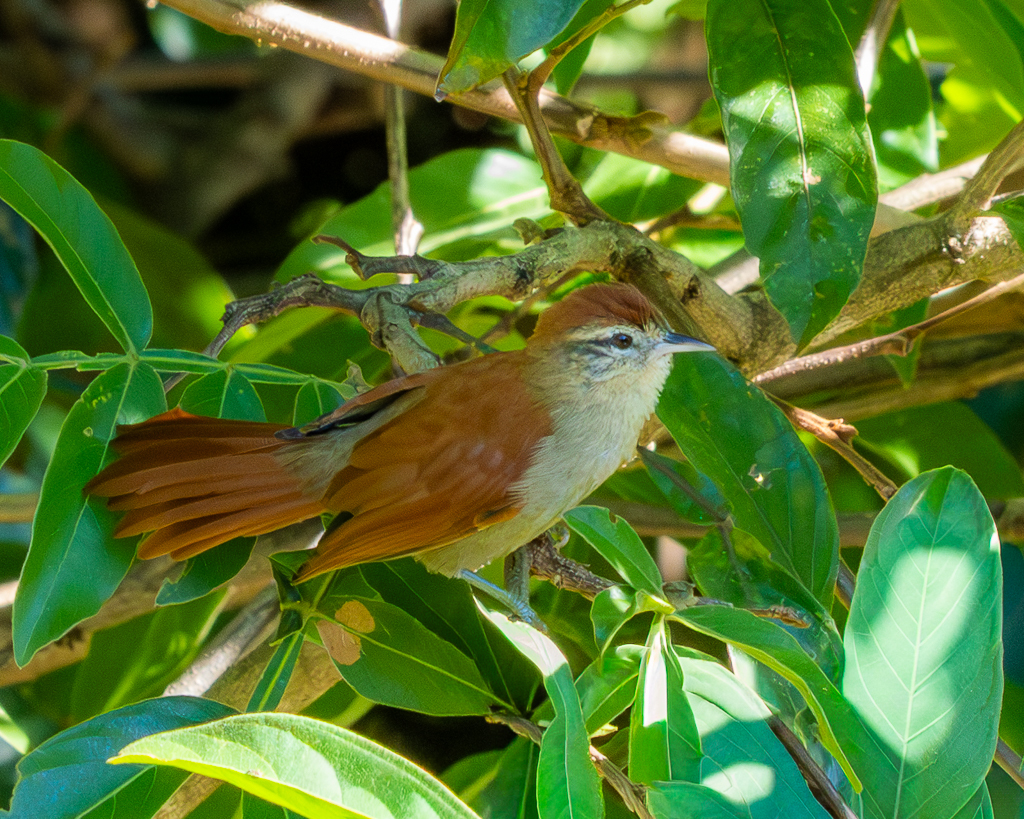
15–16 cm, with a straight, pointed bill and a graduated tail with pointed, spiny feather tips. Crown, back, wings and tail are rufous. A pale, buffy supercilium; the face is greyish. The throat is whitish, the rest of the underparts pale greyish buff. The sexes are alike; juveniles are duller, with a fainter supercilium.
Confusion species
Parker's Spinetail Cranioleuca vulpecula is almost identical, with a whiter throat and breast, and lives on river islands of the Solimões and the Amazon. Yellow-chinned Spinetail Certhiaxis cinnamomeus has a small yellow chin spot, whiter underparts and lives low in marsh vegetation. Red-and-white Spinetail Certhiaxis mustelinus has black lores and pure white underparts.
Habitat
Gallery forest, riverside scrub, várzea, scrub on river islands and thickets around lakes and marshes, also in the Pantanal and the flooded llanos; from sea level to about 800 m. It forages in pairs for insects in vines, dense shrubs and dead leaves, climbing along branches. The nest is a globe of twigs and plant material with a side entrance, in a shrub or tree near water.
Where the bird is most at home, classified by the vegetation units of Amazonia and the Guianas.





Range and movements
Brazil: widespread in the centre of the country, along the Araguaia and the Tocantins, in Mato Grosso, Goiás and the Pantanal, east to Minas Gerais and western Bahia, and locally along southern tributaries of the Amazon. Venezuela: in the llanos and along the Orinoco. Guyana, Suriname and French Guiana: absent. Outside the guide area in eastern Colombia, eastern Bolivia and on Coiba Island (Panama).
- Resident
- dark = core range, pale = thinly spread
How and when to look
In the Pantanal or along the Araguaia, search gallery forest and riverside shrubs for pairs climbing along branches and vines. The duet is often the first sign; in response to playback or imitation the birds often come to the edge of the thicket.
Conservation status
Least Concern (IUCN). The species is fairly common in suitable riverside scrub; clearing of gallery forest and the conversion of riverbanks to pasture are local threats.
Scientific name
Cranioleuca vulpina | (Pelzeln, 1856)
Pelzeln described the species in 1856 as Synallaxis vulpina; because it was later moved to another genus, the author and year stand in brackets. The genus Cranioleuca was introduced in 1853 by Reichenbach. Cranioleuca is Greek, from kranion 'skull, head' and leukos 'white', after the white crown of the type species C. albiceps. vulpina is Latin for 'fox-like', from vulpes 'fox', after the foxy-red upperparts. The specimen the first description was based on came from Engenho do Gama on the Guaporé River, Mato Grosso, Brazil.