All species › Birds of prey › Kites, Old World vultures, eagles and hawks › Semicollared Hawk
Semicollared Hawk | Microspizias collaris
Halsbandsperwer | Azor collarejo | Tauató-de-colar
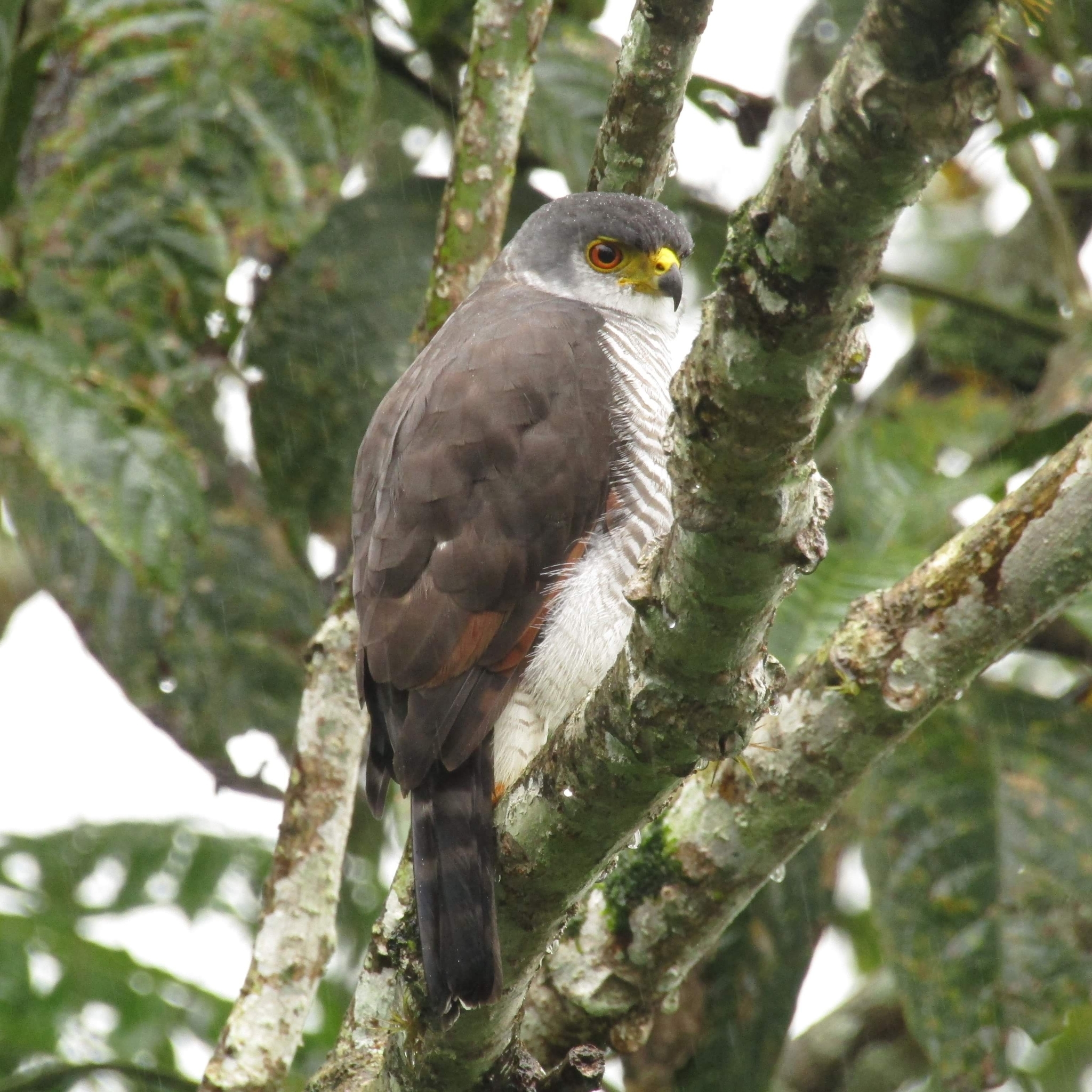
The Semicollared Hawk is a small Accipiter-like hawk of subtropical montane forest in the northern and central Andes. In the guide area it occurs only in the Andes of western Venezuela, where it is rare and seldom recorded. Its habits are only partly known.
Voice
Poorly known. Reported are high, rapid series kee-kee-kee, mainly near the nest.
No recording with a suitable Creative Commons licence is available for this species yet.
Identification
25–30 cm; the female is larger than the male. A small hawk with short, rounded wings and a fairly long tail. Adults are dark greyish brown to blackish on the crown and upperparts, with a dark, somewhat mottled cheek and a pale, broken collar on the nape. The underparts are white with coarse dark barring, the tail greyish brown with dark bands. Juveniles are browner above and barred brown below, with a less distinct collar.
Confusion species
Tiny Hawk Microspizias superciliosus is very similar, but lives in the lowlands, is more finely barred below and has no collar and no dark cheek. Sharp-shinned Hawk Accipiter striatus lives in the same elevation zone, but has rufous thighs and finer markings below. Barred Forest Falcon Micrastur ruficollis has bare yellow skin around the eye and a longer tail with narrow white bands. Double-toothed Kite Harpagus bidentatus has a black throat stripe.
Habitat
Humid subtropical montane forest and forest edges on the slopes of the Andes, mainly between about 1200 and 2500 m. It hunts from cover in the canopy and at forest edges, mainly on small birds. Little is known about the nest.
Where the bird is most at home, classified by the vegetation units of Amazonia and the Guianas.

Range and movements
In Venezuela rare in the western Andes, in Táchira and Mérida, with few documented records. Absent from Brazil, Guyana, Suriname and French Guiana. Outside the guide area locally in the Andes of Colombia, Ecuador and Peru.
- Resident
- dark = core range, pale = thinly spread
How and when to look
The best chance of a sighting is with mixed-species flocks and at forest edges in the subtropical montane forest of the Venezuelan Andes, and from viewpoints in the morning, when birds sometimes soar briefly. A photograph helps to separate it from Sharp-shinned Hawk.
Conservation status
Least Concern according to the current assessment, but scarce everywhere and dependent on montane forest, which has been cleared in many places.
Scientific name
Microspizias collaris | (Sclater, 1860) (GBIF: Accipiter collaris)
Sclater described the species in 1860 as Accipiter collaris; because it was later moved to another genus, the author and year stand in brackets. The genus Microspizias was introduced in 2021 by Sangster, Kirwan, Fuchs, Dickinson, Elliott & Gregory. Microspizias is Greek, from mikros 'small' and spizias 'hawk': 'small hawk'. collaris is Latin for 'of the neck, collared', after the pale collar. The specimen the first description was based on came from Bogotá, Colombia.