All species › Passerines › Tanagers and allies › Serra Finch
Serra Finch | Embernagra longicauda
Langstaartgors | Coludo gorjipálido | Rabo-mole-da-serra
The Serra Finch is a bulky, olive-green finch with a long tail and an orange-yellow bill. It occurs only in Brazil, in the campo rupestre of the mountain ranges of Minas Gerais and Bahia. Singing birds often perch in the open on a boulder or small shrub.

Voice
The song is a short, loud phrase of clear whistles, often repeated from a lookout, such as chee-choo-chiwee. The call is a dry chip.
Recording: Ciro Albano — CC BY-NC-SA 4.0 · shortened to the first 60 s, mono · xeno-canto
Identification
21 cm, with a long, rounded tail. The head is grey, with a white spot above the lores and dark lores, the throat is pale greyish white and the upperparts are olive-green with yellow-green edges to the flight feathers. The breast is grey, the belly paler and tinged ochre. The bill is orange-yellow with a dark culmen. The sexes are alike. Young birds are duller and somewhat streaked.
Confusion species
Pampa Finch Embernagra platensis is about the same size but has a shorter tail, less contrast on the head with no pale throat, and lives in wet grassland and marshes rather than on rocky slopes. Wedge-tailed Grass Finch Emberizoides herbicola is slimmer, ochre-brown and heavily streaked above, with a pointed tail.
Habitat
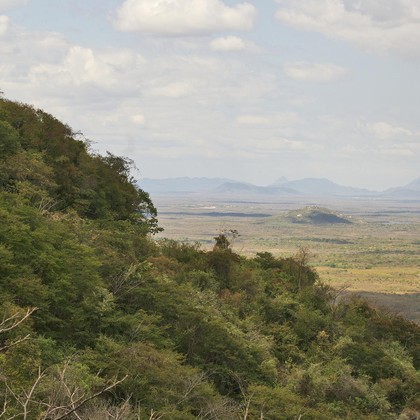
Rocky grassland with shrubs and scattered boulders on mountain tops and slopes, especially campo rupestre on quartzite, from about 900 to 2000 m. It forages on the ground and low in the vegetation for insects and seeds. The nest is a cup of grass placed low in a shrub or tussock.
Where the bird is most at home, classified by the vegetation units of Amazonia and the Guianas.


Range and movements
Only in Brazil: in the Serra do Espinhaço in Minas Gerais, such as the Serra do Cipó and the Diamantina area, and in the Chapada Diamantina in Bahia; also locally in other mountains of southern Minas Gerais. It occurs nowhere outside the guide area.
- Resident
- dark = core range, pale = thinly spread
How and when to look
Walk early in the morning through the campo rupestre of the Serra do Cipó or the Chapada Diamantina and look for birds on boulders and shrubs along the trails; singing birds often stay at the same spot for a long time.
Conservation status
Least Concern. The range is small, but much of it lies within protected areas. Fires, mining and the construction of roads and tourist facilities locally degrade the campo rupestre.
Scientific name
Embernagra longicauda | Strickland, 1844
Strickland described the species in 1844 and placed it straight away in the genus where it still stands. The genus Embernagra was introduced in 1831 by Lesson. Embernagra is a portmanteau of the genus names Emberiza 'bunting' and Tanagra 'tanager'. longicauda is Latin, from longus 'long' and cauda 'tail', after the long tail. The specimen the first description was based on came from South America (not specified).