All species › Passerines › Tanagers and allies › Shrike-like Tanager
Shrike-like Tanager | Neothraupis fasciata
Witbandtangare | Tangara bandeada | Cigarra-do-campo
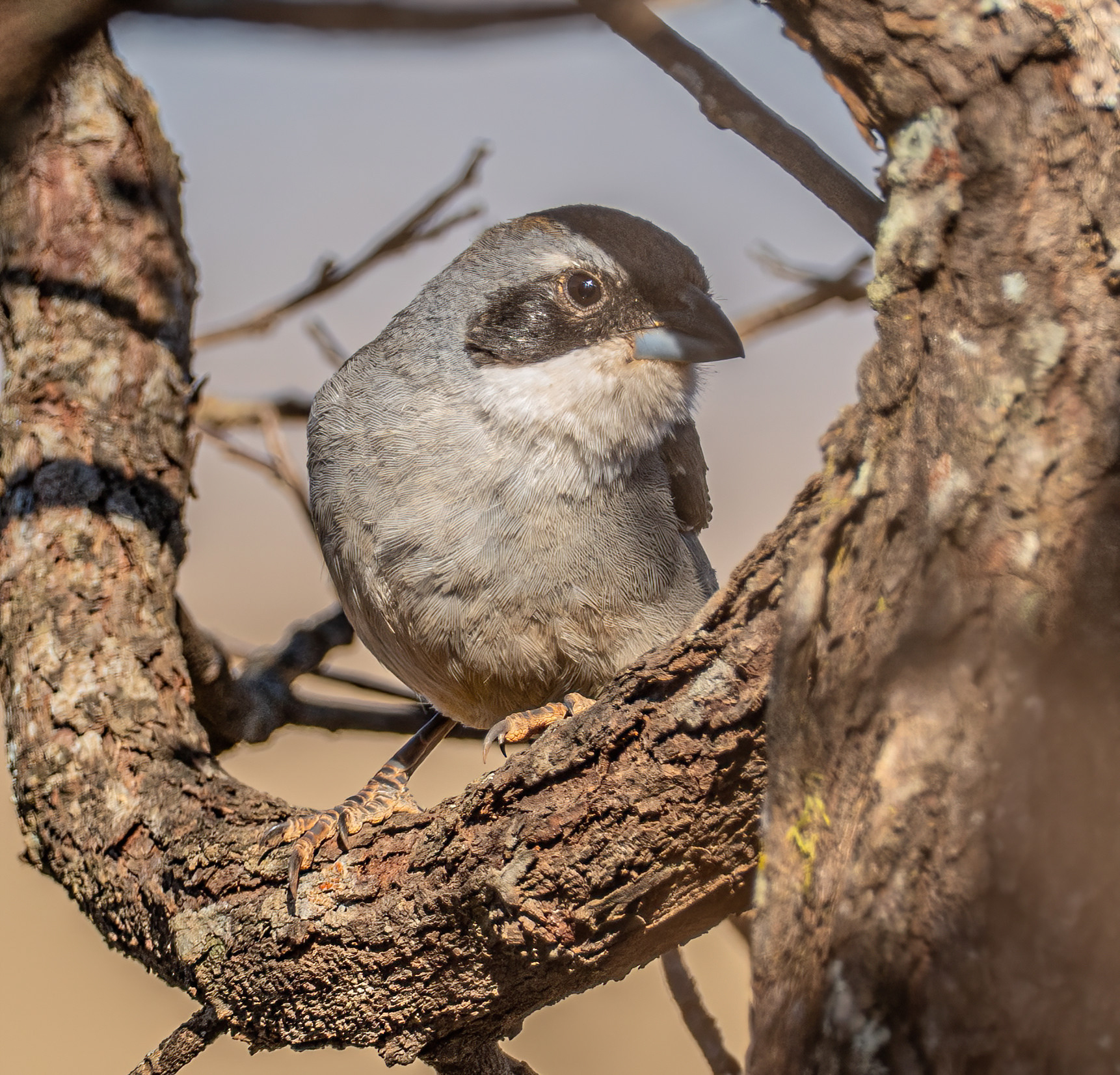
The Shrike-like Tanager is a grey tanager with a black mask, characteristic of the cerrado of central Brazil. It perches upright on a lookout, giving it the look of a shrike, and lives in family groups that often form the core of mixed flocks in open savanna woodland. Outside Brazil it occurs in the guide area only in an isolated savanna in southern Suriname.
Voice
Calls a sharp, metallic chik. The song is a loud, clear series of whistles and rattling notes, often in duet or by the whole group at dawn.
Recording: Jacob Wijpkema — CC BY-NC-SA 4.0 · xeno-canto
Identification
16 cm, with a fairly thick, slightly hooked grey bill. The male is grey above, with a black mask from the bill through the eye to the ear-coverts and a white throat. The underparts are pale grey to dirty white. The wings are blackish with a white band across the lesser coverts; the tail is dark grey. The female is browner grey, with a brownish-black mask. Juveniles are browner and have an indistinct mask.
Confusion species
Black-faced Tanager Schistochlamys melanopis is grey with a black face and a black throat and lacks the white wing band. White-rumped Tanager Cypsnagra hirundinacea lives in the same cerrado, but has black upperparts, a white rump and wing patch and a rufous throat. Bluish-grey Saltator Saltator coerulescens is larger, with a white eyebrow and no black mask.
Habitat
Open and dense cerrado, shrubby savanna grassland and savanna woodland on sandy or rocky plateaus, mostly at about 500 to 1100 m; in Suriname in open savanna with shrubs. Forages in groups of three to six birds in shrubs and low trees for insects and also eats fruit; other birds often join the group. The nest is an open cup in a shrub or low tree; the young are also fed by helpers from earlier broods.
Where the bird is most at home, classified by the vegetation units of Amazonia and the Guianas.




Range and movements
Brazil: in the Cerrado of Mato Grosso, Mato Grosso do Sul, Goiás, the Distrito Federal, Tocantins and Minas Gerais to western Bahia, rare in São Paulo. Suriname: an isolated population in the Sipaliwini savanna in the south. Venezuela, Guyana and French Guiana: not known. Outside the guide area in eastern Bolivia and north-eastern Paraguay.
- Resident
- dark = core range, pale = thinly spread
How and when to look
In the dry season, search the cerrado of the Chapada dos Guimarães, the Chapada dos Veadeiros or around Brasília for a small group of grey birds perching upright on shrub tops; other cerrado birds often follow the group.
Conservation status
Near Threatened. The cerrado is being converted at a fast rate into fields and pastures, mainly for soya and cattle, and the population is declining as a result. In protected areas with cerrado it is still fairly common.
Scientific name
Neothraupis fasciata | (Lichtenstein, 1823)
Lichtenstein described the species in 1823 as T[anagra] fasciata; because it was later moved to another genus, the author and year stand in brackets. The genus Neothraupis was introduced in 1936 by Hellmayr. Neothraupis is Greek, from neos 'new' and thraupis, an unknown finch-like bird, in ornithology 'tanager': 'new tanager'. fasciata is Late Latin for 'banded', from fascia 'band', after the white wing bar. The specimen the first description was based on came from São Paulo, Brazil.