All species › Swifts › Swifts › Sick's Swift
Sick's Swift | Chaetura meridionalis
Sicks gierzwaluw | Vencejo de Sick | Andorinhão-do-temporal
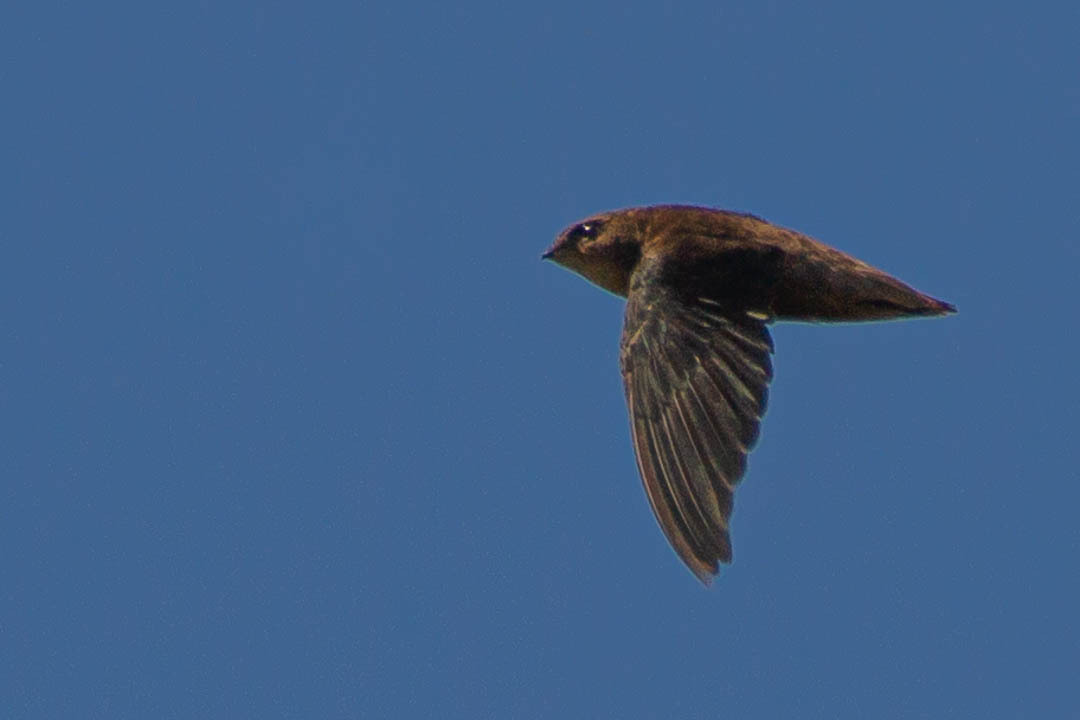
Sick's Swift is a fairly large, dark swift of the genus Chaetura that breeds in southern and central Brazil and moves to Amazonia in the austral winter. In the breeding season it is one of the common swifts over towns and forests in south-eastern Brazil, where it also nests in chimneys. It was formerly treated as a subspecies of Ashy-tailed Swift and is named after the ornithologist Helmut Sick, who described the birds of Brazil.
Voice
A dry, rapid chatter of short chip notes in flight, often by several birds at once. Similar to the calls of other Chaetura species.
Recording: JAYRSON ARAUJO DE OLIVEIRA — CC BY-NC-SA 4.0 · xeno-canto
Identification
13–14 cm, with long, narrow wings and a short, square tail whose shafts project as spines. The upperparts are dark sooty brown, with a slightly paler, greyish brown rump and uppertail coverts that contrast little. The throat is paler grey and grades into the dark grey breast and belly. The undertail coverts are dark. The sexes are alike and juveniles resemble adults.
Confusion species
Chimney Swift Chaetura pelagica, a winter visitor from North America, is very similar and often cannot be separated with certainty in the field; it averages slightly smaller and is present mainly from October to April in the north of the guide area. Chapman's Swift Chaetura chapmani is more uniformly blackish, with a barely paler rump and a darker throat. Ashy-tailed Swift Chaetura andrei in Venezuela is smaller, with an ash-grey tinged tail. Short-tailed Swift Chaetura brachyura is smaller, with a clearly pale rump, a very short tail and broadened inner secondaries.
Habitat
Hunts in the air over forest, forest edges, open country, towns and villages; in the breeding season mainly in the Atlantic Forest, the inland seasonal forest and the cerrado, in winter over lowland forest and rivers in Amazonia. It catches small flying insects, often in mixed flocks with other swifts. It nests in hollow trees, chimneys and buildings, with a nest of twigs glued to the wall with saliva.
Where the bird is most at home, classified by the vegetation units of Amazonia and the Guianas.





Range and movements
In Brazil a breeding bird in the south, south-east and centre, from Rio Grande do Sul to São Paulo, Rio de Janeiro, Minas Gerais, Goiás and Mato Grosso do Sul, from about September to April. In the austral winter, from about May to September, it moves to Amazonia, where it occurs as a winter visitor over lowland forest and rivers; in central Brazil birds are present in all months. In Guyana, Suriname and French Guiana only a few records; from Venezuela few certain data, because in the field the species can hardly be told from related Chaetura species. Outside the guide area breeding in Paraguay and northern Argentina; in winter it also reaches Colombia, Ecuador, Peru and Bolivia.
- Resident
- Winter visitor (c. Oct–Mar)
- Passage (Mar–Apr, Oct–Nov)
- dark = core range, pale = thinly spread
How and when to look
In the breeding season look over towns and forest edges in south-eastern Brazil, for example around São Paulo, Rio de Janeiro and Belo Horizonte; flocks often hunt low before thunderstorms, and at dusk they drop into chimneys and hollow trees. In the austral winter it is found among flocks of swifts over the Amazonian lowlands.
Conservation status
Least Concern. The species is widespread and also uses buildings and chimneys as nest sites.
Scientific name
Chaetura meridionalis | Hellmayr, 1907
Hellmayr described the species in 1907 and placed it straight away in the genus where it still stands. The genus Chaetura was introduced in 1826 by Stephens. Chaetura is Greek, from khaitē 'hair, bristle' and oura 'tail', after the spiny projecting shafts of the tail feathers. meridionalis is Latin for 'southern', from meridies 'south': the southern form of Chaetura andrei, of which it was first a subspecies. The specimen the first description was based on came from Santiago del Estero Province, Argentina.