All species › Passerines › Tyrant flycatchers and allies › Sierra de Lema Flycatcher
Sierra de Lema Flycatcher | Mionectes roraimae
Roraimapipratiran | Mosquerito de Sierra de Lema | Abre-asa-do-tepui
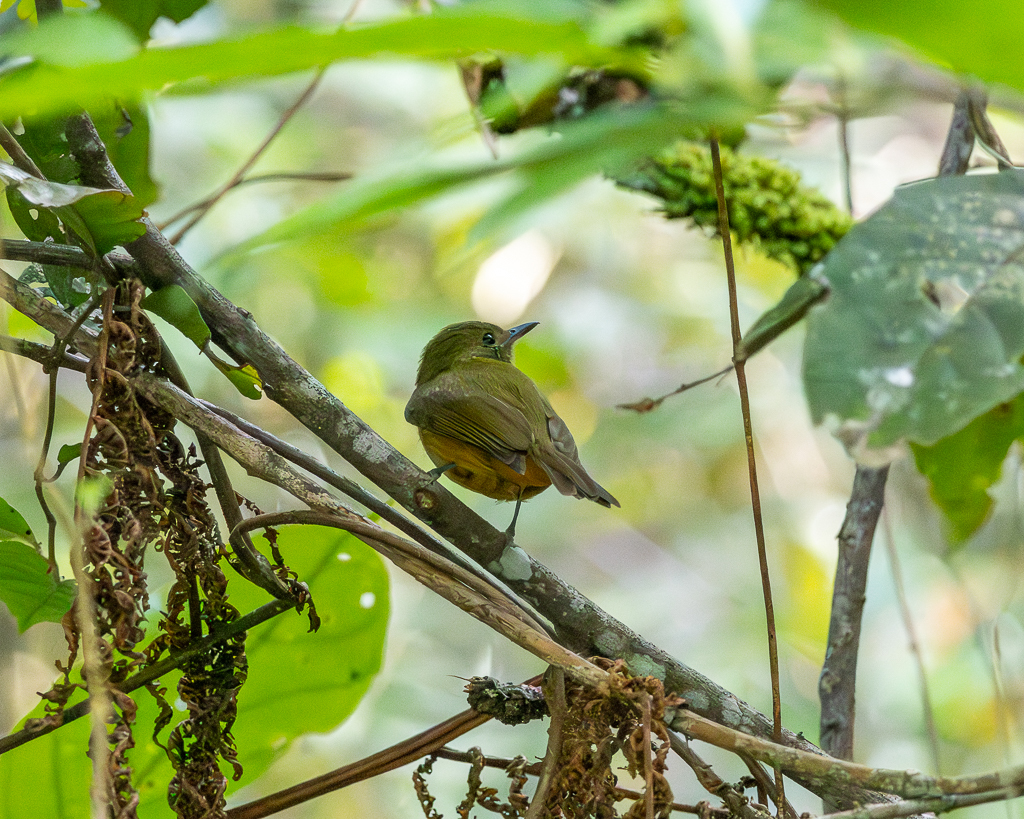
The Sierra de Lema Flycatcher is an olive-green Mionectes flycatcher with a cinnamon belly that lives only on the slopes of the tepuis. It was long treated as a subspecies of McConnell's Flycatcher and was recognised as a separate species only recently, mainly on the basis of song and display. Like its relatives, it repeatedly lifts one wing.
Voice
Two song types: a series of unmusical notes that turns into a loud, jangling burst of 10 to 15 notes, and a nasal phrase that starts with a low, vibrating note and ends in a higher, rising trill.
Recording: GABRIEL LEITE — CC BY-NC-SA 4.0 · xeno-canto
Identification
13 cm, with a thin black bill and a fairly long tail. Head, back and rump are bright olive-green; wings and tail dusky olive, without wing-bars. Throat and upper breast are greyish olive, the rest of the underparts deep cinnamon. Iris dark brown, legs grey. The sexes are alike.
Confusion species
McConnell's Flycatcher Mionectes macconnelli looks almost identical in the field, but lives mainly lower, in lowland forest; song and display are the best features. Ochre-bellied Flycatcher Mionectes oleagineus has an olive throat and breast that grade into the ochre belly, and also lives mainly in the lowlands.
Habitat
The interior of humid forest on the slopes and foothills of the tepuis, often on sandy soil or among boulders, mostly between 700 and 2000 m, locally lower. It lives in the lower and middle storeys and eats mainly small fruits and berries, supplemented by insects. Males sing from fixed song posts inside the forest.
Where the bird is most at home, classified by the vegetation units of Amazonia and the Guianas.


Range and movements
Venezuela: the tepuis of the south and south-east (Bolívar, including the Sierra de Lema and the Gran Sabana, and Amazonas). Guyana: the west, in the Pakaraima Mountains. Brazil: the far north of Roraima, along the borders with Venezuela and Guyana. Absent from Suriname and French Guiana. Does not occur outside the guide area.
- Resident
- dark = core range, pale = thinly spread
How and when to look
Search along the road through the Sierra de Lema (Escalera) in Bolívar; listen inside the forest for the jangling song and look for an olive-green bird with a cinnamon belly that lifts one wing.
Conservation status
Least Concern. Its habitat on the tepui slopes is largely intact and remote; local threats are mining and logging along roads.
Scientific name
Mionectes roraimae | (Chubb, 1919) (GBIF: Mionectes macconnelli)
Chubb described the species in 1919 as Pipromorpha oleaginea roraimae; because it was later moved to another genus, the author and year stand in brackets. The genus Mionectes was introduced in 1844 by Cabanis. Mionectes is Greek meionektēs 'small, having suffered loss', from meionekteō 'to have too little'. roraimae refers to Roraima, the tepui on the border of Venezuela, Brazil and Guyana, where the species was discovered. The specimen the first description was based on came from Mount Roraima, Venezuela.