All species › Passerines › Tanagers and allies › Sooty Grassquit
Sooty Grassquit | Asemospiza fuliginosa
Zwartborstgrondvink | Semillero fuliginoso | Cigarra-preta
The Sooty Grassquit is a dark grassquit of forest edges and clearings in forest, not of open grassland. The species wanders to places where bamboo is seeding or where new growth comes up after fire, and is therefore irregular at many sites. In the guide area it has two separate centres: the mountains of northern Venezuela and eastern Brazil, especially the Atlantic Forest.
Voice
The song is a simple, rapid series of high notes, also described as a thin, reedy, slurred phrase with a buzzy quality. The call is a short tchee.
Recording: JAYRSON ARAUJO DE OLIVEIRA — CC BY-NC-SA 4.0 · xeno-canto
Identification
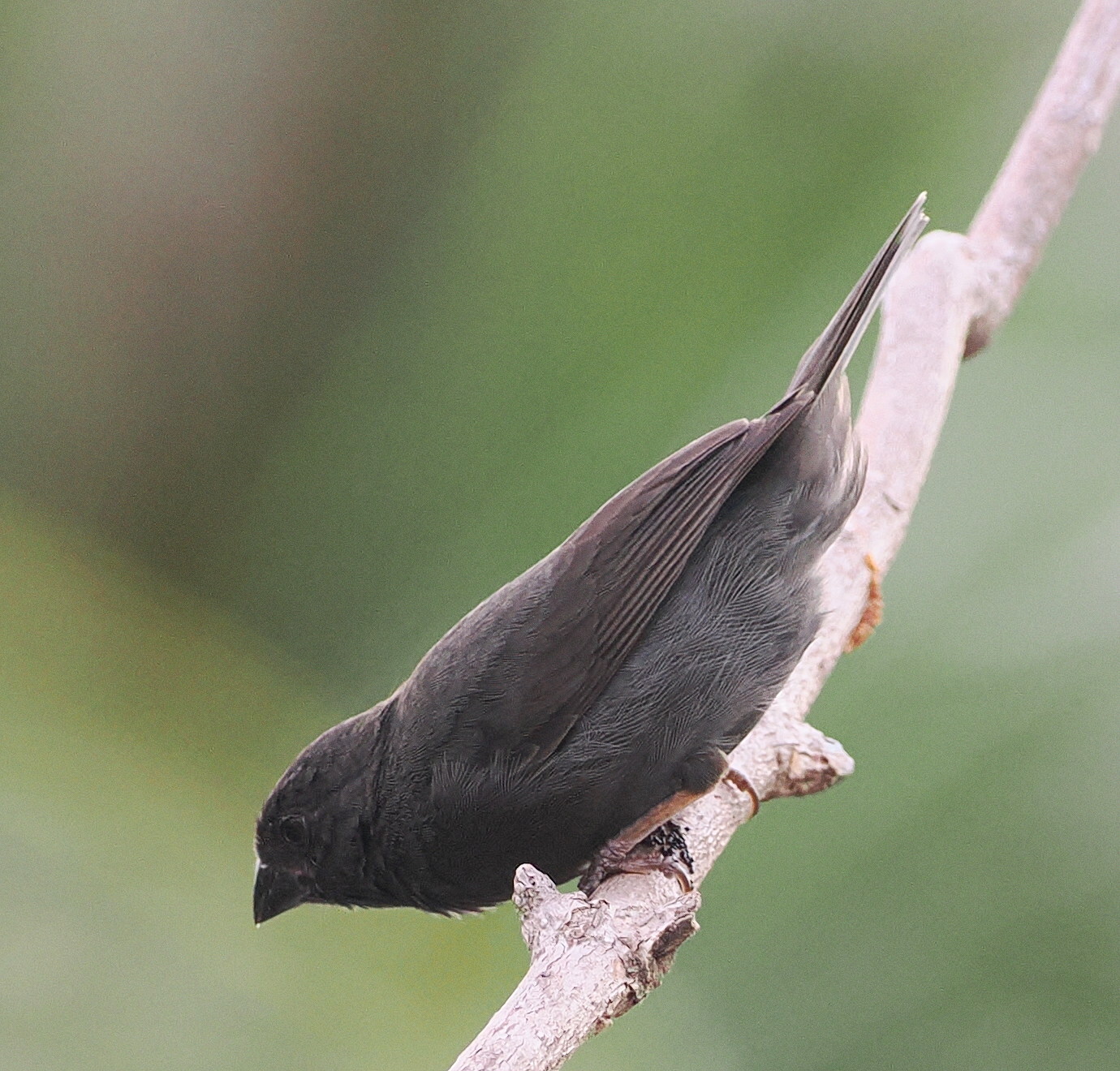
11–12 cm, with a rather long, conical dark bill. The male is entirely sooty black, with an olive tinge on the back and slightly paler underparts. The female is warm olive-brown, darker on the upperparts, with brownish wings and a paler, olive breast and belly; her bill is slightly paler. Juveniles resemble the female.
Confusion species
The male Blue-black Grassquit Volatinia jacarina is glossy blue-black, with a more pointed bill, and in display jumps up singing from a lookout in open grassland; its females are browner and streaked on the breast. The male Uniform Finch Haplospiza unicolor, which also follows bamboo seed in the Atlantic Forest, is slate grey with a thinner, pointed bill. The male Blackish-blue Seedeater Amaurospiza moesta is dark blue-black, with a thick, rounded bill. In Venezuela the male Black-faced Grassquit Melanospiza bicolor has only a black head and breast, with an olive-green back.
Habitat
Edges of humid forest, grassy clearings in and near forest, secondary growth and ground regrowing after fire, also gallery forest in the Cerrado, from the lowlands into the mountains. It eats seeds and specialises in seeding bamboo; the breeding season is probably timed to the supply of bamboo seed. Outside the breeding season sometimes in flocks. The nest is a cup or ball low in a shrub or among bamboo.
Where the bird is most at home, classified by the vegetation units of Amazonia and the Guianas.






Range and movements
Venezuela: local in the coastal range from Yaracuy and Carabobo to Miranda, in the Andes of Lara, Trujillo, Mérida and Táchira, in the Serranía de Perijá and in the mountains of Sucre and Monagas; a few records from Bolívar. Guyana: a few records. No records from Suriname or French Guiana. Brazil: mainly in the east, from Ceará, Pernambuco and Alagoas through Bahia, Minas Gerais and Espírito Santo to Rio de Janeiro, São Paulo, Paraná and Santa Catarina, inland to Goiás, the Distrito Federal and Tocantins, and locally in Maranhão and Pará. At many sites the species appears only when bamboo is seeding and is absent in other years. Outside the guide area in Colombia, on Trinidad, in Paraguay and north-eastern Argentina, with one record from Bolivia.
- Resident
- dark = core range, pale = thinly spread
How and when to look
Search forest edges and trails in the Atlantic Forest of Rio de Janeiro, São Paulo and Santa Catarina, especially where taquara bamboo is seeding; flocks may then gather there with other bamboo followers. In Venezuela, forest edges in the coastal range and in the Andes of Trujillo are worth checking. Females closely resemble other grassquits and seedeaters.
Conservation status
Least Concern (IUCN). The species has a large but highly fragmented range and is scarce and irregular in many areas. Clearance of the Atlantic Forest has reduced its habitat, although the species also uses forest edges and secondary growth.
Scientific name
Asemospiza fuliginosa | (Wied-Neuwied, 1830)
Wied-Neuwied described the species in 1830 as Fringilla fuliginosa; because it was later moved to another genus, the author and year stand in brackets. The genus Asemospiza was introduced in 2016 by Burns, Unitt & Mason. Asemospiza is Greek, from asēmos 'without marks' and spiza 'finch', after the plain, unmarked plumage. fuliginosa is Latin for 'sooty', after the male's dark, sooty plumage. The specimen the first description was based on came from Camamu, Bahia, Brazil.