All species › Swifts › Hummingbirds › Sparkling Violetear
Sparkling Violetear | Colibri coruscans
Goulds violetoorkolibrie | Colibrí rutilante | Beija-flor-violeta
The Sparkling Violetear is the largest violetear and one of the most widespread hummingbirds of the uplands of Venezuela, from forest edges and scrub to city gardens. The male sings almost all day from an exposed perch and fiercely defends flowers against other hummingbirds. It is a regular visitor to feeders.

Voice
The song is a loud, metallic, rhythmic series of notes, such as chip-chuk, chip-chuk, which the male repeats for hours from an exposed branch. In chases it gives dry, rattling notes. The male performs display flights, rising and then descending with the tail spread.
Recording: JAYRSON ARAUJO DE OLIVEIRA — CC BY-NC-SA 4.0 · xeno-canto
Identification
13–14 cm, with a fairly long, straight, black bill. Glittering green, with a large blue-violet patch running back from below the eye and joining the one on the other side under the chin. There is a blue-violet patch in the centre of the belly. The tail is blue-green with a broad, dark blue subterminal band. The sexes are nearly alike; the female is slightly smaller and duller. Young birds are duller, with rufous fringes to the feathers.
Confusion species
Lesser Violetear Colibri cyanotus is clearly smaller, with a smaller violet ear patch that does not meet under the chin and no blue belly patch; it lives on average lower. Brown Violetear Colibri delphinae is greyish brown. White-vented Violetear Colibri serrirostris of central and south-eastern Brazil has white undertail coverts and does not occur alongside this species.
Habitat
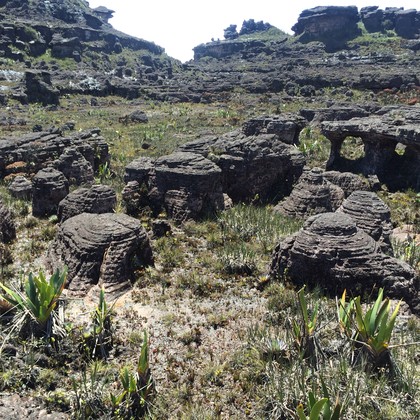
Semi-open uplands: forest edges, scrub, open woodland, páramo edges, farmland with hedges, gardens and parks, in the Andes mostly between about 1200 and 3600 m; in the tepui region on the plateau and on the slopes and summits of the tepuis. It visits a wide range of flowers, including those of planted trees such as eucalyptus, and catches insects in flight. The nest is a small cup on a low branch.
Where the bird is most at home, classified by the vegetation units of Amazonia and the Guianas.




Range and movements
In Venezuela in the Serranía de Perijá, the Andes and the coastal range, and south of the Orinoco in the tepui region of Bolívar and Amazonas. In Guyana in the highest parts of the Pakaraima Mountains, around Roraima. In Brazil known only from a few records near Mount Roraima, on the border with Venezuela and Guyana. Absent from Suriname and French Guiana. Outside the guide area along the Andes from Colombia to north-western Argentina.
- Resident
- dark = core range, pale = thinly spread
How and when to look
In gardens and parks with flowering shrubs in Mérida and other Andean towns, at lodge feeders, and along the road through the Gran Sabana. Listen for the rhythmic chip-chuk of a singing male.
Conservation status
Least Concern. It tolerates human-shaped landscapes well and has benefited from gardens and plantings.
Scientific name
Colibri coruscans | (Gould, 1846)
Gould described the species in 1846 as Trochilus (Petasophora) coruscans; because it was later moved to another genus, the author and year stand in brackets. The genus Colibri was introduced in 1824 by Spix. Colibri is the Spanish and French name for a hummingbird, supposedly based on a Carib word. coruscans is Latin for 'flashing, glittering', after the sparkling green and violet plumage. The specimen the first description was based on came from South America (not specified).