All species › Passerines › Thrushes and allies › Speckled Nightingale-Thrush
Speckled Nightingale-Thrush | Catharus maculatus
Sclaters dwerglijster | Paraulata ruiseñor | Tordo-maculado
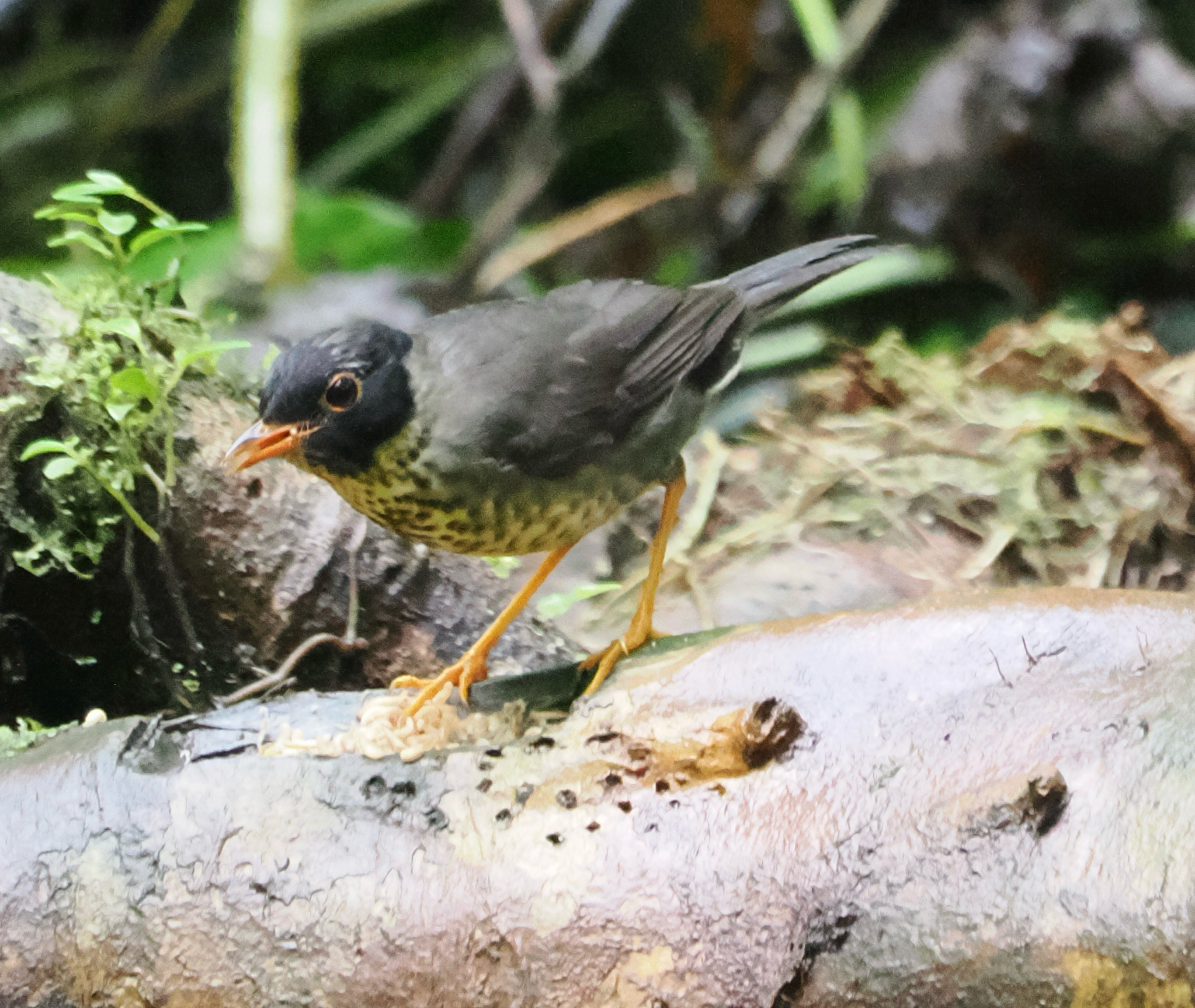
The Speckled Nightingale-Thrush is a nightingale-thrush with a black head, an orange bill and eye-ring and yellow-orange, dark-spotted underparts. It lives hidden on and just above the floor of humid montane forest, often in ravines and along streams. It was long treated as a subspecies of Yellow-throated Nightingale-Thrush Catharus dryas of Central America; since 2017 the two are regarded as separate species.
Voice
The song is a series of short, clear, fluty phrases of a few notes with short pauses between them, very similar to that of Slaty-backed Nightingale-Thrush. The call is a soft, rising, mewing rhee?.
Recording: Scott Olmstead — CC BY-NC-SA 4.0 · xeno-canto
Identification
17–19 cm, round in shape, with a fairly short tail. The male has a largely black head, an orange eye-ring and dark olive-grey upperparts. The underparts are apricot-yellow to yellow-orange, densely marked with dark spots on the breast and flanks. Bill and legs are orange, the iris dark. In the female the hindcrown and head are dark grey instead of black. Juveniles are duller, with dark spots on the underparts and a dark bill.
Confusion species
Slaty-backed Nightingale-Thrush Catharus fuscater also has a dark head and an orange bill, but is slate-grey above, has grey to whitish underparts without spots and a pale iris. Orange-billed Nightingale-Thrush Catharus aurantiirostris lacks the black head, has unspotted grey underparts and lives in more open scrub. Swainson's Thrush Catharus ustulatus, a winter visitor, has a dark bill and a pale, spotted breast without yellow.
Habitat
Understorey of humid foothill and lower montane forest, especially in damp ravines and along forest streams with dense undergrowth, at about 600–2200 m. It forages on the ground in leaf litter and low in the vegetation for insects and other invertebrates, also eats berries and sometimes follows army-ant swarms.
Where the bird is most at home, classified by the vegetation units of Amazonia and the Guianas.

Range and movements
Only in Venezuela: in the Serranía de Perijá and in the Andes, mainly in Táchira. Not in Brazil or the Guianas. Outside the guide area in the Andes of Colombia, Ecuador, Peru and Bolivia to north-western Argentina. Yellow-throated Nightingale-Thrush Catharus dryas is its Central American sister species and does not occur in the guide area.
- Resident
- dark = core range, pale = thinly spread
How and when to look
Most active and most often heard in the early morning, in the montane forest of Táchira, for example in El Tamá National Park. Search ravines with streams and dense undergrowth; the bird usually stays close to the ground.
Conservation status
Least Concern (IUCN). Tied to undisturbed, humid montane forest with a dense understorey; in Venezuela it has a small range in the west, where forest on the lower slopes is locally cleared for agriculture.
Scientific name
Catharus maculatus | (Sclater, 1858) (GBIF: Catharus dryas)
Sclater described the species in 1858 as Malacocichla maculata; because it was later moved to another genus, the author and year stand in brackets. The genus Catharus was introduced in 1850 by Bonaparte. Catharus is from Ancient Greek katharos 'pure, clean', a name given for the clean plumage of the orange-billed nightingale-thrush. maculatus is Latin for 'spotted', after the dark-spotted underparts. The specimen the first description was based on came from Ecuador.