All species › Passerines › Ovenbirds and woodcreepers › Speckled Spinetail
Speckled Spinetail | Thripophaga gutturata
Gespikkelde stekelstaart | Colaespina jaspeada | João-pintado
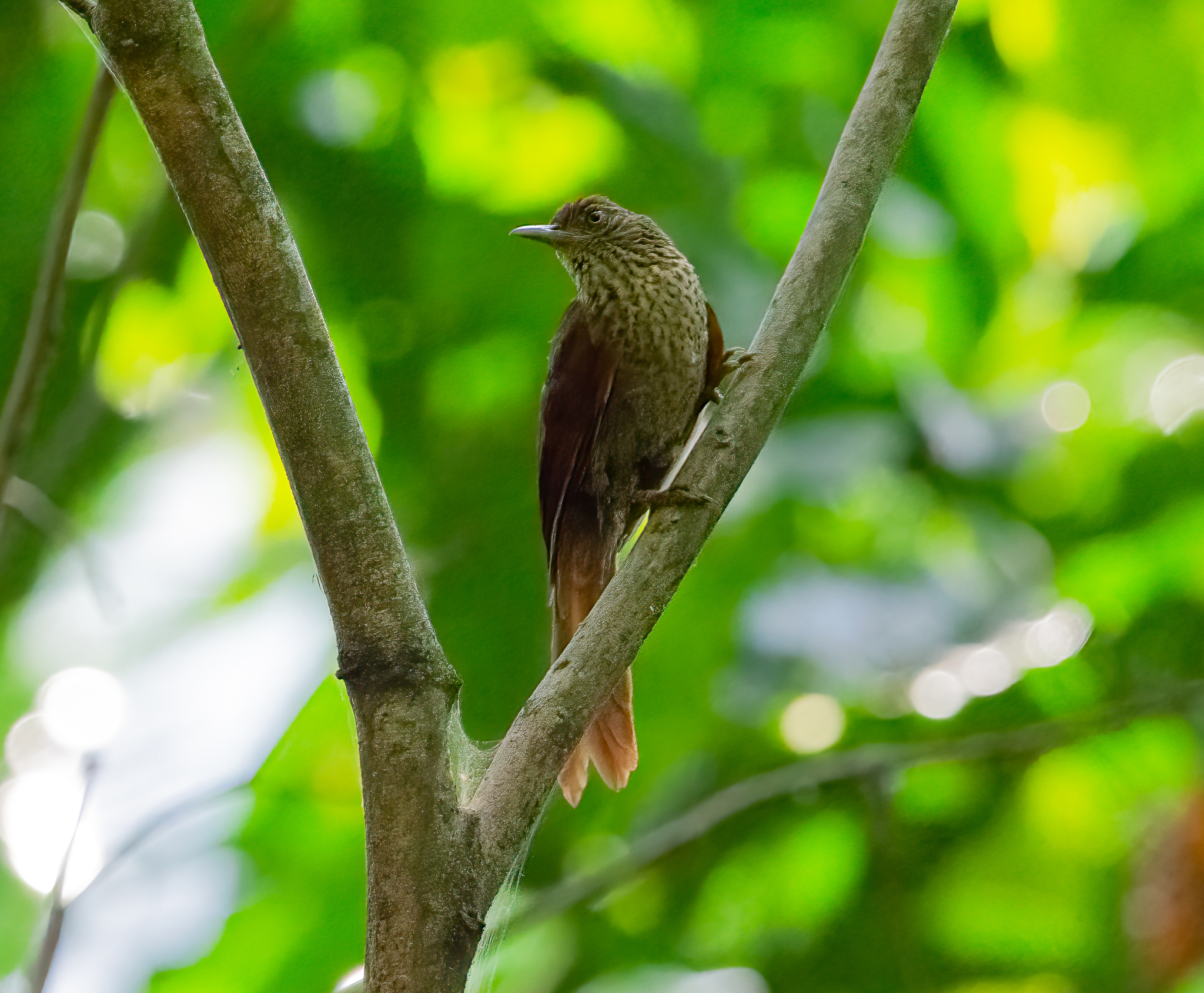
The Speckled Spinetail is a small ovenbird of Amazonia, with finely dark-speckled, buffy underparts. It climbs through vines and along branches in the middle and upper levels of the forest, usually in mixed flocks. The species was long placed in Cranioleuca.
Voice
A high, thin, descending trill, and high, sharp calls.
No recording with a suitable Creative Commons licence is available for this species yet.
Identification
14 cm, with a straight, pointed bill and a graduated tail with spiny tips. The crown is rufous, with a narrow buff supercilium. The back is olive-brown, the wings and tail rufous. The throat is pale yellow to buff, the breast and flanks buff with fine dark speckles. The sexes are alike. Juveniles are less speckled.
Confusion species
Scaled Spinetail Cranioleuca muelleri of the river islands of the lower Amazon has a scaled rather than speckled breast and a brown crown. Rusty-backed Spinetail Cranioleuca vulpina has a rufous back and plain, pale underparts. Plain Softtail Thripophaga fusciceps is larger and plainer brown, without speckles.
Habitat
Várzea and igapó, riverine and swamp forest, also terra firme forest near water and forest edges, in the lowlands, mostly below 600 m. It forages in mixed flocks, climbing along branches, vines and dead leaves, for insects and other invertebrates. Little is known about the nest.
Where the bird is most at home, classified by the vegetation units of Amazonia and the Guianas.



Range and movements
Brazil: widespread in Amazonia north and south of the Amazon, from Acre and Amazonas east to Pará and Amapá, local. Venezuela: scarce in the south, in Amazonas and Bolívar. French Guiana: local in the interior and in forest behind the coast. Guyana: very few records. Suriname: not confirmed. Outside the guide area in the Amazonian lowlands of Colombia, Ecuador, Peru and Bolivia.
- Resident
- dark = core range, pale = thinly spread
How and when to look
Follow mixed flocks in várzea and riverine forest along the large rivers, for example around Manaus and Tefé; the bird often climbs through dense vines at mid-levels. Listen for the high, descending trill.
Conservation status
Least Concern. The species has a very large range; forest loss in Amazonia may reduce its numbers in the long term.
Scientific name
Thripophaga gutturata | (d'Orbigny, ACVMD & de Lafresnaye, 1838) (GBIF: Cranioleuca gutturata)
D'Orbigny, ACVMD & de Lafresnaye described the species in 1838 as Anabates gutturatus; because it was later moved to another genus, the author and year stand in brackets. The genus Thripophaga was introduced in 1847 by Cabanis. Thripophaga is Greek, from thrips 'woodworm' and -phagos '-eating': 'woodworm-eater'. gutturata is New Latin for 'throated', from guttur 'throat', after the speckled throat. The specimen the first description was based on came from Yuracarés, Bolivia.