All species › Passerines › Ovenbirds and woodcreepers › Spot-throated Woodcreeper
Spot-throated Woodcreeper | Certhiasomus stictolaemus
Vlekkeelmuisspecht | Trepatroncos gorjipunteado | Arapaçu-de-garganta-pintada
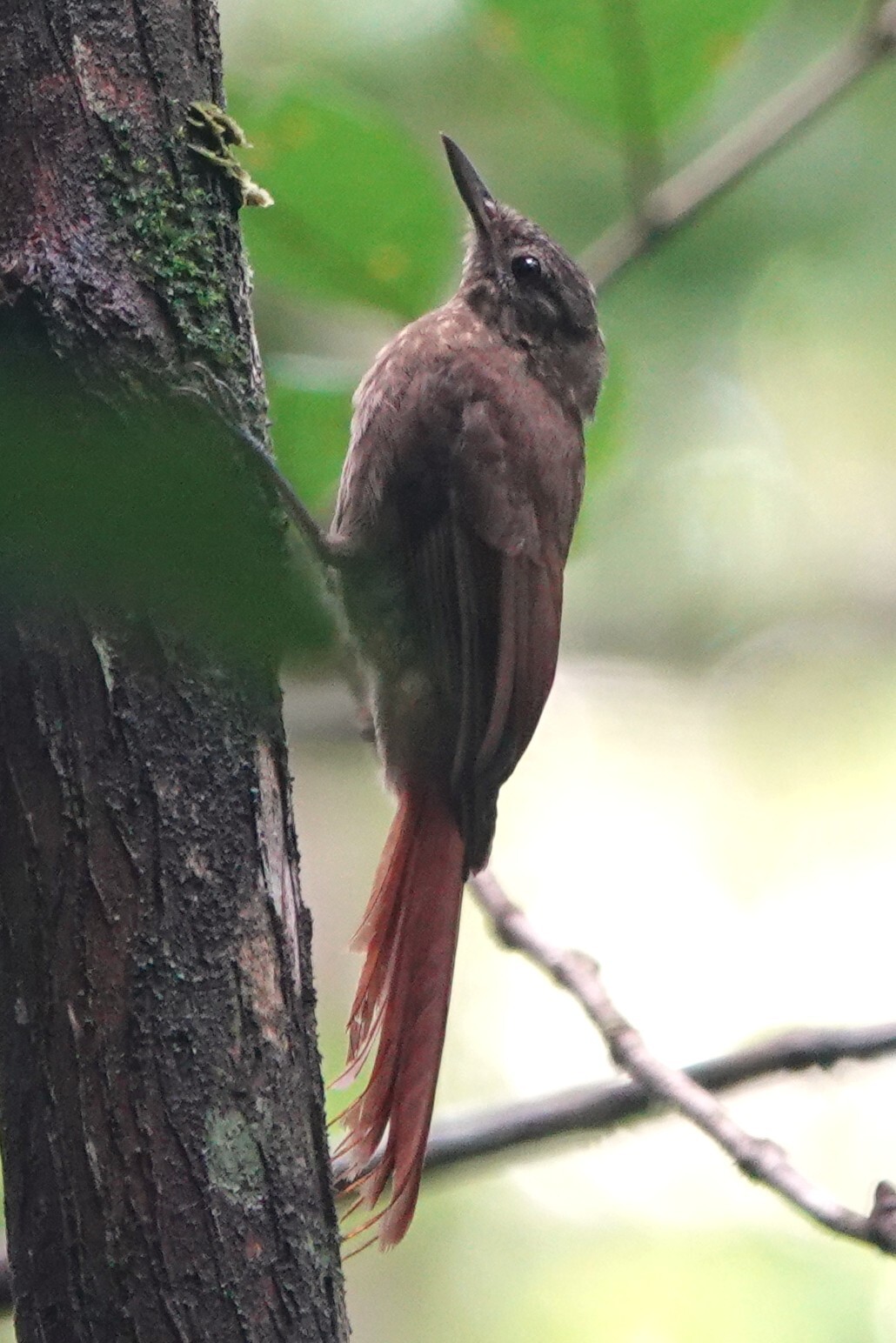
The Spot-throated Woodcreeper is a small, olive-brown woodcreeper of the interior of Amazonian forest, with a finely spotted throat and a short, thin bill. It is the only species in its genus and was long placed in Deconychura.
Voice
The song is a fast, high, slightly descending trill that accelerates after a short introduction, often at dusk. The call is a high, dry tseet.
Recording: Paul Lenrumé — CC BY-NC-SA 4.0 · xeno-canto
Identification
15–17 cm, small and slender, with a short, straight, thin bill and a stiff, rufous tail. The head and upperparts are olive-brown, the crown finely spotted pale, with a faint pale supercilium. The throat is pale ochre with fine dark spots and scales; the breast is olive-brown with small pale drop-shaped spots that fade towards the belly. Wings, rump and tail are rufous. The sexes are alike.
Confusion species
Wedge-billed Woodcreeper Glyphorynchus spirurus is just as small, but has a short, wedge-shaped, slightly upturned bill and a pale wing stripe in flight. Olivaceous Woodcreeper Sittasomus griseicapillus has a greyish head and underparts without spots. The long-tailed woodcreepers Deconychura longicauda and Deconychura pallida are larger and slimmer, with a longer tail and a longer bill. Plain-brown Woodcreeper Dendrocincla fuliginosa is much larger and almost unmarked.
Habitat
Humid terra firme forest and white-sand forest in the lowlands, up to about 600 m. It climbs thin and medium-sized trunks in the lower and middle levels of the forest, often in mixed flocks with antbirds and woodcreepers, and picks insects and spiders from bark crevices and moss. It nests in a cavity in a trunk.
Where the bird is most at home, classified by the vegetation units of Amazonia and the Guianas.


Range and movements
Brazil: widespread in Amazonia north and south of the Amazon, most frequent in the west and centre, east to Pará and scarcer there. French Guiana and Guyana: local in the forested interior; hardly known from Suriname. Venezuela: only in southern Amazonas, scarce. Outside the guide area in south-eastern Colombia, eastern Ecuador and north-eastern Peru.
- Resident
- dark = core range, pale = thinly spread
How and when to look
In tall terra firme forest around Manaus, for example in the reserves north of the city, or in the interior of French Guiana. Follow a mixed flock in the understorey in the morning and look for a small, olive-brown woodcreeper climbing thin trunks.
Conservation status
Least Concern. As a bird of the interior of undisturbed forest the species is sensitive to logging and fragmentation, but it has a large range in largely intact forest.
Scientific name
Certhiasomus stictolaemus | (Pelzeln, 1868) (GBIF: Deconychura stictolaema)
Pelzeln described the species in 1868 as Sittasomus stictolaemus; because it was later moved to another genus, the author and year stand in brackets. The genus Certhiasomus was introduced in 2010 by Derryberry, Claramunt, Chesser, Aleixo, Cracraft, Moyle & Brumfield. Certhiasomus is Greek, from Certhia 'treecreeper' and sōma 'body', after this small woodcreeper's resemblance to the treecreepers. stictolaemus is Greek, from stiktos 'spotted' and laimos 'throat', after the spotted throat. The specimen the first description was based on came from Borba, Rio Madeira, Brazil.