All species › Passerines › Ovenbirds and woodcreepers › Striolated Tit-Spinetail
Striolated Tit-Spinetail | Leptasthenura striolata
Paranámeesstekelstaart | Tijeral brasileño | Grimpeirinho
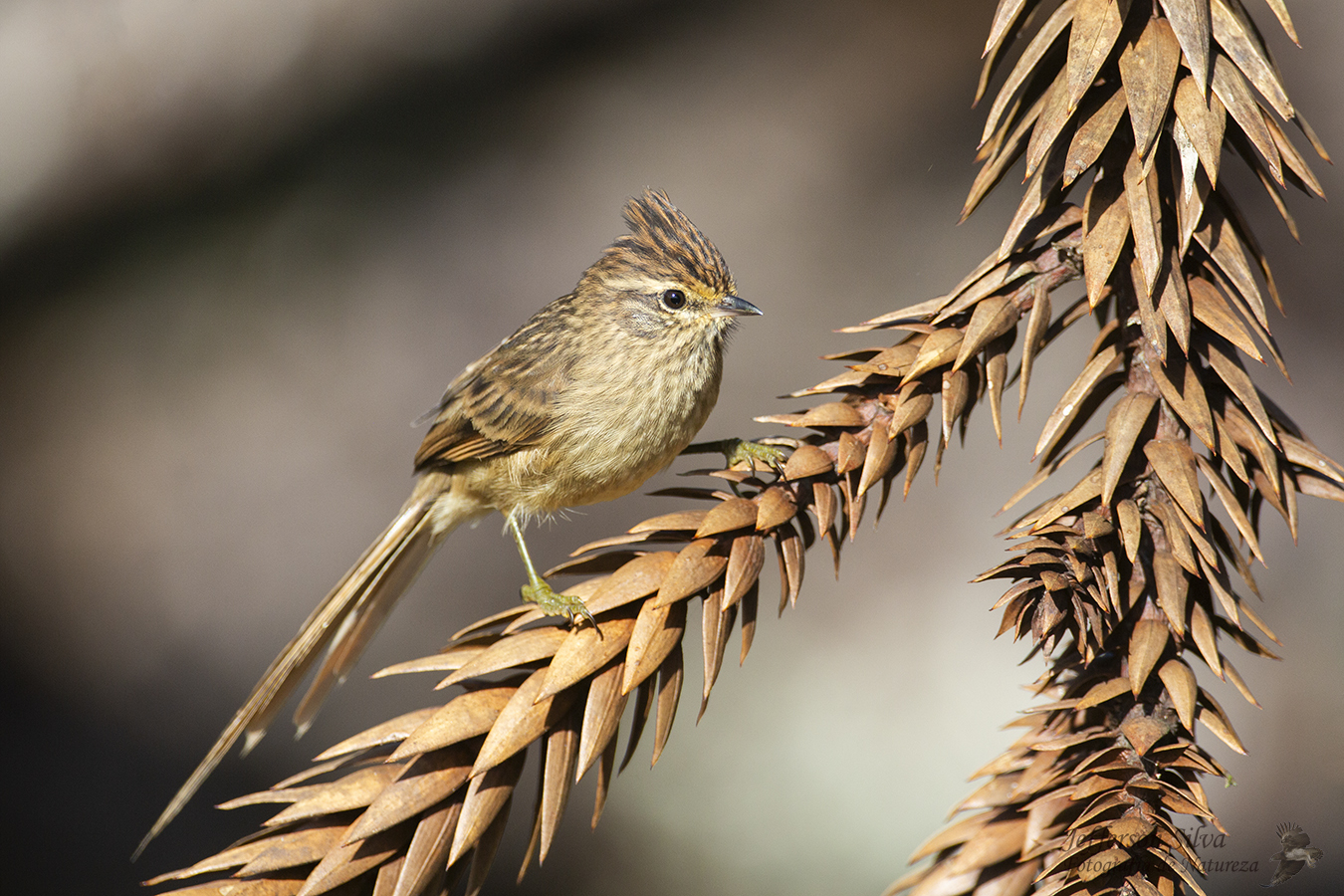
The Striolated Tit-Spinetail is a small, streaked ovenbird with a long, narrow tail, which clambers through bushes and tree crowns in pairs or small groups. It occurs only in southern Brazil and is one of the few members of its genus living outside the Andes and the Río de la Plata basin. Its habitat is the Araucaria forest of the highlands and the scrub around it.
Voice
The song is a high, dry trill, often preceded by a few sharp notes. Calls are high, thin tsee notes.
Recording: Marcelo Villegas — CC BY-NC-SA 4.0 · xeno-canto
Identification
15–16 cm, with a short, pointed bill and a long, graduated tail with pointed central feathers. The crown is rufous with fine dark streaks, with a pale supercilium. The upperparts are brown with pale streaks. The throat is whitish, breast and belly pale buff with faint dark streaks. The wings are dark with a rufous patch. The sexes are alike.
Confusion species
Araucaria Tit-Spinetail Leptasthenura setaria, which lives in the same forest, has a black crown with white spots, a plain rufous back and a much longer tail, and keeps high in the araucarias. Tufted Tit-Spinetail Leptasthenura platensis of the far south-west has a crest and an unstreaked back. Spinetails of the genus Synallaxis, such as Spix's Spinetail Synallaxis spixi, are unstreaked and live low in dense scrub.
Habitat
Edges and clearings of Araucaria forest, scrub with Baccharis, young forest, bamboo, and gardens and plantations with trees on the highlands, mostly between 500 and 1500 m. It forages in pairs or small groups, often in mixed flocks, among twigs, leaves and moss for insects and spiders. The nest is in a cavity or a dense clump of vegetation.
Where the bird is most at home, classified by the vegetation units of Amazonia and the Guianas.



Range and movements
Brazil: endemic to the south, on the highlands of Paraná and Santa Catarina and in northern Rio Grande do Sul, locally also in southern São Paulo. Not in Venezuela or the Guianas. Hardly or not at all outside the guide area.
- Resident
- dark = core range, pale = thinly spread
How and when to look
Search forest edges and scrub on the highlands of Paraná and Santa Catarina, for example around Curitiba and Urubici. Listen for the high trill and look in the outer twigs of bushes and low trees.
Conservation status
Least Concern (IUCN). The range is limited and Araucaria forest has declined greatly, but the species also lives in young forest, scrub and gardens.
Scientific name
Leptasthenura striolata | (Pelzeln, 1856)
Pelzeln described the species in 1856 as Synallaxis striolata; because it was later moved to another genus, the author and year stand in brackets. The genus Leptasthenura was introduced in 1853 by Reichenbach. Leptasthenura is Greek, from leptos 'thin', asthenēs 'weak' and oura 'tail', after the long, slender, frayed tail. striolata is Latin for 'finely streaked', from striola 'small streak', after the fine streaking on head and back. The specimen the first description was based on came from Curitiba, Paraná, Brazil.