All species › Parrots › African and New World parrots › Sulphur-breasted Parakeet
Sulphur-breasted Parakeet | Aratinga maculata
Zwavelborstparkiet | Aratinga pechisulfúrea | Cacaué
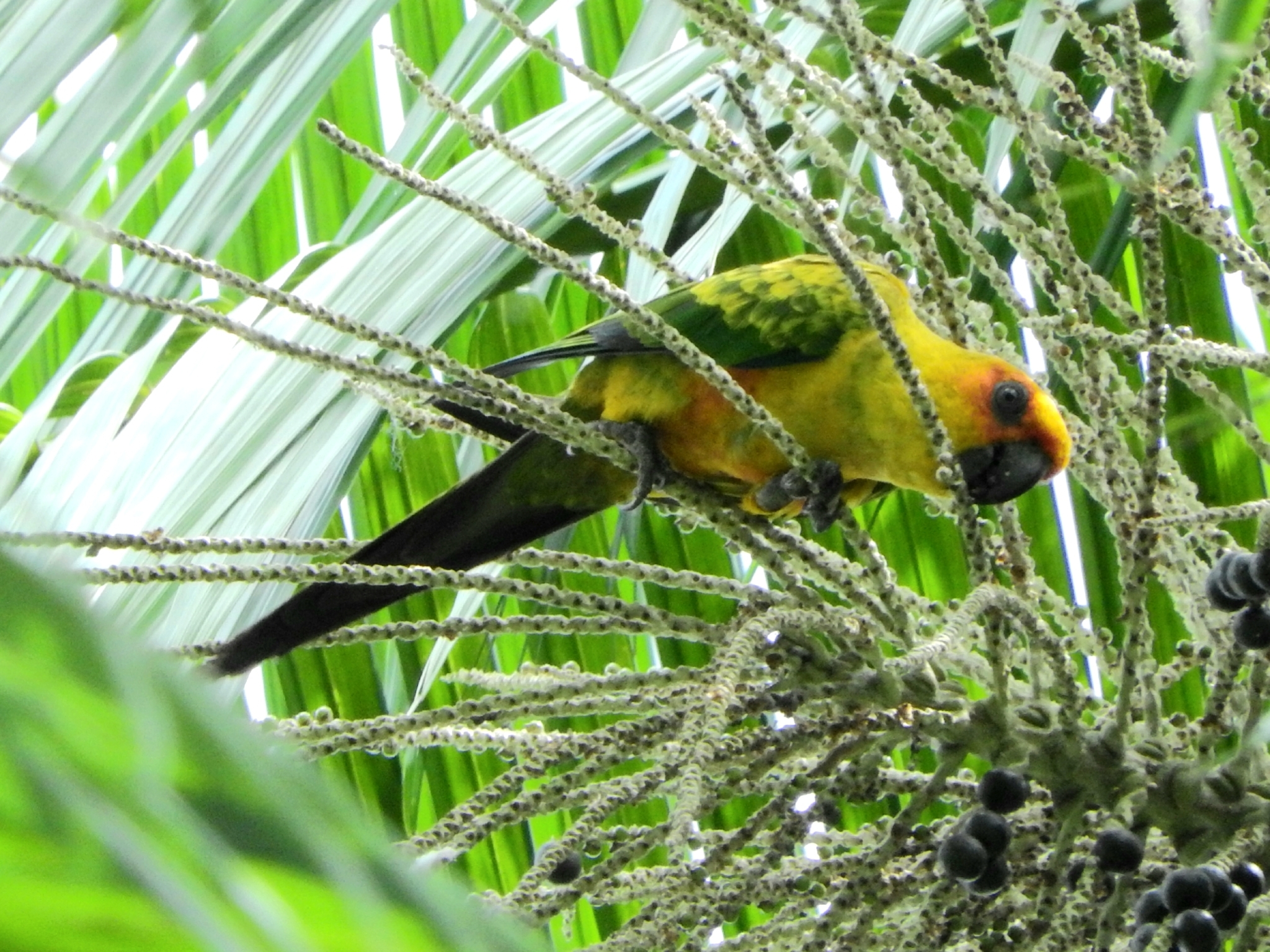
Sulphur-breasted Parakeet is a yellow and green parakeet of the savannas north of the lower Amazon and in southern Suriname. Only in 2005 did it become clear that these birds form a separate species; before then they were taken for immature Sun Parakeets. It lives in two separate areas.
Voice
Shrill, high screeches, often two-syllabled, such as sree-eek, rapidly repeated in flight; softer chattering while feeding.
Recording: GABRIEL LEITE — CC BY-NC-SA 4.0 · xeno-canto
Identification
30 cm, with a long, pointed tail, a dark grey bill and a bare white eye-ring. The head, neck and underparts are yellow, with orange around the eye and a sulphur-yellow to pale orange breast and belly. The mantle and wing coverts are green with yellow spots and edges; the flight feathers are green with dark blue tips. The tail is olive-green with a blue tip. The sexes are alike. Juveniles are greener, with less yellow on the head.
Confusion species
Adult Sun Parakeet Aratinga solstitialis is yellower on the mantle and wing coverts and more orange on the belly and face; immature Sun Parakeets closely resemble Sulphur-breasted, but Sun Parakeet lives further west, in Roraima and Guyana. Peach-fronted Parakeet Eupsittula aurea, which occurs in the Sipaliwini savanna, is green with only an orange forehead and eye-ring.
Habitat
Open and semi-open country on sandy soil with scattered trees and bushes, savannas, gallery forest, forest edges and sometimes orchards, mainly in the lowlands. It eats fruit, seeds and flowers in trees and bushes. It lives in pairs and groups. It nests in cavities in trees or palms.
Where the bird is most at home, classified by the vegetation units of Amazonia and the Guianas.




Range and movements
Two separate areas. In Brazil in northern Pará, north of the lower Amazon between the Maicuru and the Paru, including around Monte Alegre and Alenquer; occurrence in Amapá is unconfirmed. In Suriname in the Sipaliwini savanna in the south, on the border with Brazil. Only a few records from French Guiana. Absent from Venezuela and Guyana. Does not occur outside the guide area.
- Resident
- dark = core range, pale = thinly spread
How and when to look
Around Monte Alegre in Pará, in the semi-open savanna and near orchards on the edge of the town, or in the Sipaliwini savanna in Suriname; small groups fly over calling and perch in the crowns of scattered trees.
Conservation status
Not globally threatened, but its range is small. Trapping for the cage-bird trade and conversion of savanna and forest to farmland are possible threats. The species is listed on CITES Appendix II.
Scientific name
Aratinga maculata | (Müller, 1776)
Müller described the species in 1776 as Psittacus maculatus; because it was later moved to another genus, the author and year stand in brackets. The genus Aratinga was introduced in 1824 by Spix. Aratinga is from the Tupí name Ará tinga 'bright bird, bright parrot', for a kind of parakeet. maculata is Latin for 'spotted', from macula 'spot'; exactly what the name refers to is unclear. The specimen the first description was based on came from Unknown (no type locality given).