All species › Parrots › African and New World parrots › Sun Parakeet
Sun Parakeet | Aratinga solstitialis
Zonparkiet | Aratinga del sol | Jandaia-amarela
Sun Parakeet is a medium-sized parakeet with mainly golden-yellow and orange plumage. It lives in a small area in the savannas on the border of Brazil and Guyana. As a cage bird it is found worldwide, but in the wild its numbers have fallen sharply through trapping.

Voice
Shrill, high, often two-syllabled screeches, such as sree-eek, rapidly repeated in flight; softer chattering while feeding.
No recording with a suitable Creative Commons licence is available for this species yet.
Identification
30 cm, with a long, pointed tail, a dark grey bill and a bare white eye-ring. The adult is yellow to golden yellow, with orange around the eye, on the forehead and on the belly. The wing coverts are yellow with some green; the flight feathers are green with dark blue tips. The tail is olive-green with a blue tip. The sexes are alike. Juveniles are much greener and acquire the yellow plumage gradually.
Confusion species
Sulphur-breasted Parakeet Aratinga maculata closely resembles an immature Sun Parakeet, with a greener mantle, more green in the wing coverts and less orange on the belly; it lives further east, in northern Pará and southern Suriname. Brown-throated Parakeet Eupsittula pertinax, which lives in the same savannas, is green with a brown face. Golden Parakeet Guaruba guarouba is larger, all yellow with green flight feathers and a pale bill, and lives south of the Amazon.
Habitat
Savanna with scattered trees, gallery forest, forest edges and woodland patches, palm swamps with buriti palms and the edges of rocky hills, in the lowlands and hill country. It eats fruit, seeds, flowers and buds in trees and bushes. It lives in pairs and small groups, in larger groups outside the breeding season. It nests in cavities in trees or palms.
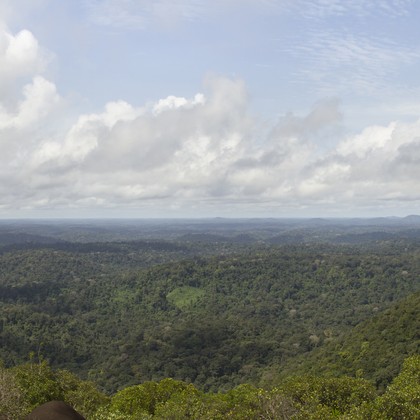
Where the bird is most at home, classified by the vegetation units of Amazonia and the Guianas.



Range and movements
Only in a small area in the north of the guide area: the savannas of north-eastern Roraima in Brazil and the Rupununi savannas of southern Guyana. Only a few records from Suriname and French Guiana, of uncertain origin; escaped cage birds occur. Absent from Venezuela. Does not occur outside the guide area.
- Resident
- dark = core range, pale = thinly spread
How and when to look
In the Rupununi of southern Guyana and in the savannas of north-eastern Roraima, where small groups fly between gallery forest and buriti palms in the morning and late afternoon; the shrill call is often heard before the birds are seen.
Conservation status
Endangered. Numbers in the wild have fallen sharply through trapping for the cage-bird trade, especially in Guyana in the late 20th century; conversion of savanna to farmland in Roraima is an additional threat. The species is bred on a large scale in captivity. It is listed on CITES Appendix II.
Scientific name
Aratinga solstitialis | (Linnaeus, 1758)
Linnaeus described the species in 1758 as Psittacus solstitialis; because it was later moved to another genus, the author and year stand in brackets. The genus Aratinga was introduced in 1824 by Spix. Aratinga is from the Tupí name Ará tinga 'bright bird, bright parrot', for a kind of parakeet. solstitialis is Latin for 'of summer', from solstitium 'solstice, summer' and sol 'sun', after the sunny yellow plumage. The specimen the first description was based on came from Cayenne, French Guiana (originally given in error as 'Guinea').