All species › Passerines › Tyrant flycatchers and allies › Sulphury Flycatcher
Sulphury Flycatcher | Tyrannopsis sulphurea
Zwaveltiran | Mosquero azufrado | Suiriri-de-garganta-rajada
The Sulphury Flycatcher is a stocky, short-tailed flycatcher that is almost everywhere tied to the Moriche palm Mauritia flexuosa. It lives in palm swamps, along rivers and in savannas with stands of this palm in Amazonia, the Guianas and eastern Venezuela. It calls little and is therefore often overlooked.
Voice
Not very vocal. The calls are high and piercing, including rapid, buzzy trills and sharp notes, often given as a duet by a pair from a palm crown.
Recording: Mauricio Cuellar Ramirez (@Birding.travel) — CC BY-NC-SA 4.0 · xeno-canto
Identification
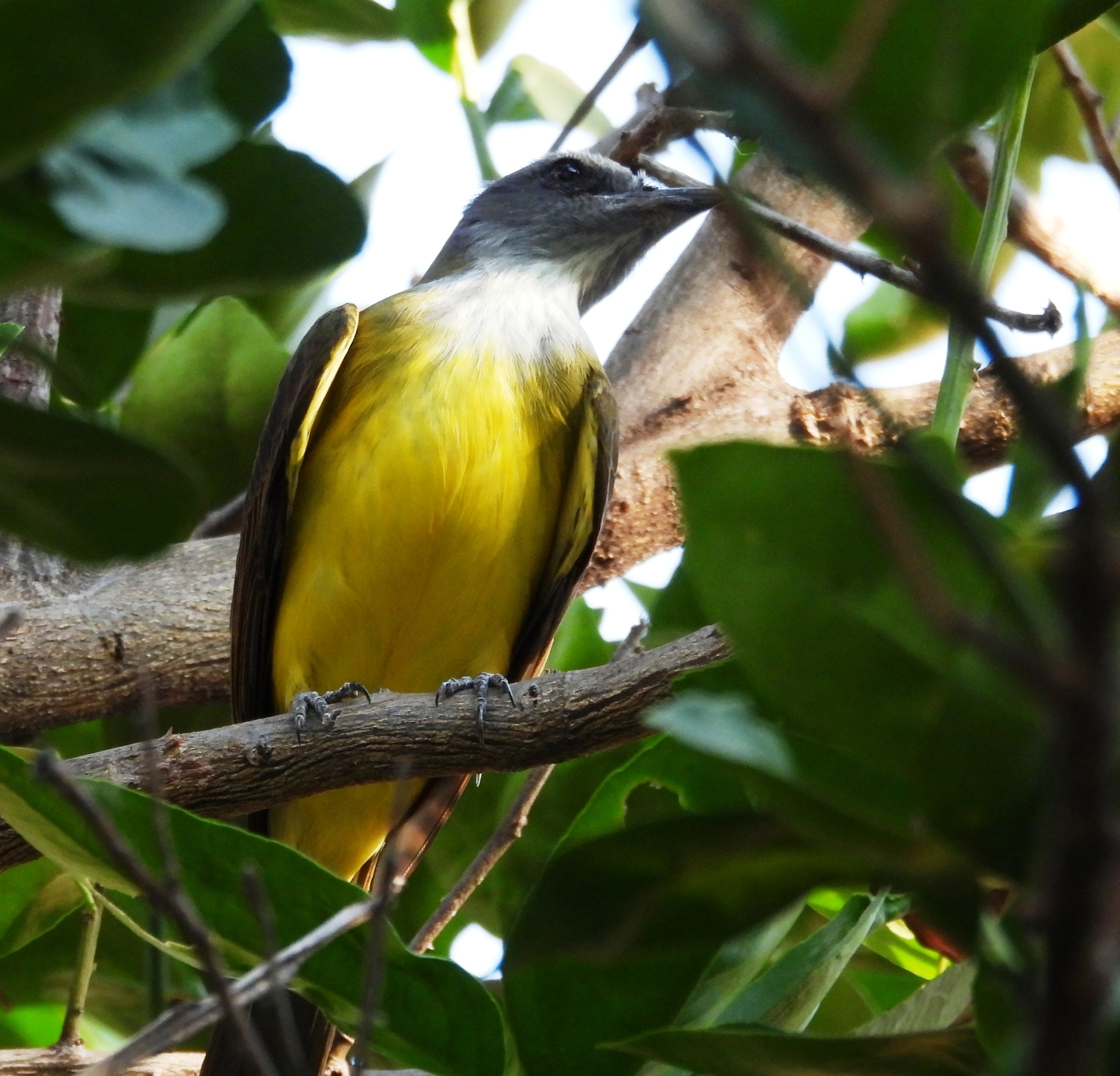
19–20 cm, sturdy, with a short, square tail and a short but broad black bill. The head is dark slate-grey with a concealed orange-yellow crown patch, an indistinct pale supercilium and a dark band from lores to ear coverts. The upperparts are dull olive-brown, the wings dark brown. The throat is white with fine grey streaks, the upper breast whitish with an olive-grey wash on breast and flanks, the rest of the underparts bright yellow. Iris brown, legs black. The sexes are alike.
Confusion species
Tropical Kingbird Tyrannus melancholicus is slimmer, with a paler grey head, a longer, notched tail and a longer bill, and calls much more often. Great Kiskadee Pitangus sulphuratus and Boat-billed Flycatcher Megarynchus pitangua have a black-and-white head with a broad white supercilium. Rusty-margined Flycatcher Myiozetetes cayanensis is smaller, with a blackish mask and a white supercilium.
Habitat
Stands of Moriche palms in palm swamps, along rivers and in veredas, scattered palms in savanna and flooded grassland, and sometimes single palms in farmland and near houses; in the lowlands. It hunts insects from the palm fronds and also eats fruit. The nest is placed in the crown of a palm, among the frond bases.
Where the bird is most at home, classified by the vegetation units of Amazonia and the Guianas.





Range and movements
Brazil: locally across much of Amazonia, wherever Moriche palms grow, from Roraima and Amapá to Acre, Rondônia and Mato Grosso, and east to about Maranhão. Venezuela: in the east and south, in the Llanos of Monagas and Anzoátegui, in Delta Amacuro, Bolívar and Amazonas. Guyana, Suriname and French Guiana: locally in the coastal belt and in the savannas of the interior. Outside the guide area on Trinidad and in eastern Colombia and Amazonian Ecuador, Peru and Bolivia.
- Resident
- dark = core range, pale = thinly spread
How and when to look
Scan stands of Moriche palms early in the morning, when the birds sit on the fronds or leaf stalks. A yellow flycatcher with a short, square tail in a palm crown in this habitat is often this species.
Conservation status
Least Concern. Because of its tie to Moriche palms, the species is locally vulnerable to the draining of palm swamps and the felling of palms.
Scientific name
Tyrannopsis sulphurea | (Spix, 1825)
Spix described the species in 1825 as Muscicapa sulphurea; because it was later moved to another genus, the author and year stand in brackets. The genus Tyrannopsis was introduced in 1905 by Ridgway. Tyrannopsis combines the genus Tyrannus with Greek opsis 'appearance': 'resembling a kingbird'. sulphurea is Latin for 'sulphur-yellow', after the yellow belly. The specimen the first description was based on came from Brazil (later restricted to Manaus, Rio Negro).