All species › Swifts › Hummingbirds › Tepui Goldenthroat
Tepui Goldenthroat | Polytmus milleri
Tepuigoudkeelkolibrie | Colibrí de tepuí | Beija-flor-dos-tepuis
The Tepui Goldenthroat is the largest species of the genus Polytmus and the only one that lives in the mountains. It occurs only on and around the tepuis, the sandstone table mountains of the Guiana Shield. Its relatives, White-tailed and Green-tailed Goldenthroats, live in lowland savannas.

Voice
While foraging, a loud series of tsit or tizzie notes.
Recording: David Ascanio — CC BY-NC-SA 4.0 · xeno-canto
Identification
11–12 cm, with a slightly decurved bill. The male is bronzy green above and glittering green below. The tail is green, with a broad white base and white tips. Around the eye the face is dusky grey, with a white streak above and below. The female is smaller, with dull white underparts densely dotted with golden green, especially on the breast.
Confusion species
White-tailed Goldenthroat Polytmus guainumbi is smaller and lives in wet lowland savannas, not on the tepuis. Green-tailed Goldenthroat Polytmus theresiae is smaller, lacks the white in the tail and lives on white-sand savannas in the lowlands. Sparkling Violetear Colibri coruscans is larger, with a violet ear patch and a dark band in the tail. Buff-breasted Sabrewing Campylopterus duidae has buff underparts and a bronzy-green tail. Velvet-browed Brilliant Heliodoxa xanthogonys has a straight bill and a dark, forked tail.
Habitat
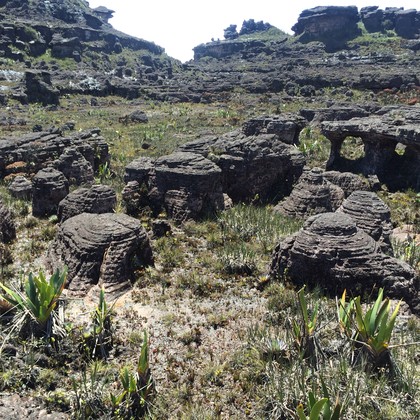
Edges of cloud forest and scrub with scattered trees on and around the tepuis, at roughly 1300 to 2200 m, locally higher. It visits flowering plants along a fixed route, catches insects in flight and gleans spiders from leaves and rock crevices. The nest is a small cup of fine fibres, covered outside with lichen, in the fork of a shrub 0.5 to 1 m above the ground. It breeds in May and June.
Where the bird is most at home, classified by the vegetation units of Amazonia and the Guianas.

Range and movements
In Venezuela on the tepuis of the south and south-east, in Bolívar and Amazonas. In Guyana only in the far west, in the tepui region along the border with Venezuela. In Brazil only in the extreme north of Roraima, at the edge of the range; records there are scarce. Absent from Suriname and French Guiana. Does not occur outside the guide area.
- Resident
- dark = core range, pale = thinly spread
How and when to look
Search forest edges and scrub on the higher parts of the tepuis and the highlands of the Gran Sabana, where shrubs are in flower. A bird regularly returns along its route to the same flowers.
Conservation status
Least Concern. The range is small and fragmented, but the habitat on the tepuis is largely inaccessible and little affected. A large part lies within national parks such as Canaima.
Scientific name
Polytmus milleri | (Chapman, 1929)
Chapman described the species in 1929 as Waldronia milleri; because it was later moved to another genus, the author and year stand in brackets. The genus Polytmus was introduced in 1760 by Brisson. Polytmus comes from Greek polutimos 'very costly, valuable', from polus 'much' and timē 'worth'. milleri honours the American ornithologist Waldron DeWitt Miller (1879–1929) of the American Museum of Natural History. The specimen the first description was based on came from Cerro Duida (c. 1430 m), Venezuela.