All species › Swifts › Swifts › Tepui Swift
Tepui Swift | Streptoprocne phelpsi
Tepuigierzwaluw | Vencejo de los tepuyes | Taperuçu-dos-tepuis
The Tepui Swift is a small black swift with a broad orange-chestnut collar, found only in the tepui region of the Guiana Shield. Flocks hunt high over montane forest, savannas and cliffs and breed on rock faces and in caves. The species was formerly placed in the genus Cypseloides.

Voice
Two flight calls: a squeak followed by a trill and short squeals, and a slow series of reedy or hissing tic notes.
Recording: GABRIEL LEITE — CC BY-NC-SA 4.0 · xeno-canto
Identification
14–16 cm, with long, narrow wings and a slightly forked tail. The male has a broad orange-chestnut collar that encircles the neck and also covers the upper breast, chin, throat and most of the face; the rest of the plumage is sooty black, sometimes with a few white feathers below the collar. The female resembles the male, but some females have a paler breast mixed with brown. Juveniles have grey edges to the feathers of the underparts.
Confusion species
Chestnut-collared Swift Streptoprocne rutila is very similar, but the female often has no collar or only a faint one, and the male's collar is narrower and more rufous; it occurs mainly elsewhere in Venezuela. White-collared Swift Streptoprocne zonaris is much larger, with a white collar. White-chinned Swift Cypseloides cryptus is larger and black without a collar, at most with a white chin.
Habitat
Airspace over humid montane and lowland forest, montane grasslands and cliffs of the tepuis, mostly at 200–2200 m, exceptionally up to 2630 m. It hunts flying insects in flocks, often with other swifts. Nests have rarely been found: on cliffs and in rocky grottos; one nest was a cup of rootlets and moss on a rock shelf in a cave. It may breed in colonies.
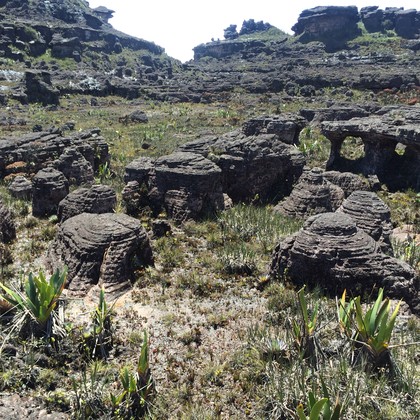
Where the bird is most at home, classified by the vegetation units of Amazonia and the Guianas.



Range and movements
In the guide area on the Guiana Shield in south-eastern Venezuela (Bolívar and Amazonas), western Guyana (Pakaraima Mountains) and the far north of Brazil (Roraima and northern Amazonas). One bird was seen in the far north of Venezuela; whether it was a vagrant or a migrant is unclear. Not known from Suriname or French Guiana.
- Resident
- dark = core range, pale = thinly spread
How and when to look
Watch from viewpoints in the Gran Sabana, at waterfalls and cliffs around the tepuis, or along the road to the Sierra de Lema. In good light the orange-chestnut collar can be seen even in flight.
Conservation status
Least Concern. Population size is unknown and thought to be declining; no direct threats are known, but deforestation may play a role in the long term.
Scientific name
Streptoprocne phelpsi | (Collins, 1972)
Collins described the species in 1972 as Cypseloides phelpsi; because it was later moved to another genus, the author and year stand in brackets. The genus Streptoprocne was introduced in 1906 by Oberholser. Streptoprocne is Greek, from streptos 'collar' and Procne, the figure of Greek myth turned into a swallow, after the coloured collar. phelpsi honours William Henry Phelps Sr. (1875–1965), US-Venezuelan businessman and ornithologist, founder of the Colección Ornitológica Phelps in Caracas. The specimen the first description was based on came from Auyán-tepui, Venezuela.