All species › Passerines › Shrike-babblers, Erpornis and vireos › Tepui Vireo
Tepui Vireo | Vireo sclateri
Tepuivireo | Vireo de los tepuis | Vite-vite-do-tepui
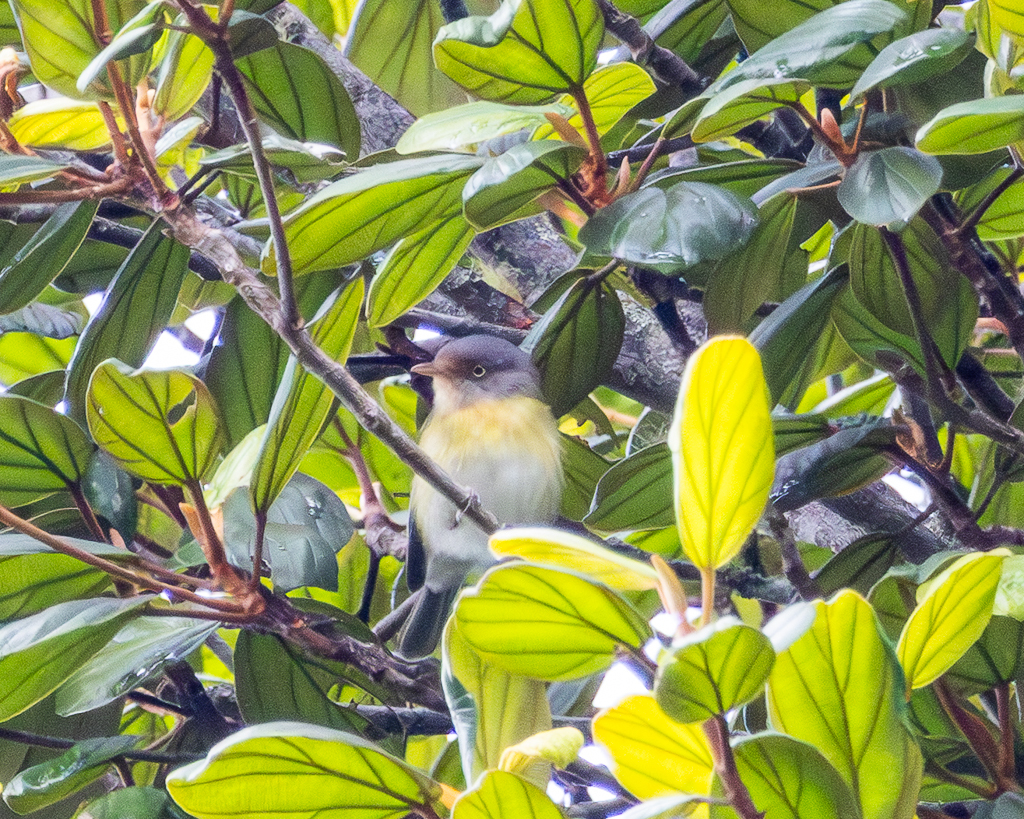
The Tepui Vireo is a small vireo of the montane forests on the tepuis of the Guiana Shield and does not occur outside the guide area. It was long placed as a greenlet in the genus Hylophilus, but genetic research showed that it belongs to the genus Vireo. It lives mainly in the middle storey and canopy, often in mixed flocks.
Voice
The song differs from that of other vireos: a short, clear whistled phrase that rises quickly and falls again, often repeated many times in succession. The alarm call is a nasal, downslurred scold.
Recording: GABRIEL LEITE — CC BY-NC-SA 4.0 · xeno-canto
Identification
12 cm, with a fairly short, pale bill. Forehead buffy, crown and face grey, upperparts olive-green; wings and tail grey with paler edges. Chin and throat white, breast yellow with greenish-yellow sides and flanks, belly dull white. The eye is grey to white in adults and dark in juveniles. The sexes are nearly alike; in the male the yellow breast band is more sharply defined.
Confusion species
Buff-cheeked Greenlet Pachysylvia muscicapina, at lower elevations, has a dark eye, a buffy face and a greyish-buff breast. Lemon-chested Greenlet Hylophilus thoracicus resembles Tepui Vireo in pattern, with a grey crown, a pale eye and a yellow breast band, but lives in the lowlands; elevation usually separates the two. Red-eyed Vireo Vireo olivaceus is larger, with a white supercilium and a red eye.
Habitat
Interior and edges of humid and wet montane forest on the tepuis and the slopes below them, between about 600 and 2000 m. It actively searches for insects in the middle storey and canopy, lower at forest edges, often hanging upside down from leaves; it often joins mixed flocks. Nothing is known about the nest and breeding biology.
Where the bird is most at home, classified by the vegetation units of Amazonia and the Guianas.

Range and movements
Venezuela: in the south-east, on the tepuis and highlands of Bolívar and Amazonas, where most records come from. Brazil: in the extreme north, on the tepuis along the border with Venezuela, mainly in Roraima. Guyana: in the west, in the Pakaraima Mountains. Suriname: known only from Tafelberg in the centre of the country, where it was discovered in 2005. Absent from French Guiana. It does not occur outside the guide area.
- Resident
- dark = core range, pale = thinly spread
How and when to look
In the montane forest along the Escalera in the Sierra de Lema, on the road to the Gran Sabana in Bolívar, look for mixed flocks in the middle storey and listen for the short, rising and falling whistled phrase.
Conservation status
Least Concern. Its habitat on the tepuis is largely remote and little affected. In south-eastern Venezuela the species is fairly common; little is known about its numbers in Brazil, Guyana and Suriname.
Scientific name
Vireo sclateri | (Salvin & Godman, 1883) (GBIF: Hylophilus sclateri)
Salvin & Godman described the species in 1883 as Hylophilus sclateri; because it was later moved to another genus, the author and year stand in brackets. The genus Vireo was introduced in 1808 by Vieillot. Vireo was used by Latin authors for a small, green, migratory bird, probably the Eurasian golden oriole, though the European greenfinch has also been suggested. sclateri honours the English ornithologist Philip Lutley Sclater (1829–1913), a leading authority on South American birds. The specimen the first description was based on came from Roraima, Venezuela.