All species › Passerines › New World warblers › Tepui Whitestart
Tepui Whitestart | Myioborus castaneocapilla
Tepuizanger | Candelita de tepuí | Mariquita-de-cabeça-parda
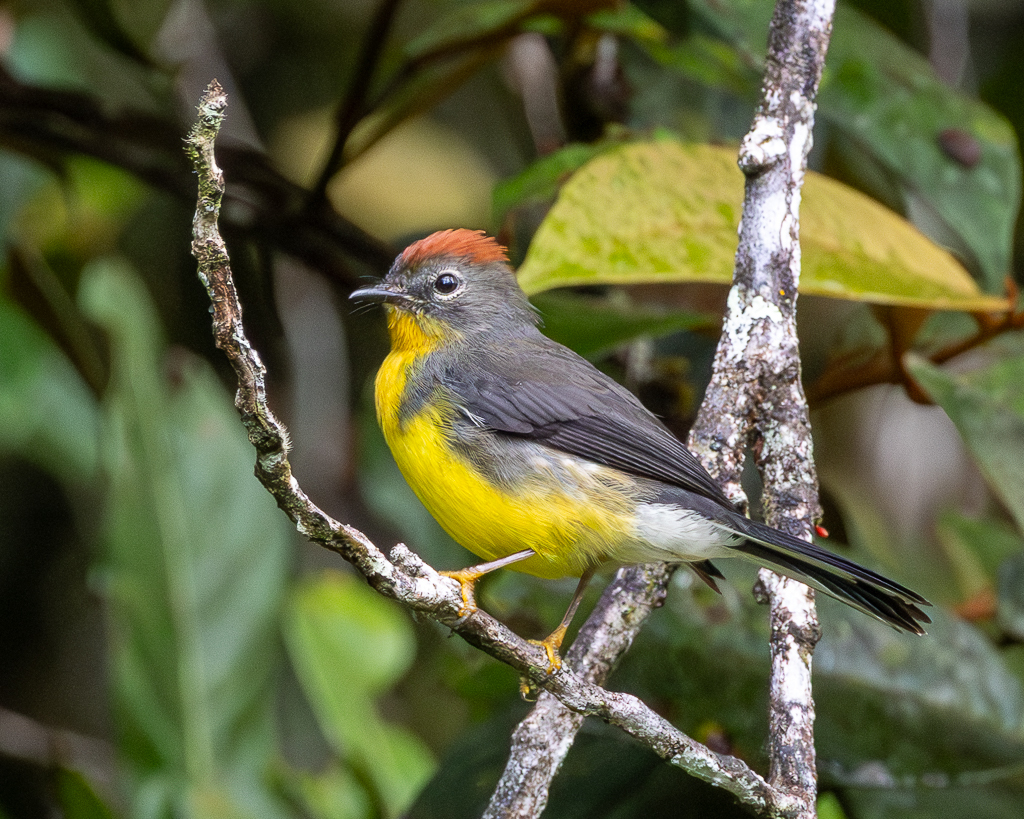
The Tepui Whitestart is a Myioborus of the tepuis of the Guiana Highlands, with a rufous crown, yellow spectacles and much white in the tail. Like its relatives it spreads its tail and wings while foraging to flush insects. It is sometimes treated as a form of Brown-capped Whitestart Myioborus brunniceps of the southern Andes.
Voice
The song is a fast series of high, thin chip notes, sometimes speeding up into a short trill. The call is a thin tsip.
Recording: Joe Klaiber — CC BY-NC-SA 4.0 · xeno-canto
Identification
13 cm, with a long, often fanned tail. The crown is chestnut to rufous; lores and eye-ring are yellow and form spectacles. Cheeks and nape are grey, the upperparts grey to olive-grey. Throat and underparts are yellow, the undertail coverts white. The black tail has much white in the outer feathers. The sexes are alike. Young birds are duller and browner, with hardly any head colour. Different groups of tepuis hold forms that differ slightly in crown and back colour.
Confusion species
Slate-throated Whitestart Myioborus miniatus, which lives lower on the tepuis, has a dark slate-grey head and throat, without yellow spectacles. White-faced Whitestart Myioborus albifacies of the tepuis of northern Amazonas has a white face and a black crown, Guaiquinima Whitestart Myioborus cardonai of Cerro Guaiquinima a black crown and white eye crescents; neither occurs together with Tepui Whitestart. Paria Whitestart Myioborus pariae closely resembles Tepui Whitestart but lives only on the Paria Peninsula.
Habitat
Humid montane forest, cloud forest and forest edge on the slopes of the tepuis, and tall scrub and thickets on the sandstone summits, mainly between about 1200 and 2500 m, locally lower. It forages for insects in pairs or small groups in the lower and middle levels, often with mixed flocks. As in related species, the nest is on or just above the ground in a bank.
Where the bird is most at home, classified by the vegetation units of Amazonia and the Guianas.


Range and movements
Venezuela: on the tepuis of Bolívar, from the Sierra de Lema and the Gran Sabana to Mount Roraima, and on tepuis in Amazonas such as Duida and Neblina. Guyana: in the Pakaraima Mountains, including Roraima. Brazil: only on the tepuis and mountains along the border in Roraima and northern Amazonas. Not in Suriname and French Guiana. Found only in the Guiana Highlands.
- Resident
- dark = core range, pale = thinly spread
How and when to look
All year in the cloud forest along the road through the Sierra de Lema to the Gran Sabana, especially above about 1200 m. The birds often forage along the forest edge and fan their tails, showing the white in the tail.
Conservation status
Least Concern. The montane forest and scrub of the tepuis are largely intact and remote; locally the lower slopes are affected by fires and mining.
Scientific name
Myioborus castaneocapilla | (Cabanis, 1849)
Cabanis described the species in 1849 as Setophaga castaneocapilla; because it was later moved to another genus, the author and year stand in brackets. The genus Myioborus was introduced in 1865 by Baird. Myioborus is Greek, from muia 'fly' and -boros '-devouring': 'fly-eater'. castaneocapilla is Latin, from castaneus 'chestnut-coloured' and -capillus '-crowned', after the chestnut crown. The specimen the first description was based on came from Roraima, Venezuela.