All species › Passerines › Tyrant flycatchers and allies › Todd's Sirystes
Todd's Sirystes | Sirystes subcanescens
Todds sirystestiran | Mosquero canoso | Gritador-da-guiana
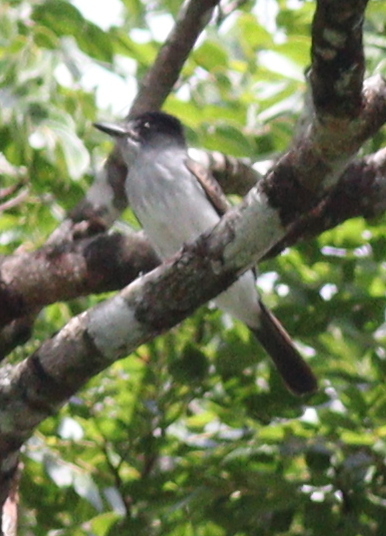
Todd's Sirystes is a grey-and-black flycatcher of the lowland forest canopy in the Guianas and northern Brazil. It was long treated as one species with Sibilant Sirystes and White-rumped Sirystes; the present sirystes species were separated mainly on their calls and on small differences in plumage.
Voice
A series of clear, whistled notes, often as whee-whee-whee or pwee-pwee, sometimes a single note; also a fast, chattering babble. Pairs call to each other frequently from the canopy.
Recording: GABRIEL LEITE — CC BY-NC-SA 4.0 · converted to mono · xeno-canto
Identification
18 cm. Head with a black cap and a crest that can be slightly raised. Back and mantle grey, rump pale grey. Wings blackish with narrow white edges to the coverts and secondaries; tail black. Throat and breast pale grey, belly whitish. Bill black and fairly broad. Sexes alike; juveniles have browner edges to the wing feathers.
Confusion species
Sibilant Sirystes Sirystes sibilator lives in eastern and southern Brazil, outside the range of this species, and is best told by voice. White-rumped Sirystes Sirystes albocinereus west of the Rio Negro has a bright white rump and a different, rattling voice. Becards such as Cinereous Becard Pachyramphus rufus are smaller, with a bulkier head and no black tail. Short-crested Flycatcher Myiarchus ferox has a yellow belly.
Habitat
Canopy and upper levels of tall humid forest, both primary forest and older secondary forest, also forest edges and clearings with tall trees and the edges of flooded forest; from sea level to about 1000 m. It takes insects and other arthropods in flight or while hovering at leaves, and also eats small fruits. It often joins mixed canopy flocks. The nest is built in a tree cavity.
Where the bird is most at home, classified by the vegetation units of Amazonia and the Guianas.



Range and movements
Brazil: north of the Amazon, from the Rio Negro east through Amazonas and Pará to Amapá; the boundary with White-rumped Sirystes and the assignment of birds south of the Amazon are not yet fully resolved. Suriname and French Guiana: scattered in the lowland forest of the interior. Guyana: few records, but probably more widespread than the records suggest. Not in Venezuela. It does not occur outside the guide area.
- Resident
- dark = core range, pale = thinly spread
How and when to look
In the forest around Manaus, in the interior of Suriname (such as Brownsberg and Raleighvallen) and in French Guiana, listen for whistled series from the canopy. A canopy tower or a clearing with a view of the treetops gives the best chance to see the bird itself.
Conservation status
Least Concern. Its range includes large, continuous forests. Deforestation along the edges of Amazonia affects the species locally, but its population is considered stable.
Scientific name
Sirystes subcanescens | Todd, 1920
Todd described the species in 1920 and placed it straight away in the genus where it still stands. The genus Sirystes was introduced in 1860 by Cabanis & Heine. Sirystes is Greek suristēs 'piper', from surizō 'to play the pipes', after the whistled call. subcanescens is Latin for 'somewhat greyish', from sub 'somewhat' and canescens 'greyish', after the grey plumage. The specimen the first description was based on came from northern Pará, Brazil (river 'Rocana', not further identified).