All species › Passerines › Wrens › Tooth-billed Wren
Tooth-billed Wren | Odontorchilus cinereus
Amazonewinterkoning | Cucarachero dentado | Cambaxirra-cinzenta
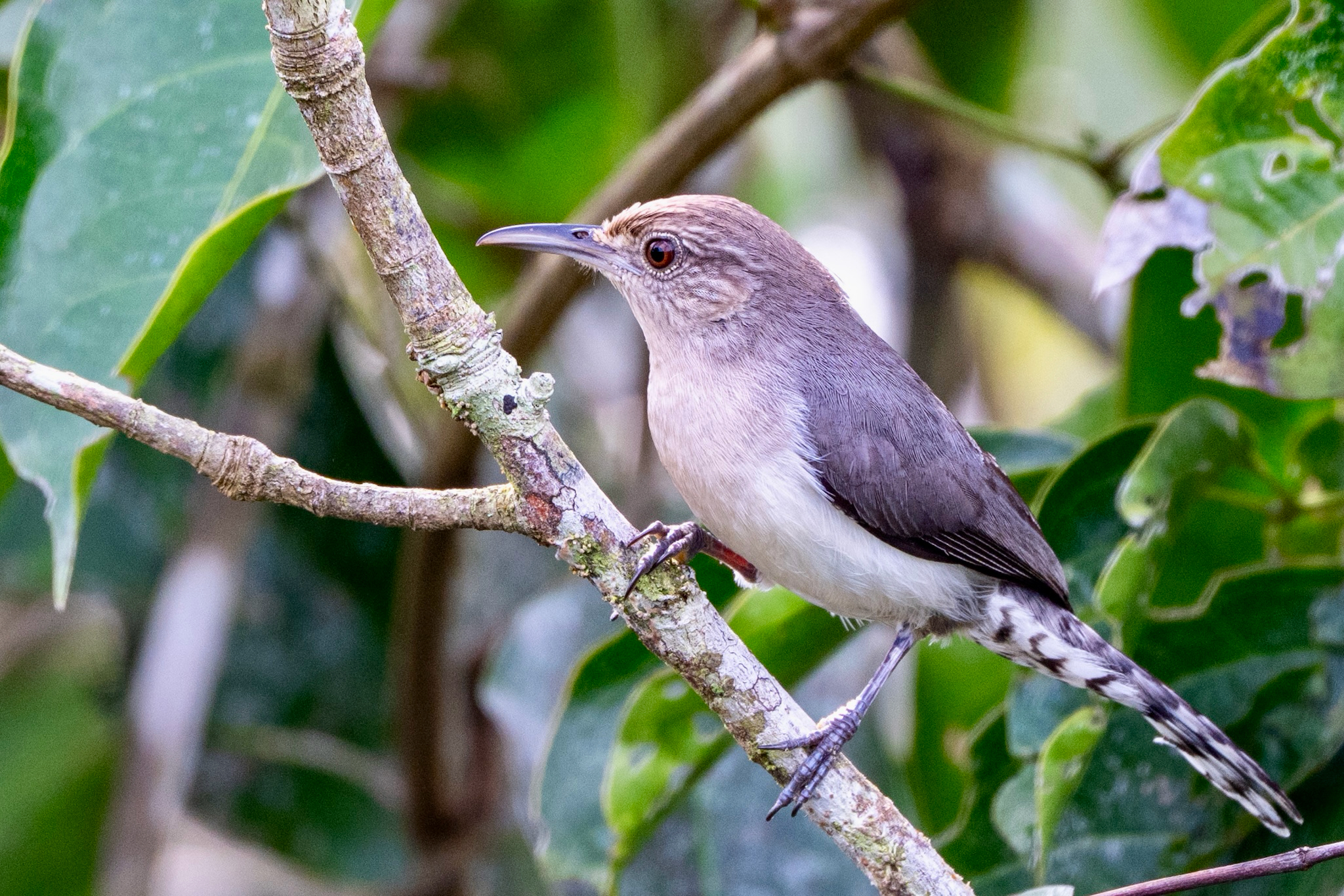
The Tooth-billed Wren is a small, grey canopy wren that resembles a gnatcatcher in posture and behaviour. It lives high in the trees of the forest south of the Amazon and often travels with mixed flocks. The English and Spanish names refer to the fine serrations along the edge of the bill.
Voice
The song is a fast, high, dry trill or series of thin notes, often repeated from the canopy. The call is a short, high tsit.
Recording: JAYRSON ARAUJO DE OLIVEIRA — CC BY-NC-SA 4.0 · xeno-canto
Identification
12–13 cm. Slender, with a thin, straight bill and a fairly long tail that is often cocked. Upperparts greyish brown, crown slightly browner, faint pale supercilium. Tail grey with narrow black bars. Underparts whitish to pale grey, throat palest. Male and female alike. Young birds are duller.
Confusion species
Para Gnatcatcher Polioptila paraensis and Tropical Gnatcatcher Polioptila plumbea are bluer grey, have a black tail with white outer edges and no bars, and the male has a black cap. Trilling Gnatwren Ramphocaenus melanurus has a much longer bill and buff cheeks and lives lower, in lianas and undergrowth.
Habitat
Canopy and upper levels of humid terra firme forest and tall forest edges, also along rivers and in tall secondary forest, in the lowlands. It creeps along branches and searches leaves and thin twigs for small insects and spiders, often together with mixed canopy flocks. Little is known about the nest.
Where the bird is most at home, classified by the vegetation units of Amazonia and the Guianas.


Range and movements
Brazil: south of the Amazon, from the Madeira and Rondônia east to about the Tocantins in Pará, and south to northern Mato Grosso. Not in Venezuela or the Guianas. Outside the guide area locally in northern Bolivia.
- Resident
- dark = core range, pale = thinly spread
How and when to look
Found from canopy towers and at places with a view of the treetops, such as near Alta Floresta in Mato Grosso. Watch for mixed flocks in the canopy; the bird moves a lot and often cocks its barred tail.
Conservation status
Least Concern (IUCN). The species lives in a region where much forest is cleared for farming and cattle ranching, along the so-called arc of deforestation in southern Amazonia, and it depends on tall forest.
Scientific name
Odontorchilus cinereus | (Pelzeln, 1868)
Pelzeln described the species in 1868 as Odontorhynchus cinereus; because it was later moved to another genus, the author and year stand in brackets. The genus Odontorchilus was introduced in 1915 by Richmond. Odontorchilus is Greek, from odous, odontos 'tooth' and orkhilos 'wren': 'tooth-wren', after the finely toothed edges of the bill. cinereus is Latin for 'ash-grey', from cinis 'ashes', after the grey upperparts. The specimen the first description was based on came from Salto do Girau, upper Rio Madeira, Amazonas, Brazil.