All species › Passerines › Tanagers and allies › Tropeiro Seedeater
Tropeiro Seedeater | Sporophila beltoni
Beltons dikbekje | Capuchino tropeiro | Patativa-tropeira
The Tropeiro Seedeater was described as a species only in 2013; before that the birds were included in Plumbeous Seedeater. It breeds in the high grasslands of southern Brazil and moves in the austral winter to the cerrado in the centre of the country. The English and Portuguese names refer to the tropeiros, cattle drovers who once followed a route roughly matching the bird's migration route.
Voice
The song is a melodious series of clear whistles and trills, which differs from that of Plumbeous Seedeater in the structure of its phrases. The call is a soft tsee.
Recording: Douglas Meyer — CC BY-NC-SA 4.0 · xeno-canto
Identification
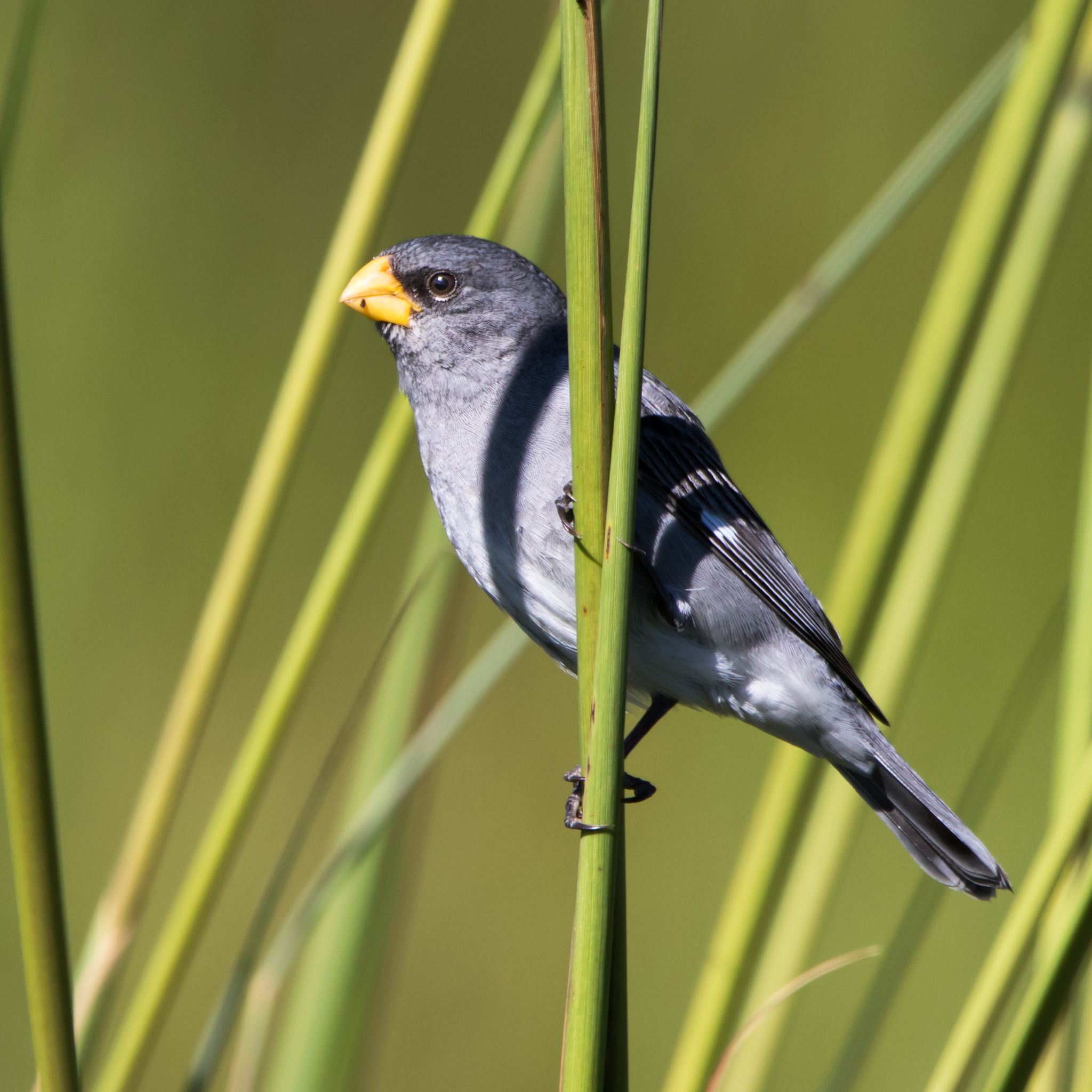
11–12 cm, with a thick, bright yellow bill in the male. The male is grey above and paler grey below, with a white chin, a small white spot below the eye, a white wing speculum and a whitish centre to the belly. The female is light brown above and paler buffy below, with a yellowish-brown to dark bill. Young males resemble the female.
Confusion species
Plumbeous Seedeater Sporophila plumbea has a blackish bill and is slightly smaller; in the cerrado the two species occur side by side in winter. Grey Seedeater Sporophila intermedia has a less bright yellow bill and no white spot below the eye. Temminck's Seedeater Sporophila falcirostris also has a yellow bill, but lives in bamboo in the Atlantic Forest. Females can hardly be separated in the field from those of Plumbeous Seedeater.
Habitat
In the breeding season moist, tall grassland with scattered shrubs, often along marshy hollows, on the plateau between 800 and 1300 m, in the region of araucaria forest. In winter open cerrado and wet grasslands along veredas. It feeds on grass seeds. The nest is a small cup in a shrub in the grassland.
Where the bird is most at home, classified by the vegetation units of Amazonia and the Guianas.



Range and movements
Only in Brazil. It breeds from about November to March on the plateaus of northeastern Rio Grande do Sul, Santa Catarina and southern Paraná. In the austral winter, roughly from April to October, it moves north and winters in the cerrado of Goiás, Minas Gerais and the Distrito Federal, and probably into southern Mato Grosso and western Bahia. Not in Venezuela, Guyana, Suriname and French Guiana. Not known outside the guide area.
- Winter visitor (c. Oct–Mar)
- dark = core range, pale = thinly spread
How and when to look
In the austral summer on the high grasslands of the Campos de Cima da Serra in Rio Grande do Sul and Santa Catarina, where males sing from shrubs. In winter among Plumbeous Seedeaters in the cerrado: look for the bright yellow bill.
Conservation status
Vulnerable. The population is small; the high grasslands of the breeding area are being converted to tree plantations and cropland, the cerrado in the wintering area is disappearing, and trapping for the cage-bird trade occurs.
Scientific name
Sporophila beltoni | Repenning & Fontana, 2013
Repenning & Fontana described the species in 2013 and placed it straight away in the genus where it still stands. The genus Sporophila was introduced in 1844 by Cabanis. Sporophila is Greek, from sporos 'seed' and philos 'lover': 'seed-lover'. beltoni honours the US diplomat and ornithologist William Henry Belton (1914–2009), pioneer of bird study and sound recording in Rio Grande do Sul. The specimen the first description was based on came from southern Brazil (not stated in the source).