All species › Passerines › New World warblers › Two-banded Warbler
Two-banded Warbler | Myiothlypis bivittata
Dubbelbandzanger | Reinita bandeada | Pula-pula-de-duas-fitas
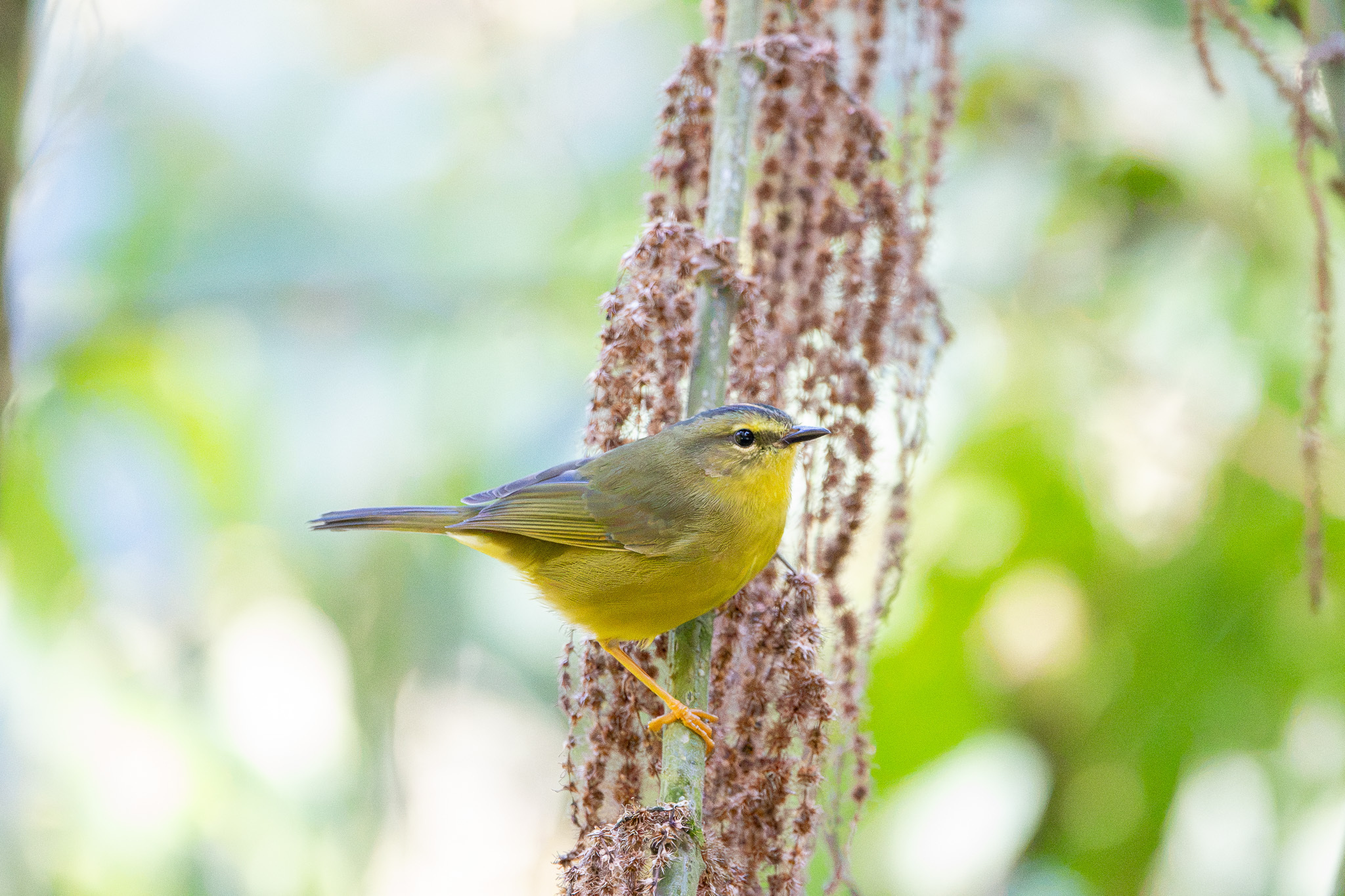
The Two-banded Warbler is an olive-green and yellow warbler with broad black bands along a yellow-orange crown stripe, living in the undergrowth of montane forest. In the guide area it occurs only on and around the tepuis of the Guiana Highlands, far separated from the birds on the east slope of the Andes in Peru, Bolivia and Argentina. The tepui form, roraimae, is treated as a separate species in some classifications.
Voice
The song is a long, fast series of clear, chipping notes that accelerates and increases in volume; pairs sometimes sing in duet. The call is a dry chek.
Recording: Richard E. Webster — CC BY-NC-SA 4.0 · xeno-canto
Identification
14 cm, with a fairly long tail. The upperparts are olive-green. The crown has an ochre-yellow to orange-yellow central stripe, bordered on each side by a broad black band. Below these run an olive-yellow supercilium and a short dark eye-line; the cheeks are olive. The underparts are bright yellow, with dark olive breast sides and flanks. In the tepui form the black crown bands are pure black, without olive feather tips. The sexes are alike. Young birds are duller and browner olive, with fainter head stripes.
Confusion species
Golden-crowned Warbler Basileuterus culicivorus, which occurs on the same tepuis, has a similar crown pattern, but is smaller, with a finer bill, a greyer head and a paler supercilium; it more often forages higher in the vegetation. Tepui Whitestart Myioborus castaneocapilla has a rufous crown, a grey back and white outer tail feathers, which it constantly fans.
Habitat
Undergrowth and lower storey of humid primary and secondary montane forest on the slopes of the tepuis, often in dense scrub along forest edges, stream valleys and ravines, roughly between 700 and 1800 m. It forages in pairs or family groups, often with mixed flocks, for insects on and just above the ground. As in related species, the nest is a domed nest on the ground or in a bank.
Where the bird is most at home, classified by the vegetation units of Amazonia and the Guianas.


Range and movements
Venezuela: on the tepuis of Bolívar and Amazonas, including the Gran Sabana and the Sierra de Lema. Guyana: in the west, in the Pakaraima Mountains. Brazil: in the far north, on the tepuis of Roraima and northern Amazonas, with scattered records further south and east. Not in Suriname and French Guiana. Outside the guide area along the east slope of the Andes from south-eastern Peru through Bolivia to northern Argentina.
- Resident
- dark = core range, pale = thinly spread
How and when to look
In the undergrowth of montane forest along the road over the Sierra de Lema to the Gran Sabana, where pairs move low through scrub and forest edges with mixed flocks. The accelerating, chipping song, sometimes as a duet, is often the first sign.
Conservation status
Least Concern. The montane forest of the tepuis is largely intact and remote. Locally, gold mining, fires and road building on the edges of the Guiana Highlands threaten the habitat.
Scientific name
Myiothlypis bivittata | (d'Orbigny, ACVMD & de Lafresnaye, 1837)
D'Orbigny, ACVMD & de Lafresnaye described the species in 1837 as Muscicapa bivittata; because it was later moved to another genus, the author and year stand in brackets. The genus Myiothlypis was introduced in 1851 by Cabanis. Myiothlypis is Greek, from muia 'fly' and thlupis, an unidentified small bird: 'fly-warbler'. bivittata is Latin for 'two-banded', from bi- 'two' and vitta 'band', after the two black crown stripes. The specimen the first description was based on came from Yungas, Bolivia.