All species › Passerines › Tyrant flycatchers and allies › Urich's Tyrannulet
Urich's Tyrannulet | Phyllomyias urichi
Urichs vliegenpikker | Mosquerito de Paria | Piolhinho-de-urich
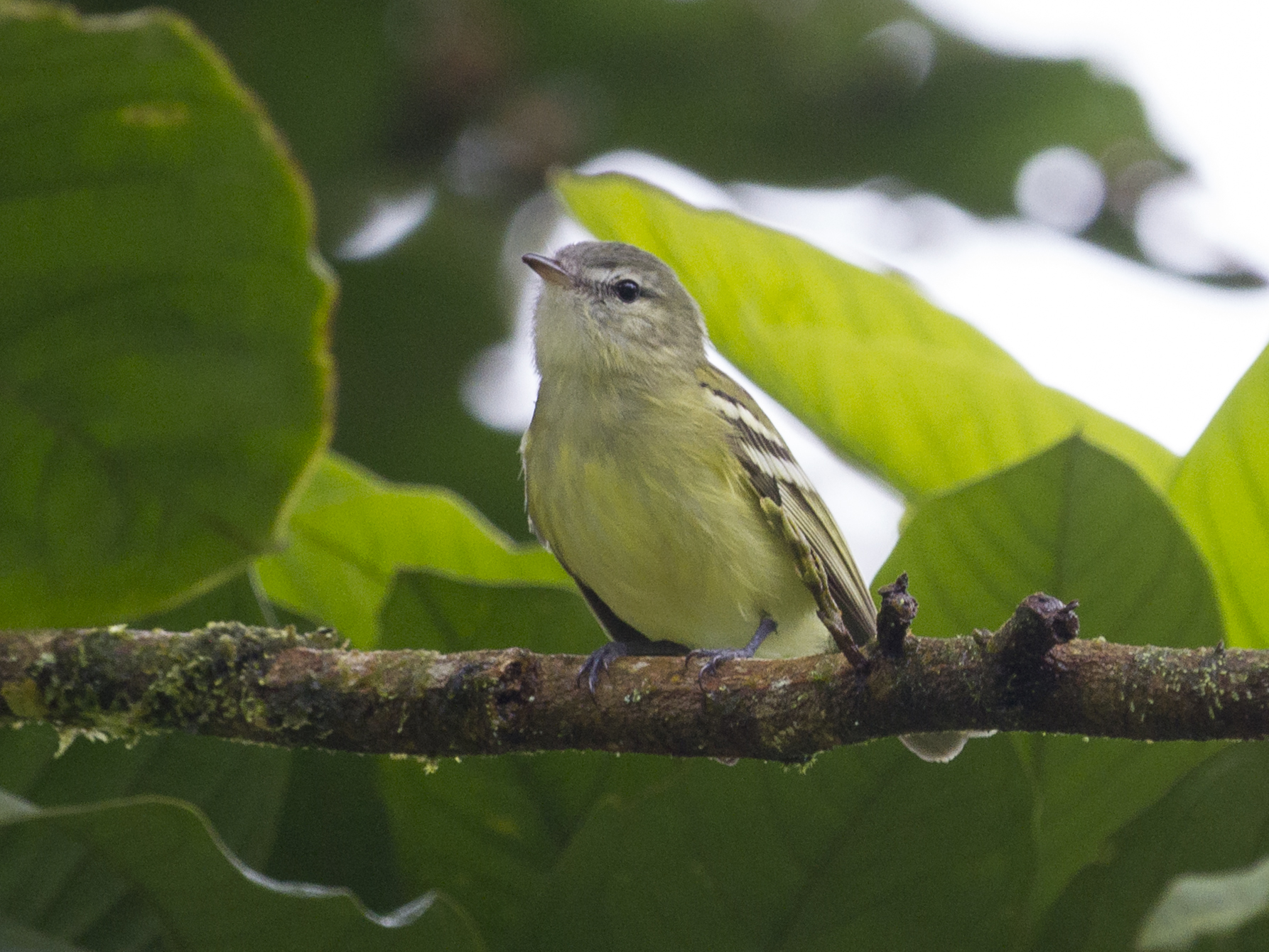
Urich's Tyrannulet is a small, olive-green flycatcher that occurs only in the mountains of north-eastern Venezuela. It was formerly treated as a subspecies of Greenish Tyrannulet of the Atlantic Forest. There are very few records, and it is listed as Endangered.
Voice
High, thin calls and a short series of rapid notes; the voice has hardly been described. It is probably similar to that of the related Greenish Tyrannulet.
No recording with a suitable Creative Commons licence is available for this species yet.
Identification
11.5 cm, with a short, black bill and a rounded head. Crown greyish olive; a narrow, yellowish eyebrow and an indistinct pale eye-ring. Upperparts olive-green. Wings dark with two distinct yellow wing-bars and yellow edges to the feathers. Throat and breast yellowish with faint olive streaks, belly brighter yellow. Sexes alike; juveniles duller.
Confusion species
Venezuelan Tyrannulet Zimmerius petersi lacks distinct wing-bars but has yellow edges to the flight feathers, a pale iris and often holds its tail cocked. Yellow-crowned Tyrannulet Tyrannulus elatus has a grey face, a yellow crown stripe and a very short bill and lives lower down. Southern Beardless Tyrannulet Camptostoma obsoletum is greyer, with a small crest and dull wing-bars. Greenish Elaenia Myiopagis viridicata is larger, with a longer tail and without distinct wing-bars.
Habitat
Humid montane forest and cloud forest, forest edges and tall secondary forest, also shade coffee with tall trees; about 900–1200 m. It takes insects in the canopy, often in mixed-species flocks. Nothing is known about the nest.
Where the bird is most at home, classified by the vegetation units of Amazonia and the Guianas.

Range and movements
Venezuela: only the mountains of the north-east, in the Cordillera de Caripe and the Serranía de Turimiquire on the border of Anzoátegui, Sucre and Monagas; possibly also elsewhere in the eastern coastal range. Not in Brazil or the Guianas. It does not occur outside the guide area.
- Passage (Mar–Apr, Oct–Nov)
- dark = core range, pale = thinly spread
How and when to look
The best chance is in the montane forests above Caripe in Monagas, in mixed flocks in the canopy along forest edges and roads. Records are scarce; any small, green tyrannulet with yellow wing-bars in these mountains is worth checking.
Conservation status
Endangered. The range is very small and fragmented. Deforestation for agriculture, conversion of shade coffee to open plantations and fires are the main threats. Part of the area lies within El Guácharo National Park.
Scientific name
Phyllomyias urichi | (Chapman, 1899)
Chapman described the species in 1899 as Mecocerculus urichi; because it was later moved to another genus, the author and year stand in brackets. The genus Phyllomyias was introduced in 1860 by Cabanis & Heine. Phyllomyias is Greek, from phullon 'leaf' and Modern Latin myias 'flycatcher': 'leaf-flycatcher', after its foraging among foliage. urichi honours the Trinidadian naturalist Friedrich William Urich (1870–1937), who also collected in Venezuela. The specimen the first description was based on came from Quebrada Seca, Sucre, Venezuela.