All species › Swifts › Hummingbirds › Velvet-browed Brilliant
Velvet-browed Brilliant | Heliodoxa xanthogonys
Tepuibriljantkolibrie | Brillante de tepuy | Brilhante-veludo
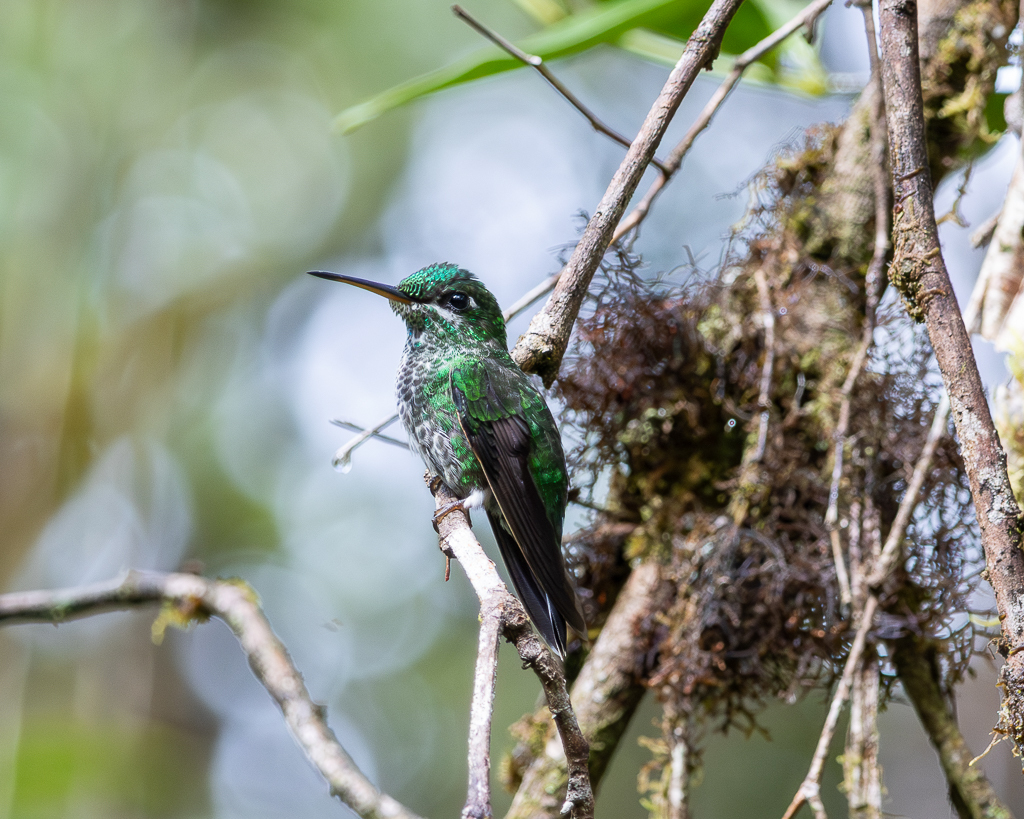
The Velvet-browed Brilliant is a medium-sized, dark green brilliant of the montane forest on the slopes of the tepuis. The name refers to the velvety black eyebrow stripe of the male above the eye. The species occurs only in the highlands of the Guiana Shield, where Venezuela, Guyana and Brazil meet.
Voice
In flight a repeated, nasal squank. Also high, drawn-out trills that rise and fall in pitch.
Recording: GABRIEL LEITE — CC BY-NC-SA 4.0 · xeno-canto
Identification
10–11 cm, with a straight black bill of about 2 cm and a slightly forked, dark tail. The male has a glittering golden to emerald-green central crown, a velvety black eyebrow stripe, dark golden-green upperparts and underparts and a small, glittering violet-blue patch on the upper throat. The female is less iridescent; she lacks the black eyebrow stripe and the throat patch, and has a white moustachial stripe, whitish underparts with green spots and white tips to the outer tail feathers. In the southern form willardi the female has more white and fewer green spots on the belly.
Confusion species
No other brilliants occur in the tepui region; Gould's Jewelfront Heliodoxa aurescens lives in the Amazonian lowlands and has a rufous breast band. The female Fork-tailed Woodnymph Thalurania furcata is grey below without green spots and has a deeply forked tail. Sparkling Violetear Colibri coruscans is larger, with a violet ear patch and a blue band in the tail.
Habitat
The interior, edges and clearings of humid montane forest on the tepui slopes, also scrub, mostly between 700 and 2000 m, locally from 500 m. It takes nectar at flowers in the middle levels and catches small insects. The breeding season probably falls between January and March; the nest is a cup saddled on a branch.
Where the bird is most at home, classified by the vegetation units of Amazonia and the Guianas.


Range and movements
In Venezuela in the south, on the tepuis of Bolívar and Amazonas, including the Sierra de Lema. In Guyana in the Pakaraima Mountains and in Brazil in northern Roraima and Amazonas along the border with Venezuela, where the form willardi also lives. A few records are known from Suriname. The species does not occur outside the guide area.
- Resident
- dark = core range, pale = thinly spread
How and when to look
Along the road through the Sierra de Lema to the Gran Sabana in Venezuela, at flowering trees and shrubs at the forest edge. In flight, listen for the nasal call.
Conservation status
Least Concern. Its habitat is largely remote and little disturbed; locally mining and clearance along roads are a threat.
Scientific name
Heliodoxa xanthogonys | Salvin & Godman, 1882
Salvin & Godman described the species in 1882 and placed it straight away in the genus where it still stands. The genus Heliodoxa was introduced in 1850 by Gould. Heliodoxa is Greek, from hēlios 'sun' and doxa 'glory': 'sun-glory', after the brilliant plumage. xanthogonys joins Greek xanthos 'yellow' and gonys 'lower mandible'; what exactly the describers meant is unclear. The specimen the first description was based on came from Merumé Mountains, Guyana.