All species › Swifts › Hummingbirds › Venezuelan Sylph
Venezuelan Sylph | Aglaiocercus berlepschi
Berlepsch' langstaartnimf | Silfo de Berlepsch | Silfo-venezuelano
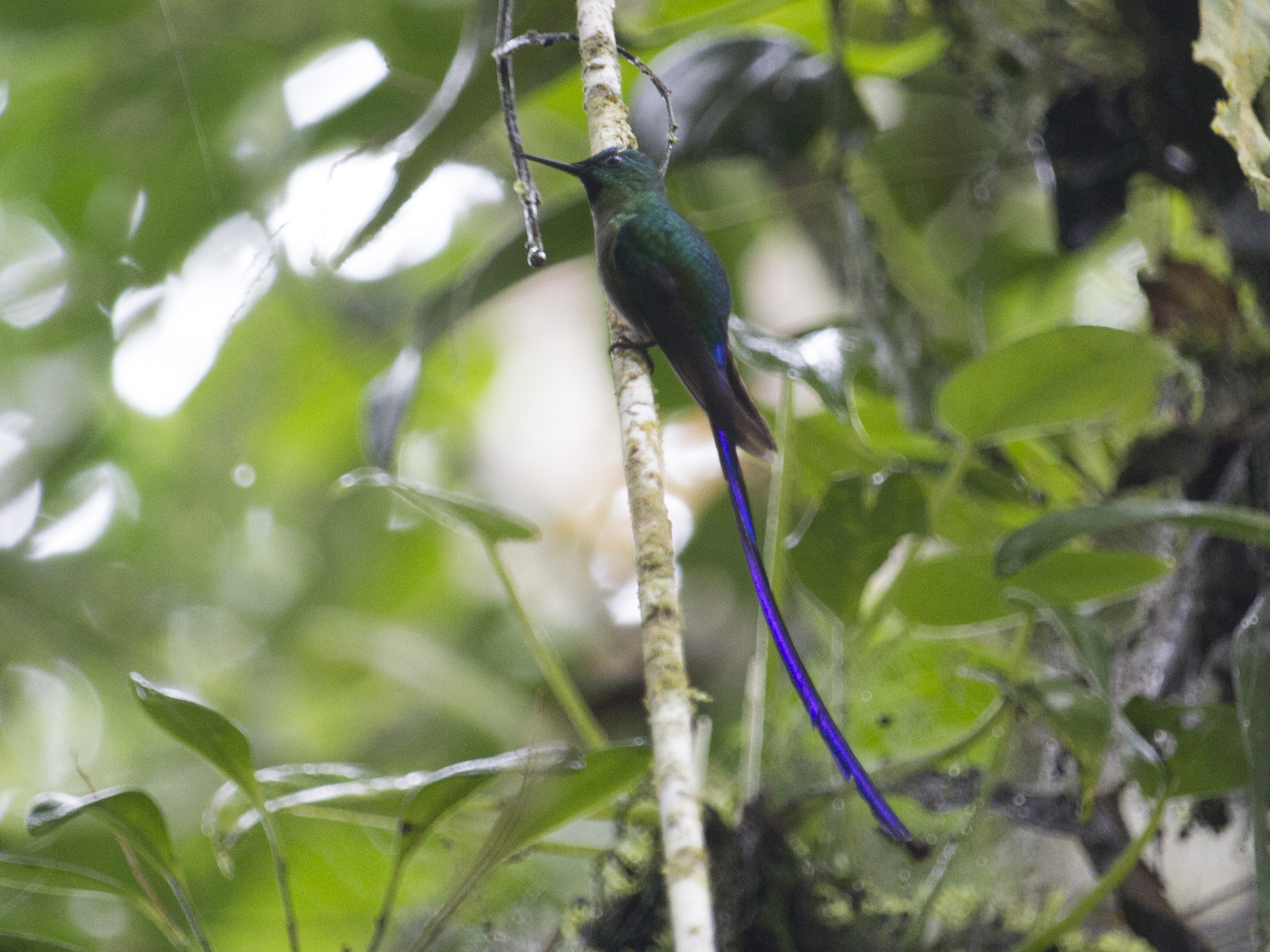
The Venezuelan Sylph is a hummingbird of the montane forest of north-eastern Venezuela, the male of which has a tail almost twice as long as its body. The species lives only in the Turimiquire massif and has one of the smallest ranges of all hummingbirds in the guide area.
Voice
The song is probably a continuous series of buzzy notes, bzzt… bzzt… bzzt…. Also a high, rising twitter.
Recording: Nick Athanas — CC BY-NC-SA 3.0 · xeno-canto
Identification
Male about 22 cm, of which 14–15 cm are outer tail feathers, female 9.5–11 cm; the bill is short, straight and black. The male has a dark glittering green crown, a shining green back, a glittering blue gorget, bronze-green underparts and white puffs on the thighs. The outer tail feathers are very long, deep violet at the base and blue towards the tip. The female has a glittering blue crown, a white throat, breast and belly with green spots, and a short, slightly forked, blue-green tail with white tips to the outer feathers.
Confusion species
Long-tailed Sylph Aglaiocercus kingii is very similar, but lives farther west, in the coastal range from Carabobo to Miranda and in the Andes; in the Turimiquire massif only this species occurs, so locality is the best feature. The female Long-tailed Sylph has a green crown and rufous underparts, not white with green spots. Other hummingbirds in the area lack a long tail.
Habitat
Humid montane forest, forest edges and scrub on the slopes of the coastal mountains, mainly between about 1450 and 1800 m. It takes nectar at flowers in the lower and middle levels of the forest and at the forest edge and catches small insects. Little is known about the nest; in related species it is a domed ball of moss with a side entrance.
Where the bird is most at home, classified by the vegetation units of Amazonia and the Guianas.

Range and movements
Endemic to Venezuela: only in the north-east, where the states of Sucre, Monagas and Anzoátegui meet, in the Cordillera de Caripe and the Serranía de Turimiquire. Absent from Brazil and the Guianas. The species does not occur outside the guide area.
- Resident
- dark = core range, pale = thinly spread
How and when to look
In the montane forest of El Guácharo National Park near Caripe, along forest edges and trails above about 1400 m. The male can be recognised in flight by the long tail.
Conservation status
Vulnerable. The very small range is increasingly being converted to fields and pasture; the population may number no more than about 1500 mature birds and is probably declining. The species occurs in El Guácharo National Park, but clearance continues in the protected zone of the Turimiquire massif.
Scientific name
Aglaiocercus berlepschi | (Hartert, 1898)
Hartert described the species in 1898 as Cyanolesbia berlepschi; because it was later moved to another genus, the author and year stand in brackets. The genus Aglaiocercus was introduced in 1930 by Zimmer. Aglaiocercus is Greek, from aglaia 'splendour, beauty' and kerkos 'tail', after the male's long, glittering tail. berlepschi honours the German ornithologist Hans von Berlepsch (1850–1915), an authority on South American birds. The specimen the first description was based on came from Cumaná, Venezuela.