All species › Passerines › New World blackbirds, troupials and allies › Venezuelan Troupial
Venezuelan Troupial | Icterus icterus
Troepiaal | Turpial venezolano | Corrupião-venezuelano
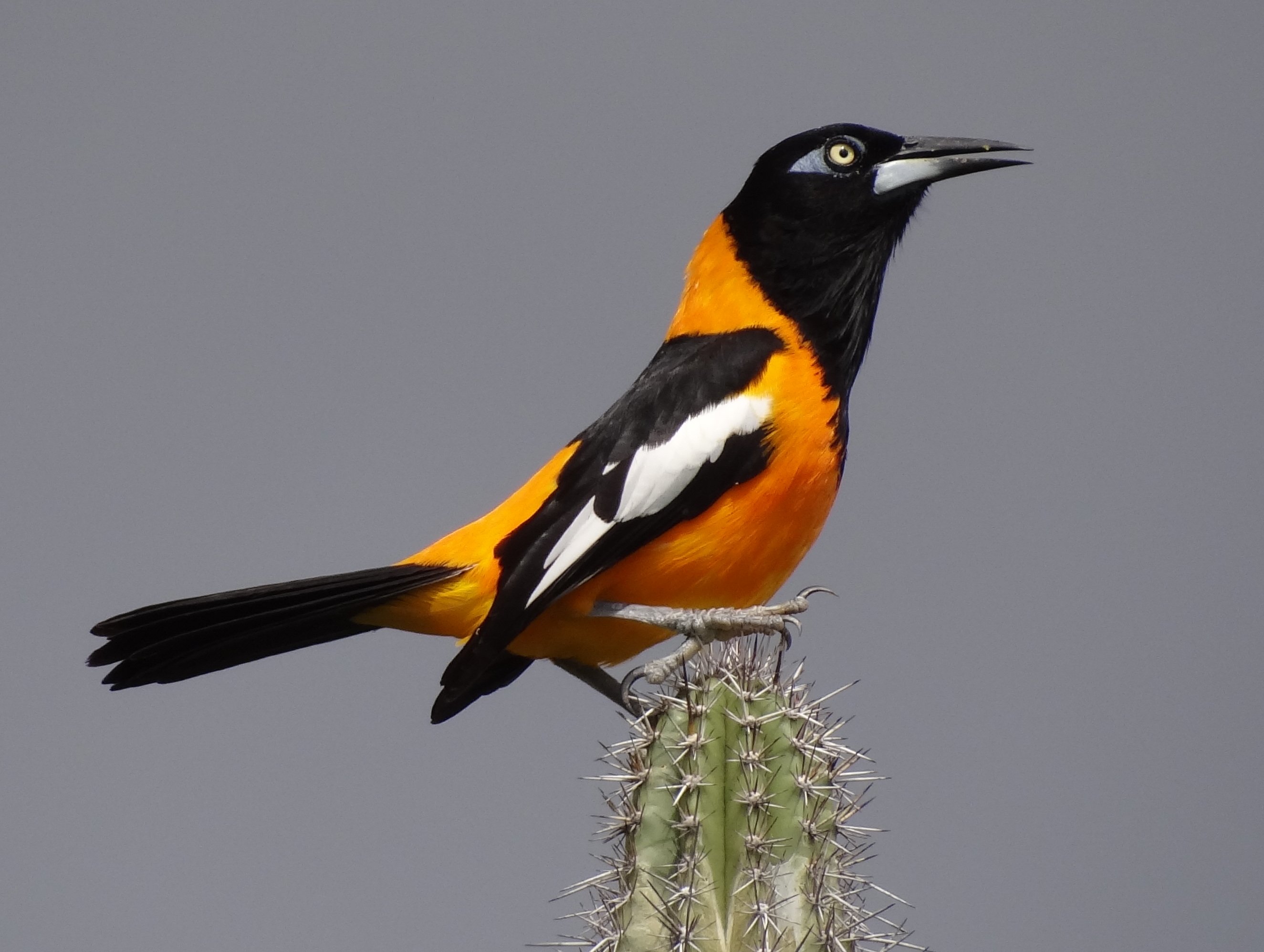
The Venezuelan Troupial is a large orange-and-black oriole of dry, open landscapes in northern South America, and the national bird of Venezuela. It rarely builds a nest of its own, instead taking over the nests of other birds, often after driving off the owners. In the guide area it lives only in Venezuela; in Amazonia and northeastern Brazil it is replaced by related species.
Voice
The song is a series of loud, clear, whistled phrases of two or three notes, such as troop-treeal, troop-treeal, often repeated at length; partners also sing in duet. Also a harsh, nasal chak and a dry rattle.
Recording: Rosendo Fraga — CC BY-NC-SA 4.0 · xeno-canto
Identification
23–27 cm, large and heavy, with a long tail and a heavy, pointed bill. Head, throat, upper breast and mantle are black, with a ragged lower edge to the bib on the breast. A broad band across the nape, the rump and the underparts are orange to orange-yellow. The wings are black with a large white patch across the coverts and an orange shoulder patch; the tail is black. The iris is yellow, surrounded by a patch of bare blue skin. The sexes are alike; juveniles are duller with less black.
Confusion species
Yellow Oriole Icterus nigrogularis is smaller and yellow instead of orange, with only a black mask and bib, and no blue skin around the eye. Orange-backed Troupial Icterus croconotus of Amazonia has an orange crown and mantle and only a black face and bib. Campo Troupial Icterus jamacaii of northeastern Brazil has an orange crown and a smaller white wing patch. Oriole Blackbird Gymnomystax mexicanus has a yellow head, a black back and wings without white, and lives along rivers and marshes.
Habitat
Dry forest, thorn scrub and cactus vegetation, open savanna with scattered trees and palms, gallery forest, farmyards, parks and gardens, mostly below 500 m. Eats fruit, insects and nectar. For breeding it takes over the nest of another bird, such as the stick nests of thornbirds Phacellodomus or the domed nests of Great Kiskadee Pitangus sulphuratus, sometimes eating eggs or young of the owners.
Where the bird is most at home, classified by the vegetation units of Amazonia and the Guianas.



Range and movements
In Venezuela in the north, from the dry lowlands around Lake Maracaibo and Falcón east along the coast to Sucre, in the Llanos and on Margarita; largely absent south of the Orinoco. Not in Brazil, Guyana, Suriname or French Guiana; troupials seen there are Orange-backed Troupial or Campo Troupial. Outside the guide area in northern and eastern Colombia and on Aruba, Curaçao and Bonaire; introduced to Puerto Rico and a few other Caribbean islands.
- Resident
- dark = core range, pale = thinly spread
How and when to look
In Venezuela almost everywhere in dry, open country and in the Llanos, often at the top of a tree or columnar cactus, and in villages and gardens. The loud, whistled song gives the bird away from afar.
Conservation status
Least Concern. Common in suitable habitat. In Venezuela and Colombia the species is trapped for the cage-bird trade.
Scientific name
Icterus icterus | (Linnaeus, 1766)
Linnaeus described the species in 1766 as O[riolus] icterus; because it was later moved to another genus, the author and year stand in brackets. The genus Icterus was introduced in 1760 by Brisson. Icterus is from Ancient Greek ikteros, a yellow bird usually taken to be the golden oriole, the sight of which was thought to cure jaundice. icterus is from Greek ikteros 'jaundice', a yellow bird whose sight, according to Pliny, cured jaundice. The specimen the first description was based on came from Cayenne, French Guiana (accepted).