All species › Jacamars and puffbirds › Puffbirds › Western Striolated Puffbird
Western Striolated Puffbird | Nystalus obamai
Obama's baardkoekoek | Buco estriado occidental | Rapazinho-estriado-do-oeste
The Western Striolated Puffbird is the western half of the former, broadly defined Striolated Puffbird; it was described as a separate species in 2013 and named after Barack Obama. In the guide area it lives only in south-western Amazonia in Brazil, west of the Rio Madeira. In the field it differs from its eastern sister species mainly in song.
Voice
A soft, sad series of whistles with a rising then falling cadence, like whip, whee-wheeu, wheeeeeuu, mainly shortly after dawn and before dusk. The male often starts, the female follows slightly lower.
Recording: Juan Freile — CC BY-NC-SA 4.0 · converted to mono · xeno-canto
Identification
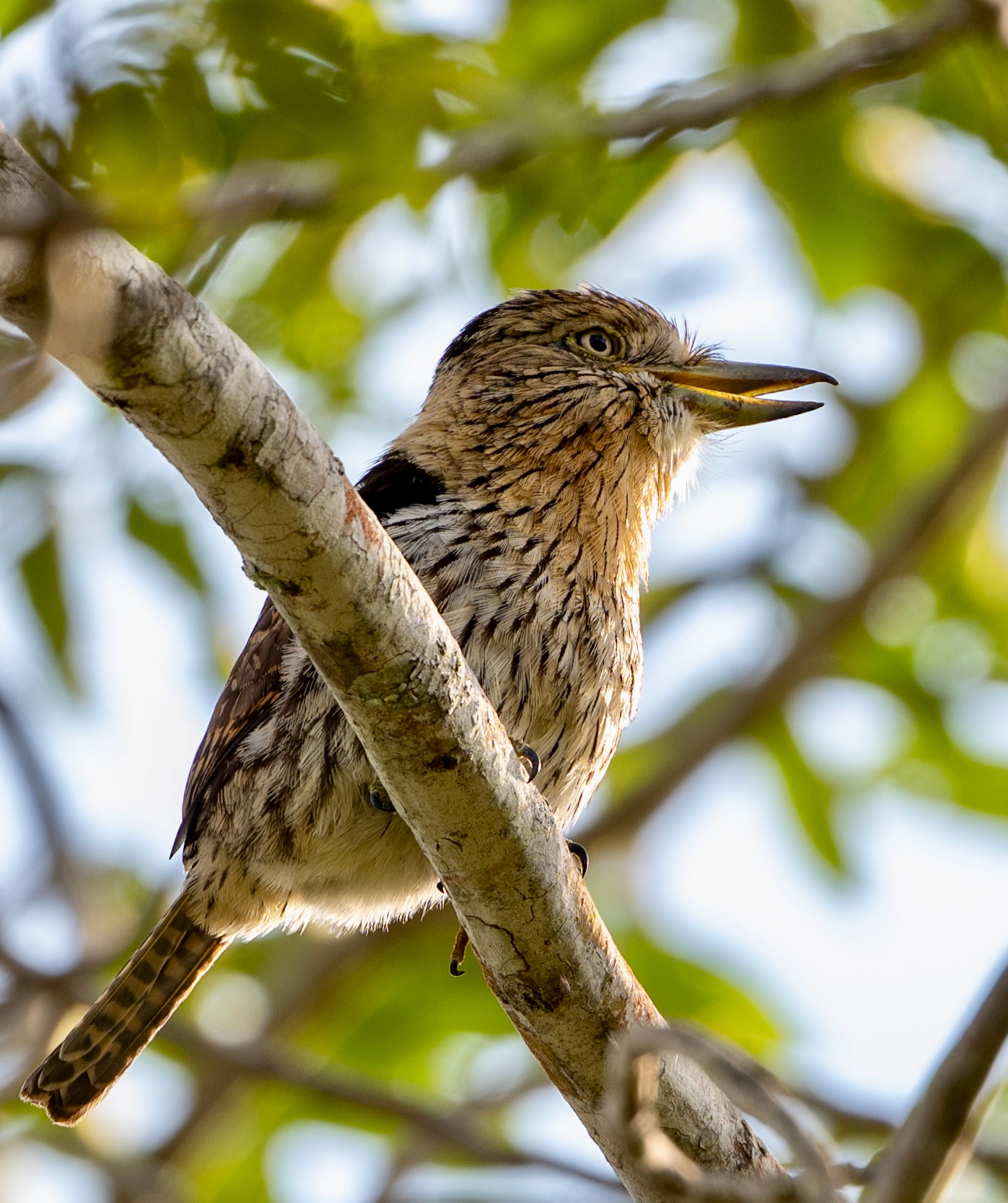
20–21 cm, with a large head, a heavy, dull grey-green bill with a dark tip and a medium-length tail. The upperparts are brown with fine buff and rufous barring. A buff band crosses the hindneck. The face is streaked, the throat white. The breast is buff, the belly whitish, both with fine black streaks, especially on the breast and flanks. The sexes are alike.
Confusion species
Eastern Striolated Puffbird Nystalus striolatus is almost identical and differs mainly in song; it lives east of the Rio Madeira, so the river largely separates the two species. White-eared Puffbird Nystalus chacuru has a red bill and a white ear patch and lives in open country. Rufous-necked Puffbird Malacoptila rufa has a grey head with a rufous neck and a white moustachial stripe. Spotted Puffbird Bucco tamatia is scalloped, with an orange-rufous throat.
Habitat
Edges of humid terra firme lowland forest, bamboo forest, transitional forest and clearings with tall trees, in the guide area in the lowlands. It sits in the lower canopy or crown and sallies out after large insects. It probably nests in a burrow in the ground, like related species.
Where the bird is most at home, classified by the vegetation units of Amazonia and the Guianas.



Range and movements
In Brazil only in south-western Amazonia: in Acre, Rondônia and south-western Amazonas, south of the Solimões and west of the Rio Madeira. Absent from Venezuela, Guyana, Suriname and French Guiana. Outside the guide area in eastern Peru, northern and central Bolivia, and in the foothills of Ecuador and southern Colombia.
- Resident
- dark = core range, pale = thinly spread
How and when to look
Along roads and forest edges in Acre and Rondônia, for example around Rio Branco, early in the morning or late in the afternoon, when the birds sing. The bird often sits high and in the open on a bare branch.
Conservation status
Least Concern. The range is large and the species tolerates forest edges, but much forest is being cleared in Acre and Rondônia.
Scientific name
Nystalus obamai | Whitney, Piacentini, Schunck, Aleixo, Sousa, Silveira & Rêgo, 2013
Whitney, Piacentini, Schunck, Aleixo, Sousa, Silveira & Rêgo described the species in 2013 and placed it straight away in the genus where it still stands. The genus Nystalus was introduced in 1863 by Cabanis & Heine. Nystalus comes from Greek nustalos 'drowsy', after the quiet, motionless perching of these puffbirds. obamai honours Barack Obama (b. 1961), the 44th President of the United States (2009–2017). The specimen the first description was based on came from Unknown (no type locality given).