All species › Passerines › Tyrant flycatchers and allies › White-banded Tyrannulet
White-banded Tyrannulet | Mecocerculus stictopterus
Witbandtachuri | Tiranillo alibandeado | Tiranete-de-faixa-branca
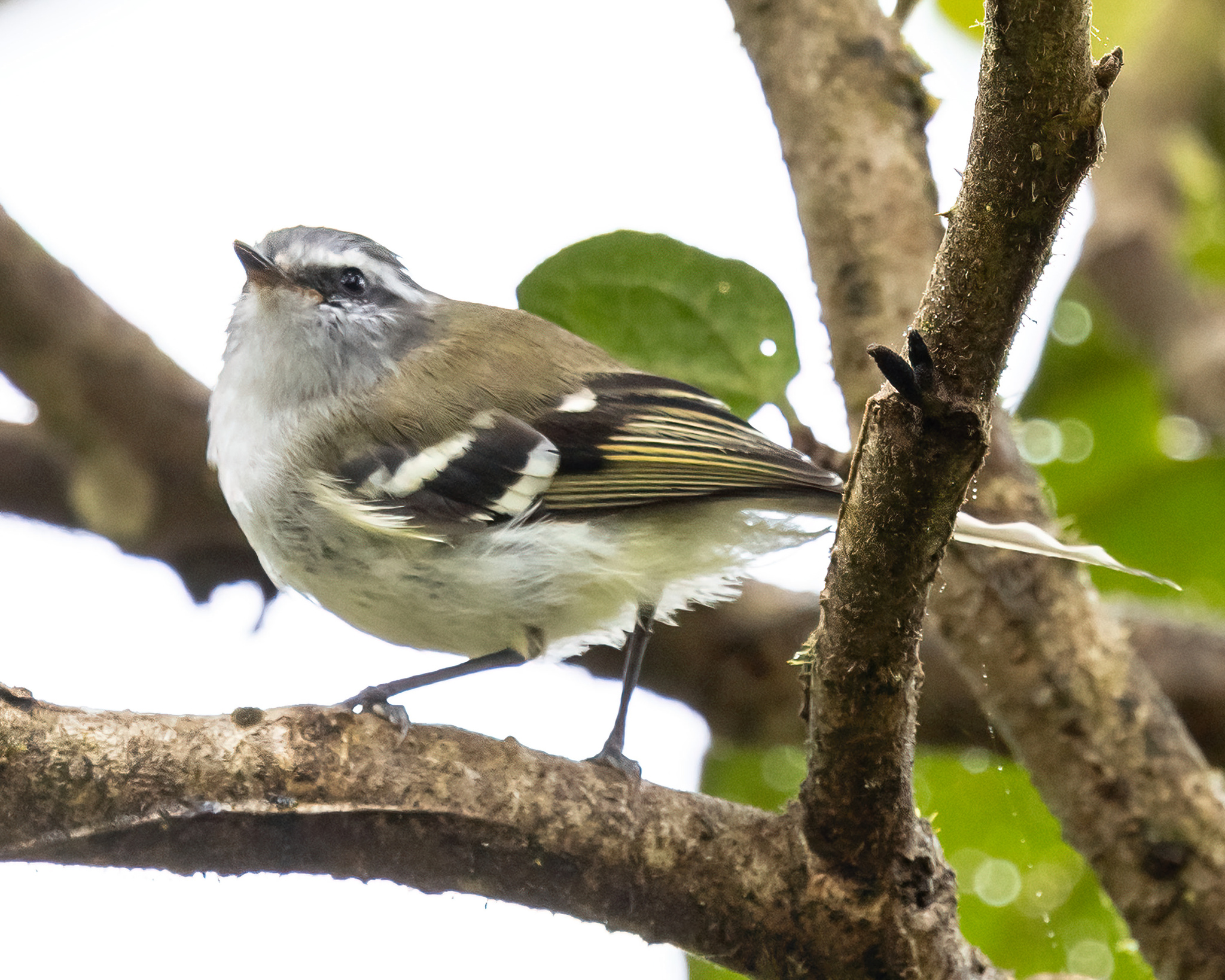
The White-banded Tyrannulet is a small, brownish-grey tyrannulet of high Andean montane forest, with two broad white wing bands. In the guide area it occurs only in the Venezuelan Andes. It searches the canopy for insects, usually together with mixed flocks.
Voice
A drawn-out, somewhat nasal call, like tsee-oo, and a short, dry trill. It calls often in mixed flocks.
Recording: Jacob Wijpkema — CC BY-NC-SA 4.0 · converted to mono · xeno-canto
Identification
12–13 cm, with a thin black bill and a fairly long tail. The head and upperparts are greyish brown to olive-brown, the back slightly browner than the crown. There is a long white supercilium and a dark eyeline. The wings are blackish, with two broad white wing bands, the lower one the widest, and white-edged tertials. The throat and breast are grey, the belly whitish with a yellow wash towards the undertail. The sexes are alike.
Confusion species
White-throated Tyrannulet Mecocerculus leucophrys is larger, with a conspicuous puffy white throat, a longer tail and narrower buffy wing bands. Sulphur-bellied Tyrannulet Mecocerculus minor is more olive-green, with a bright yellow breast and belly and buffy wing bands.
Habitat
Humid high montane forest, cloud forest and elfin forest up to the treeline, also forest edges with scattered trees, in Venezuela roughly between 2300 and 3500 m. It searches the canopy and outer branches for insects and spiders, often hanging from twigs. It joins mixed flocks of tanagers and other songbirds. The nest is an open cup among moss in a tree.
Where the bird is most at home, classified by the vegetation units of Amazonia and the Guianas.

Range and movements
Venezuela: only in the Andes of Trujillo, Mérida and Táchira, and possibly in the Sierra de Perijá. Absent from Brazil, Guyana, Suriname and French Guiana. Outside the guide area in the Andes of Colombia, Ecuador and Peru to Bolivia.
- Resident
- dark = core range, pale = thinly spread
How and when to look
In the high montane forest of the Sierra Nevada de Mérida, for example along roads up to the páramo, check mixed flocks for a small greyish-brown bird with two broad white wing bands.
Conservation status
Least Concern. In Venezuela its habitat is small and lies partly in national parks; forest at the upper limit is locally damaged by fires and grazing.
Scientific name
Mecocerculus stictopterus | (Sclater, 1859)
Sclater described the species in 1859 as Elainia stictoptera; because it was later moved to another genus, the author and year stand in brackets. The genus Mecocerculus was introduced in 1862 by Sclater. Mecocerculus is a diminutive from Greek mēkos 'length' and kerkos 'tail': 'little long-tail'. stictopterus is Greek, from stiktos 'spotted' and -pteros '-winged', after the bold white wing bars. The specimen the first description was based on came from Matus, Chimborazo, Ecuador.