All species › Passerines › Ovenbirds and woodcreepers › White-chinned Thistletail
White-chinned Thistletail | Asthenes fuliginosa
Witkindistelstaart | Colicardo barbiblanco | Cauda-de-cardo-de-queixo-branco
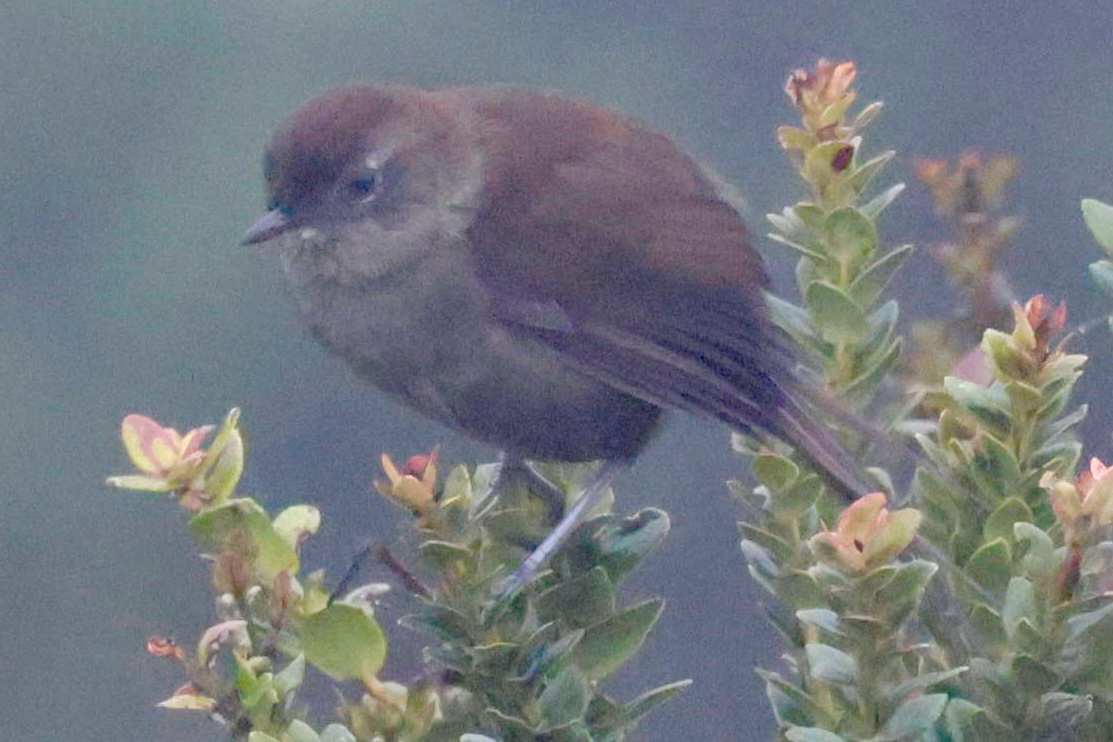
The White-chinned Thistletail is the most widespread thistletail of the northern Andes, but in the guide area it reaches only south-western Táchira. It lives at the treeline and in shrubby páramo and creeps through dense vegetation. The long, forked tail with ragged tips and the white chin are the best features.
Voice
The song is a weak, high trill that accelerates and rises, or a descending series that turns into a trill; also a rising series of triple notes, like tididit. Calls are a sharp peek or kik and a chink.
Recording: Pritam Baruah — CC BY-NC-SA 4.0 · xeno-canto
Identification
18–20 cm, with a short, pointed bill and a long, deeply forked tail whose tips look ragged because of the loose barbs. Crown, back, rump and tail are dark rufous-brown, the wings brighter rufous. A faint greyish-buff supercilium and a whitish eye-ring in a blackish to dark brown face. The chin is whitish, the underparts grey with brown flanks. The sexes are alike.
Confusion species
Ochre-browed Thistletail Asthenes coryi, north of the Táchira depression, is more olive-brown, with a distinct ochre supercilium and a rufous chin patch. White-browed Spinetail Hellmayrea gularis is smaller, with a short tail and a distinct white supercilium. Rufous Spinetail Synallaxis unirufa is uniformly rufous, with black lores and no white chin, and lives lower in montane forest.
Habitat
Shrubby páramo, elfin forest, the upper edge of cloud forest and dense undergrowth at the treeline, in the northern Andes mostly at 2800–4000 m, locally from 2400 m. It searches for insects low in dense vegetation. Little is known about its nest.
Where the bird is most at home, classified by the vegetation units of Amazonia and the Guianas.

Range and movements
Venezuela: only in south-western Táchira, in the area of the Páramo de Tamá on the border with Colombia. Not in Brazil or the Guianas. Outside the guide area in the Andes of Colombia, Ecuador and northern and central Peru.
- Resident
- dark = core range, pale = thinly spread
How and when to look
Search El Tamá National Park at the treeline and in shrubby páramo. The bird sometimes sings briefly from the top of a bush and then drops back into the vegetation.
Conservation status
Least Concern. In Venezuela the range is very small and largely protected. Fires in the páramo and grazing at the treeline locally affect its habitat.
Scientific name
Asthenes fuliginosa | (de Lafresnaye, 1843) (GBIF: Schizoeaca fuliginosa)
De Lafresnaye described the species in 1843 as Synnalaxis fuliginosus; because it was later moved to another genus, the author and year stand in brackets. The genus Asthenes was introduced in 1853 by Reichenbach. Asthenes is Greek for 'insignificant, weak', from a- 'not' and sthenos 'strength', after the drab little brown birds. fuliginosa is Late Latin for 'sooty', from fuligo 'soot', after the dark brown plumage. The specimen the first description was based on came from Bogotá, Colombia.