All species › Birds of prey › Kites, Old World vultures, eagles and hawks › White-collared Kite
White-collared Kite | Leptodon forbesi
Witkraagwouw | Milano de Forbes | Gavião-de-pescoço-branco
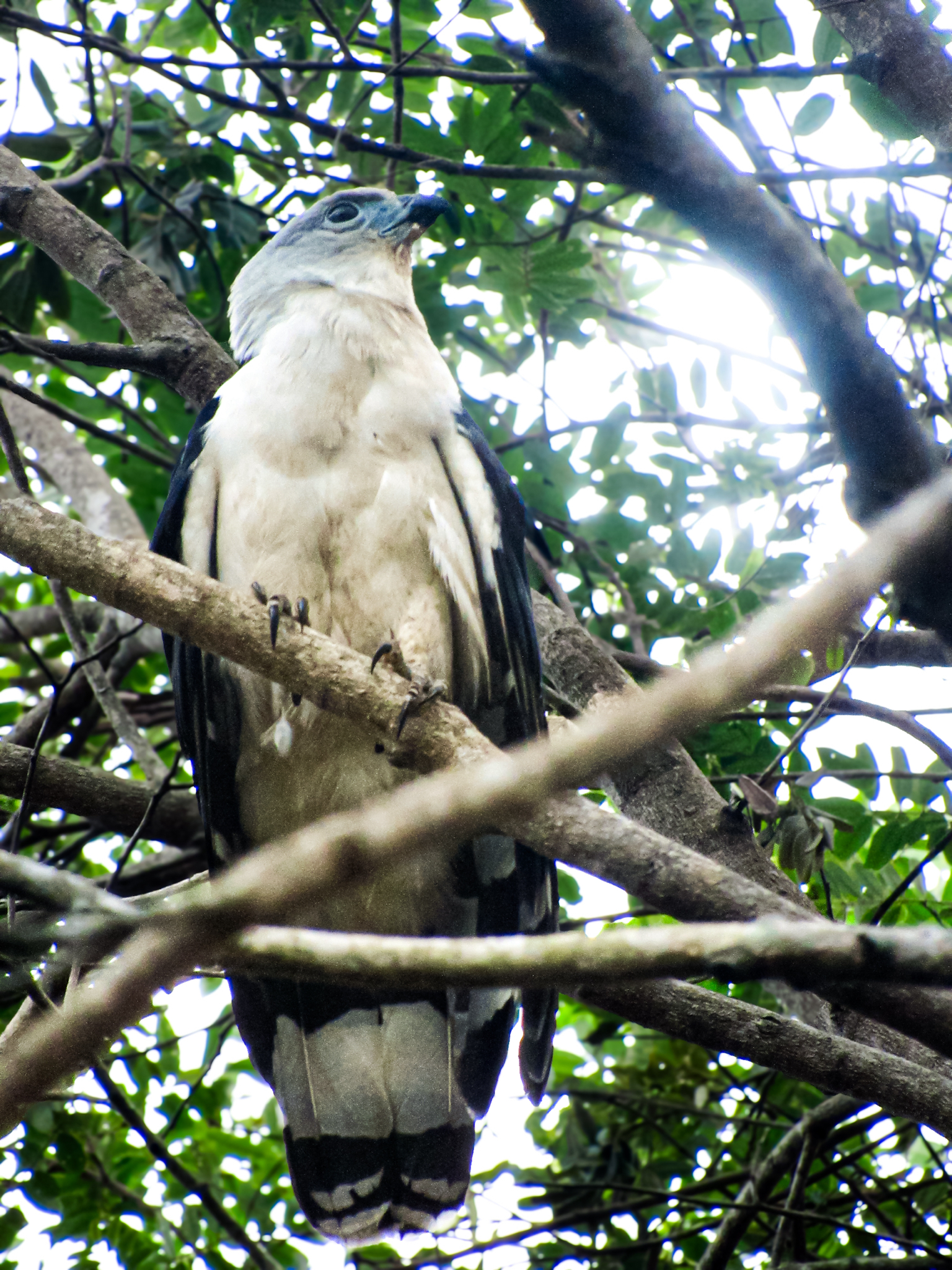
The White-collared Kite is a forest raptor found only in the last forest remnants of Alagoas and Pernambuco, in north-eastern Brazil. For a long time it was known only from a single specimen and was sometimes treated as a plumage form of the Grey-headed Kite; studies of specimens and field observations support it as a separate species. It is among the most threatened raptors of the guide area.
Voice
Little recorded. Probably similar to Grey-headed Kite: a loud, mewing kyow and a fast, laughing series ke-ke-ke-ke, mainly in flight over the forest.
Recording: Eduardo Vieira 1301 — CC BY-NC-SA 4.0 · converted to mono · xeno-canto
Identification
46–52 cm. Head pale grey, with a white collar on the nape that separates the head from the blackish back. The underparts are white. The mantle, scapulars and wings are blackish, in freshly moulted birds with white feather tips that wear off quickly. In most birds the underwing coverts are largely or entirely white, and the secondaries from below are mostly white with little black barring. The tail is black with white bands, but the broad white band is missing in some birds. The wings are broad and rounded, the tail fairly long. The juvenile plumage is poorly known.
Confusion species
Grey-headed Kite Leptodon cayanensis lives further south in Bahia and in Amazonia, and probably not in the same area. It has a darker grey head without a clear white collar, black underwing coverts and heavily black-barred flight feathers, and grey rather than white tail bands. Mantled Hawk Pseudastur polionotus and White-necked Hawk Buteogallus lacernulatus also have a white head and underparts with black upperparts, but have a white rather than grey head, a shorter tail, which in Mantled Hawk looks largely white from below and in White-necked Hawk is black with one broad white band across the middle; White-necked Hawk is also more compact, with shorter wings.
Habitat
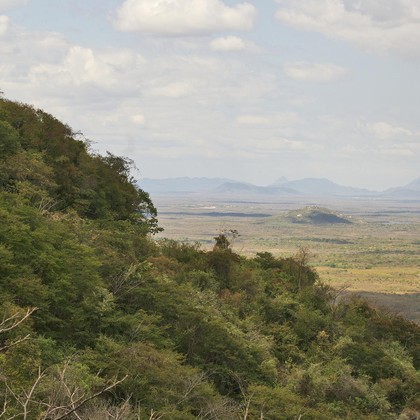
Lowland and hill forest of the north-eastern Atlantic Forest, from sea level to about 600 m, also forest edges and tall secondary forest. It regularly soars over the forest and over adjacent sugar cane fields and mangroves, but otherwise avoids open country. Little is known of its food and nest; Grey-headed Kite eats mainly wasp and bee larvae, reptiles, amphibians and large insects and builds a stick nest high in a tree.
Where the bird is most at home, classified by the vegetation units of Amazonia and the Guianas.

Range and movements
Only in Brazil, in the forest remnants of eastern Alagoas and Pernambuco, including Murici and São Miguel dos Campos in Alagoas. Reports from Paraíba, Sergipe and northern Bahia are unconfirmed; birds from southern Bahia are Grey-headed Kites. Not in other parts of the guide area. It does not occur outside the guide area.
- Resident
- dark = core range, pale = thinly spread
How and when to look
In late morning, when thermals start, watch from a viewpoint over forest in Alagoas or Pernambuco for a soaring raptor with a pale grey head, white collar and white underwings. A photograph of the underwing and nape helps to separate it from the other black-and-white raptors.
Conservation status
Endangered. The range is very small and the forest of the northeast has largely been converted to sugar cane and pasture; what remains consists of small, fragmented patches.
Scientific name
Leptodon forbesi | (Swann, 1922)
Swann described the species in 1922 as Odontriorchis forbesi; because it was later moved to another genus, the author and year stand in brackets. The genus Leptodon was introduced in 1836 by Sundevall. Leptodon is Greek, from leptos 'fine, slender' and odous, odontos 'tooth', after the fine tooth-like projection on the edge of the bill. forbesi honours the British zoologist William Alexander Forbes (1855–1883), who collected in Pernambuco in 1880. The specimen the first description was based on came from Pernambuco, Brazil.