All species › Passerines › New World warblers › White-faced Whitestart
White-faced Whitestart | Myioborus albifacies
Witwangzanger | Candelita cariblanca | Mariquita-de-cara-branca
The White-faced Whitestart is a Myioborus of a few remote tepuis in the north of the Venezuelan state of Amazonas. The white face below a black crown sets it apart from all its relatives. Genetic studies point to Guaiquinima Whitestart of Cerro Guaiquinima as its closest relative.
No photograph of a living wild bird of this species with a suitable Creative Commons licence exists. Do you have one that meets the rules? Send it in.
Voice
Little described. The song is a series of high, thin chip notes, as in related species; the call is a thin tsip.
No recording with a suitable Creative Commons licence is available for this species yet.
Identification
13–14 cm, with a long, often fanned tail. The crown is black; lores, cheeks and the area around the eye are white and form a white face. Nape and upperparts are slate-grey. Throat and underparts are orange-yellow to deep yellow, the undertail coverts white. The black tail has much white in the outer feathers. The sexes are alike. The juvenile plumage is little known.
Confusion species
No other Myioborus in the guide area has a white face. Guaiquinima Whitestart Myioborus cardonai of Cerro Guaiquinima has a slate-grey face with only white eye crescents. Tepui Whitestart Myioborus castaneocapilla has a rufous crown and yellow spectacles. Slate-throated Whitestart Myioborus miniatus, which lives lower on the slopes, has a dark slate-grey head and throat.
Habitat
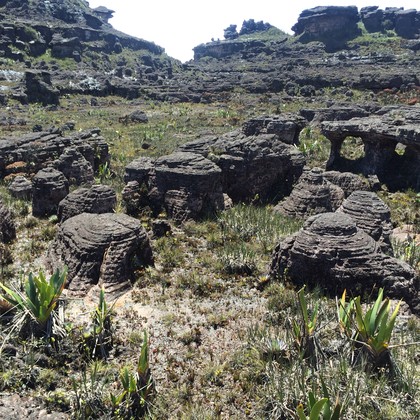
Humid montane forest, cloud forest and forest edge on the slopes of the tepuis, and tall scrub near the summits, mainly between about 1300 and 2000 m. Like related species it forages in pairs or small groups for insects in the lower and middle levels, fanning its tail and wings. The nest has not been described.
Where the bird is most at home, classified by the vegetation units of Amazonia and the Guianas.

Range and movements
Venezuela: only on a few tepuis in northern Amazonas and on the border with Bolívar, such as Cerro Yaví and the Sipapo massif with Cerro Paraque. Not in Brazil, Guyana, Suriname and French Guiana. Found nowhere else in the world.
How and when to look
The tepuis where the species lives have no roads and can be reached only by plane or helicopter; records come almost entirely from scientific expeditions.
Conservation status
Least Concern. The range is small, but the tepuis are remote and largely intact. Fires and mining in the lowlands around the tepuis are a possible threat to the lower slopes.
Scientific name
Myioborus albifacies | Phelps & Phelps, 1946
Phelps & Phelps described the species in 1946 and placed it straight away in the genus where it still stands. The genus Myioborus was introduced in 1865 by Baird. Myioborus is Greek, from muia 'fly' and -boros '-devouring': 'fly-eater'. albifacies is Latin for 'white-faced', from albus 'white' and facies 'face', after the white face. The specimen the first description was based on came from Cerro Paraque, Amazonas, Venezuela.