All species › Birds of prey › Kites, Old World vultures, eagles and hawks › White-rumped Hawk
White-rumped Hawk | Parabuteo leucorrhous
Witstuitbuizerd | Gavilán lomiblanco | Gavião-de-sobre-branco
The White-rumped Hawk is a small, blackish hawk of humid montane forest. It lives concealed in and above the canopy and is usually seen briefly when it soars low over the forest. In the guide area it occurs in two separate areas: the montane Atlantic Forest of south-eastern Brazil and the Andes of Venezuela.
Voice
A high, thin, descending scream, kee-aah, often in flight.
Recording: Paul Molina Abril — CC BY-NC-SA 4.0 · converted to mono · xeno-canto
Identification
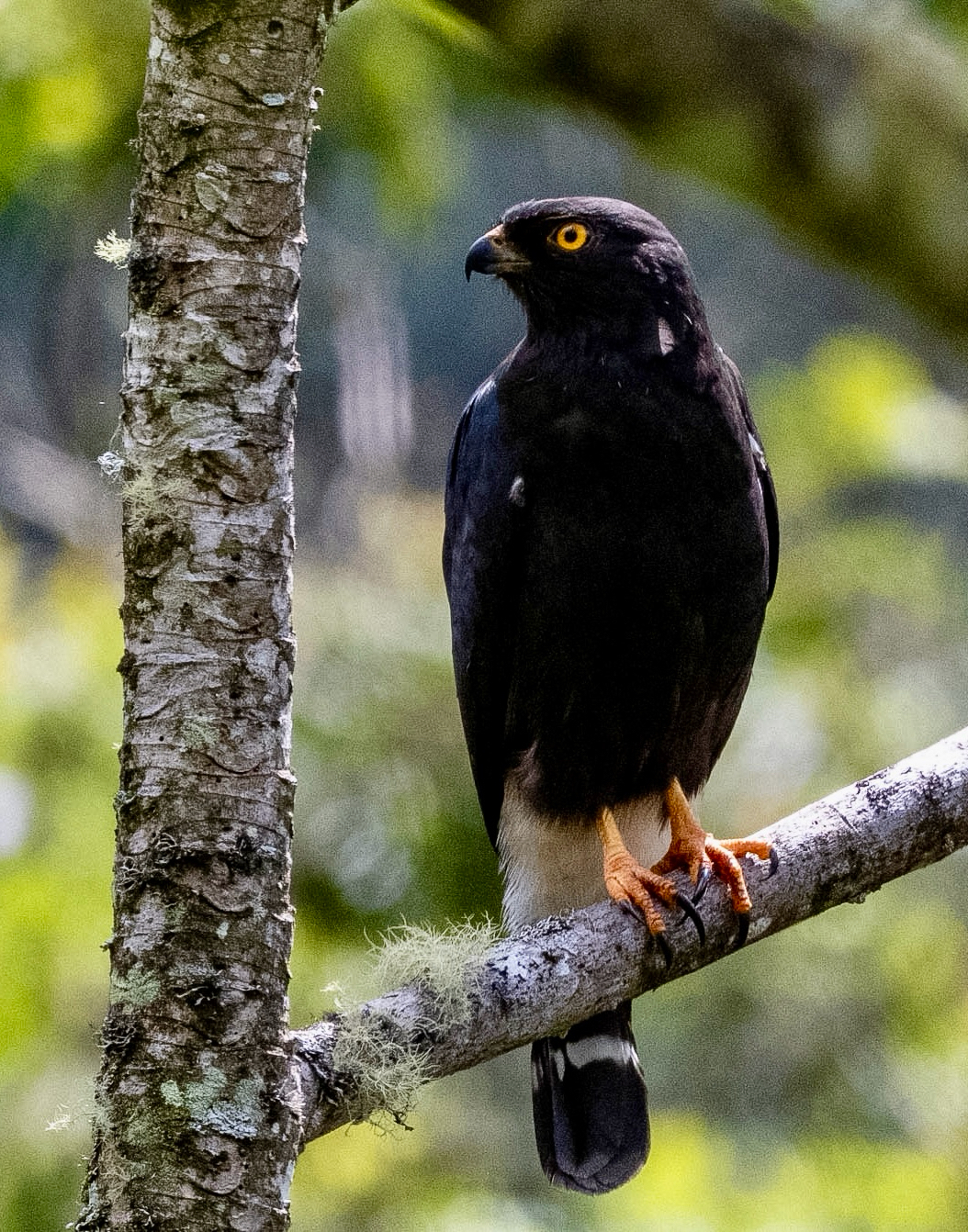
34–40 cm; the female is larger than the male. The adult is largely blackish, with a white rump and white undertail coverts and rufous thighs. The tail is black with one or two narrow pale grey to white bands and a narrow pale tip. The eye is pale yellow, the cere and legs yellow. In flight the whitish underwing coverts contrast with the dark body and the grey, barred flight feathers. Juveniles are dark brown with buff streaks on the head and underparts, and also have a pale rump.
Confusion species
The dark morph of Short-tailed Hawk Buteo brachyurus lacks the white rump and rufous thighs and has dark underwing coverts. Harris's Hawk Parabuteo unicinctus is larger, has rufous shoulders and lives in dry open country. Roadside Hawk Rupornis magnirostris is grey-brown with a barred belly and a rufous wing panel. In the Venezuelan Andes, White-throated Hawk Buteo albigula has white underparts with dark flank patches.
Habitat
Humid montane and cloud forest, araucaria forest, forest edges and clearings, also forest-pasture mosaic. In Brazil mainly between about 500 and 2000 m, in Venezuela mainly between 1500 and 3000 m. It hunts from the canopy or in a short flight low over the forest for small mammals, birds and reptiles. Little is known about the nest.
Where the bird is most at home, classified by the vegetation units of Amazonia and the Guianas.




Range and movements
In Brazil in the uplands of the Atlantic Forest and on the southern plateaus, from Minas Gerais and Espírito Santo through Rio de Janeiro and São Paulo to Paraná, Santa Catarina and Rio Grande do Sul. In Venezuela in the Andes of Táchira, Mérida, Trujillo and Lara and in the Serranía de Perijá. Absent from the Guianas. Outside the guide area along the Andes from Colombia to Bolivia and north-western Argentina, and in eastern Paraguay and north-eastern Argentina.
- Resident
- dark = core range, pale = thinly spread
How and when to look
Watch on sunny mornings from a spot overlooking the canopy, for example in the Serra da Mantiqueira, the Serra do Mar or the Itatiaia massif, or along roads through cloud forest in the Andes of Mérida. The white rump and white undertail coverts show when the bird glides low over the forest.
Conservation status
Least Concern. Widespread in montane forest but everywhere at low densities; locally vulnerable to deforestation.
Scientific name
Parabuteo leucorrhous | (Quoy & Gaimard, 1824) (GBIF: Percnohierax leucorrhous)
Quoy & Gaimard described the species in 1824 as Falco Leucorrhous; because it was later moved to another genus, the author and year stand in brackets. The genus Parabuteo was introduced in 1874 by Ridgway. Parabuteo is Greek para 'beside, near' plus the genus Buteo: 'near-buzzard'. leucorrhous is Greek, from leukos 'white' and orrhos 'rump', after the white rump. The specimen the first description was based on came from Rio de Janeiro, Brazil.