All species › Passerines › Tanagers and allies › Wing-barred Seedeater
Wing-barred Seedeater | Sporophila americana
Bont dikbekje | Semillero aliblanco | Coleiro-do-norte
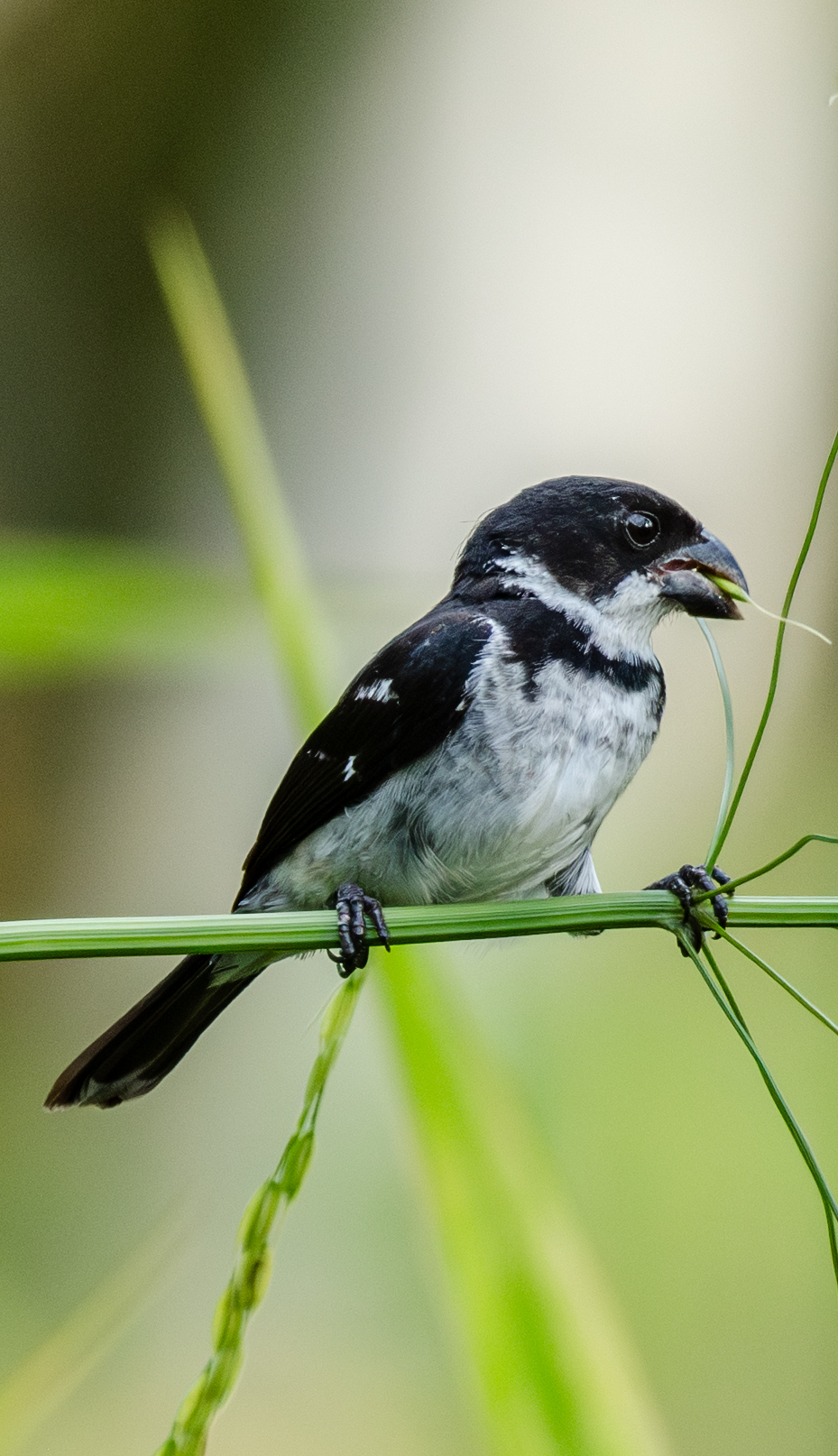
The Wing-barred Seedeater is a black-and-white seedeater of the coast of the Guianas and the lower Amazon, with white wing bars. In Paramaribo, Cayenne and Georgetown it is a common bird of gardens, yards and rough open country. The song is varied and, for a seedeater, long.
Voice
The song is a long, varied series of clear whistles and twittering, partly harsh phrases, often from a high perch. The call is a soft tsee.
Recording: Rolf A. de By — CC BY-NC-SA 4.0 · shortened to the first 60 s, mono · xeno-canto
Identification
11–12 cm, with a thick, curved, black bill. The male is glossy black above with a grey rump, has a white throat and a white partial collar, a black breast band and otherwise white underparts; on the black wing there are two narrow white wing bars and a white wing speculum. The female is olive-brown above and buffy below, with a dark bill and no distinct wing bars. Young males at first have a female-like plumage with the first black feathers.
Confusion species
White-throated Seedeater Sporophila albogularis of northeastern Brazil has a grey back and no wing bars. Double-collared Seedeater Sporophila caerulescens has a grey back, a white moustachial stripe and a yellow bill. Lesson's Seedeater Sporophila bouvronides and Lined Seedeater Sporophila lineola have a black throat with a white moustachial stripe and no wing bars. Caqueta Seedeater Sporophila murallae of western Amazonia, outside this area, lacks the grey rump and has a narrower breast band.
Habitat
Scrub, gardens, yards, plantations, rank grassland and forest edges in the lowlands, also along mangroves and on river islands with young growth; mostly below 500 m. It feeds mainly on grass seeds, also small fruits and insects. The nest is a small, shallow cup of fine fibres in a shrub.
Where the bird is most at home, classified by the vegetation units of Amazonia and the Guianas.





Range and movements
Along the coast of the Guianas: in Guyana, Suriname and French Guiana common on the coastal plain and inland along the large rivers. In Venezuela only in the far east, in the Orinoco delta. In Brazil in Amapá and along the lower Amazon in Pará and eastern Amazonas, mainly on the banks and river islands. Outside the guide area on Tobago.
- Resident
- dark = core range, pale = thinly spread
How and when to look
In gardens and on waste ground in Paramaribo, Cayenne or Georgetown, and along dykes and roads on the coastal plain. Singing males perch on wires and at the top of shrubs, where the white wing bars and the black breast band can be seen.
Conservation status
Least Concern. A common species of open and disturbed land in the coastal zone; trapping for the cage-bird trade occurs locally.
Scientific name
Sporophila americana | (Gmelin, 1789)
Gmelin described the species in 1789 as Loxia americana; because it was later moved to another genus, the author and year stand in brackets. The genus Sporophila was introduced in 1844 by Cabanis. Sporophila is Greek, from sporos 'seed' and philos 'lover': 'seed-lover'. americana is Latin for 'American', a vague indication of origin for a New World bird. The specimen the first description was based on came from Cayenne, French Guiana (designated).