All species › Passerines › Tyrant flycatchers and allies › Yellow-browed Tody-Flycatcher
Yellow-browed Tody-Flycatcher | Todirostrum chrysocrotaphum
Geelbrauwschoffelsnavel | Titirijí cejiamarillo | Ferreirinho-de-sobrancelha
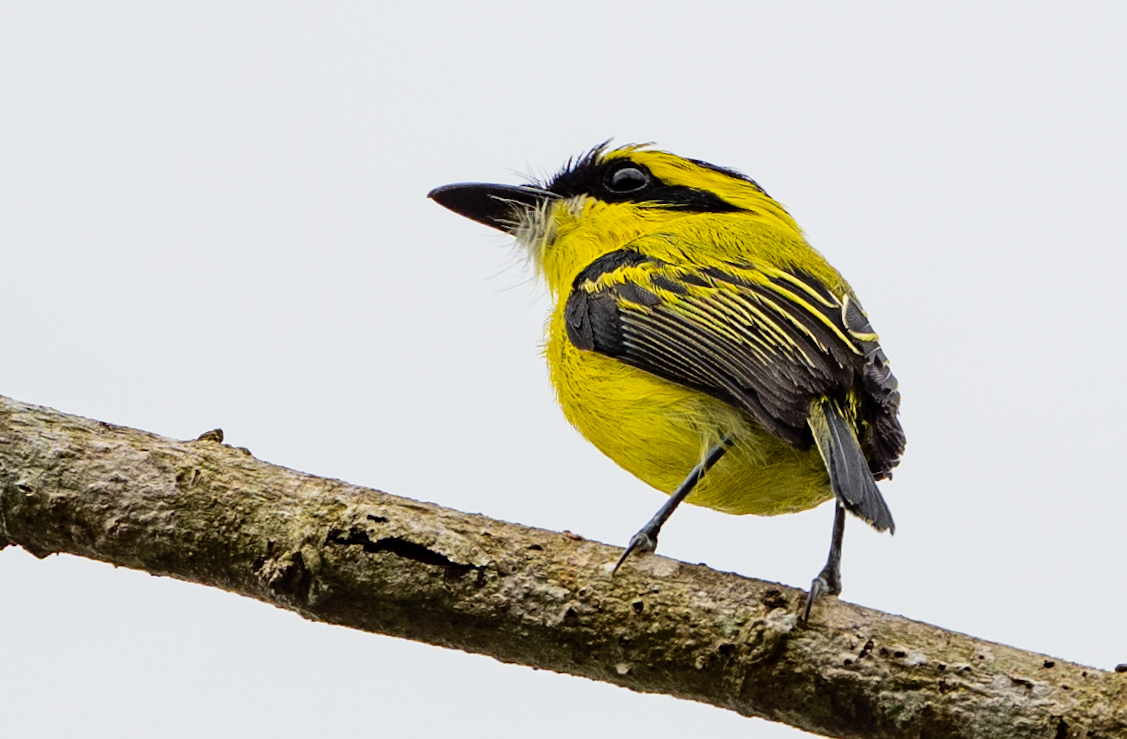
The Yellow-browed Tody-Flycatcher is a small flycatcher of the canopy of the Amazon rainforest. It usually sits high in the treetops and is often first recognised by its call. The black crown with a yellow eyebrow distinguishes it from the other tody-flycatchers of the lowlands.
Voice
A rapid series of high, dry tik notes, sometimes running into a short rattle, from the crown of a tree.
Recording: Sidnei Dantas — CC BY-NC-SA 4.0 · converted to mono · xeno-canto
Identification
9 cm, with a long, flat bill and a short tail. The crown is black, with a yellow stripe above the eye that continues behind the eye; the side of the head is blackish. The back is olive-green, the wings are black with yellow edges. The throat is white, the rest of the underparts bright yellow. In some forms the breast has black spots, in others these are small or absent. The eye is dark. The sexes are alike.
Confusion species
Spotted Tody-Flycatcher Todirostrum maculatum has a grey head without an eyebrow, a yellow eye and dense black streaks on the throat and breast, and lives in scrub along rivers. Painted Tody-Flycatcher Todirostrum pictum north of the Amazon has a black head without a yellow eyebrow and a black-spotted breast. Common Tody-Flycatcher Todirostrum cinereum has a grey hindcrown, a pale eye and a yellow throat.
Habitat
The canopy and edges of humid lowland forest, both terra firme and várzea, also tall trees at clearings and along rivers, up to about 900 m. It forages in pairs, often with mixed flocks in the treetops, for insects in the foliage. The nest is a hanging pouch.
Where the bird is most at home, classified by the vegetation units of Amazonia and the Guianas.



Range and movements
Brazil: in large parts of Amazonia, north and south of the Amazon, south into Mato Grosso and east into Pará and western Maranhão. Venezuela: only a few records in the south. Suriname: only a few records; not known from Guyana and French Guiana. Outside the guide area in Amazonian Colombia, Ecuador, Peru and Bolivia.
- Resident
- dark = core range, pale = thinly spread
How and when to look
Search from a tower or along a river with a view of the treetops, for example near Manaus or Alta Floresta; follow mixed flocks in the canopy and listen for the rapid series of high ticks.
Conservation status
Least Concern. The species has a large range in Amazonia, but depends on forest.
Scientific name
Todirostrum chrysocrotaphum | Strickland, 1850
Strickland described the species in 1850 and placed it straight away in the genus where it still stands. The genus Todirostrum was introduced in 1831 by Lesson. Todirostrum combines the genus Todus (tody) with Latin rostrum 'bill', after the long, flat, tody-like bill. chrysocrotaphum is Greek, from khrusos 'gold' and krotaphos 'temple', after the yellow eyebrow. The specimen the first description was based on came from Peru (not specified further).