All species › Passerines › Finches, euphonias and allies › Yellow-faced Siskin
Yellow-faced Siskin | Spinus yarrellii
Geelwangsijs | Jilguero cariamarillo | Pintassilgo-do-nordeste
The Yellow-faced Siskin is a small black, olive-green and yellow siskin with a highly fragmented range. Nearly all records come from northeastern Brazil; from northern Venezuela there are only a few old records. The male has a black cap and a bright yellow face. Trapping for the cage-bird trade has made the species Vulnerable.

Voice
It calls a high, clear chee and a soft twitter. The song is a fast, drawn-out series of twitters and trills, similar to that of Hooded Siskin.
Recording: Guilherme Melo — CC BY-NC-SA 4.0 · converted to mono · xeno-canto
Identification
10 cm. The male has a black cap, a bright yellow forehead, cheek and throat, an olive-green back with a yellow rump and bright yellow underparts; the wings are black with a broad yellow band and the tail is black with yellow sides at the base. The female lacks the black cap, is olive-green above and yellowish olive below, with a yellow wing band. Juveniles resemble the female. Bill short and pointed.
Confusion species
Male Hooded Siskin Spinus magellanicus has an all-black head and throat instead of only a black cap; that species locally occurs in the same area in northeastern Brazil. Females of the two species are very similar; female Hooded Siskin is greyer below. In open country yellow-finches Sicalis may also cause confusion, but they lack the black wings with a yellow band.
Habitat
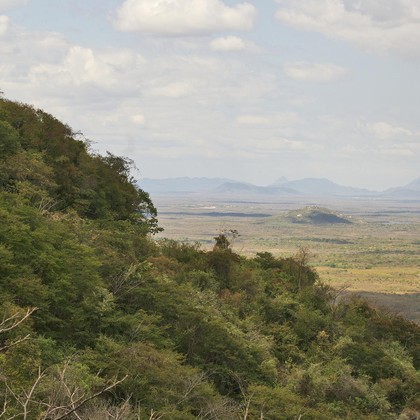
Edges of humid and secondary forest, open country with scattered trees, plantations and gardens, in northeastern Brazil mainly in the humid montane and coastal forests and their edges, locally also in the transition to caatinga, from sea level to about 1000 m. It eats seeds of herbs and trees. It lives in pairs or small groups and wanders outside the breeding season. The nest is a small cup in a tree or shrub.
Where the bird is most at home, classified by the vegetation units of Amazonia and the Guianas.




Range and movements
In Brazil a scarce and local resident in the northeast, mainly in Pernambuco and Alagoas, with records from surrounding states such as Paraíba, Ceará and northern Bahia. In Venezuela known from a few old records in the Coastal Cordillera in the north; whether a population exists or existed there is uncertain. Absent from Guyana, Suriname and French Guiana. It does not occur outside the guide area.
- Resident
- dark = core range, pale = thinly spread
How and when to look
Search forest edges, plantations and gardens near remnants of humid forest in Pernambuco and Alagoas. Listen for the high call and look for a small siskin with a black cap and a yellow face; flocks often sit in the crowns of seeding trees.
Conservation status
Vulnerable. The population is small and fragmented and is declining due to trapping for the cage-bird trade and the loss of humid forest in northeastern Brazil. Legally protected in Brazil.
Scientific name
Spinus yarrellii | (Audubon, 1839)
Audubon described the species in 1839 as Carduelis yarrellii; because it was later moved to another genus, the author and year stand in brackets. The genus Spinus was introduced in 1816 by Koch. Spinus goes back to Ancient Greek spinos, a name for a small bird that can no longer be identified with certainty. yarrellii honours the English zoologist and bookseller William Yarrell (1784–1856), author of standard works on British birds and fishes. The specimen the first description was based on came from Bahia, Brazil.