All species › Passerines › New World sparrows › Yellow-mandibled Sparrow
Yellow-mandibled Sparrow | Arremon axillaris
Geelkaakgors | Cerquero de mandíbula amarilla | Tico-tico-de-mandíbula-amarela
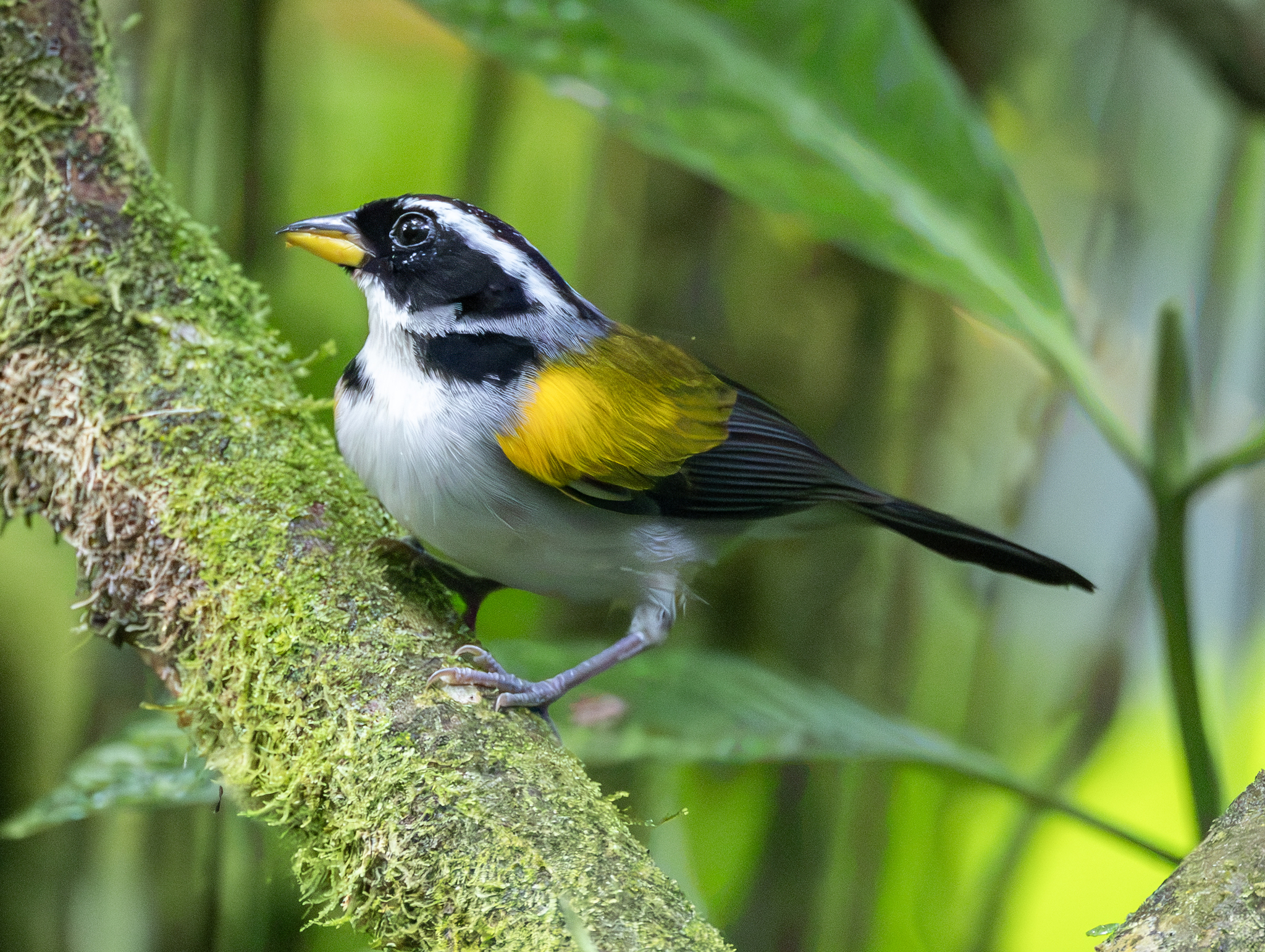
The Yellow-mandibled Sparrow is a sparrow with a black-and-white striped head of humid forest at the foot of the Eastern Andes in Colombia and western Venezuela. It was long treated as a subspecies of Pectoral Sparrow Arremon taciturnus and is recognised as a separate species because of its plumage and voice. In the guide area it has a small, still poorly documented occurrence.
Voice
The song is little known but resembles that of Pectoral Sparrow: a series of high, thin whistles, roughly zitip, zeee zeee zeee. The call is a high tseet.
No recording with a suitable Creative Commons licence is available for this species yet.
Identification
15 cm, with a fairly short, conical bill: the upper mandible is black, the lower mandible yellow. The head is black, with a narrow grey median crown stripe and a narrow white supercilium. Throat and neck sides are white, back, wings and tail olive-green, with yellowish-green wing coverts and an extensive yellow patch on the shoulder. The underparts are white, with a black breast band broken in the centre. The female is creamy white below and duller overall. Juveniles are olive-brown, with a vaguer head pattern.
Confusion species
Pectoral Sparrow Arremon taciturnus is almost identical but has an all-black bill and less yellow on the shoulder; in Venezuela it lives south of the Orinoco and is separated from Yellow-mandibled Sparrow. Golden-winged Sparrow Arremon schlegeli in northern Venezuela has an all-black, unstriped head and an entirely golden-yellow bill.
Habitat
Understorey of humid evergreen forest in the lowlands and foothills, also in older secondary forest and less often in lighter woodland and coffee plantations, especially near wooded stream valleys, below about 1000 m. It forages in pairs mainly on the ground, hidden in the undergrowth. Little is known about the nest.
Where the bird is most at home, classified by the vegetation units of Amazonia and the Guianas.


Range and movements
In the guide area only in the far west of Venezuela, at the foot of the Andes in Táchira and possibly adjacent parts of Apure and Barinas; there are few documented records. Absent from Brazil and the Guianas. Outside the guide area in Colombia at the eastern base of the Eastern Andes.
- Resident
- dark = core range, pale = thinly spread
How and when to look
Search humid forest and wooded stream valleys at the foot of the Andes in Táchira in the early morning, when the high song can be heard. With any striped Arremon in this area, check the colour of the lower mandible.
Conservation status
Least Concern. The range is small and lowland forest at the foot of the Andes is being converted to pasture and fields in many places; in Venezuela the species is known from only a few sites.
Scientific name
Arremon axillaris | Sclater, 1855 (GBIF: Arremon taciturnus)
Sclater described the species in 1855 and placed it straight away in the genus where it still stands. The genus Arremon was introduced in 1816 by Vieillot. Arremon is Greek, from arrhēmōn 'silent, speechless', after Buffon's 'Oiseau silencieux', a bird said to be rarely heard. axillaris comes from the Latin axilla 'armpit', after the yellow at the bend of the wing and shoulder. The specimen the first description was based on came from New Granada (present-day Colombia, unspecified).