All species › Passerines › Ovenbirds and woodcreepers › Zimmer's Woodcreeper
Zimmer's Woodcreeper | Dendroplex kienerii
Zimmers muisspecht | Trepatroncos de Zimmer | Arapaçu-de-zimmer
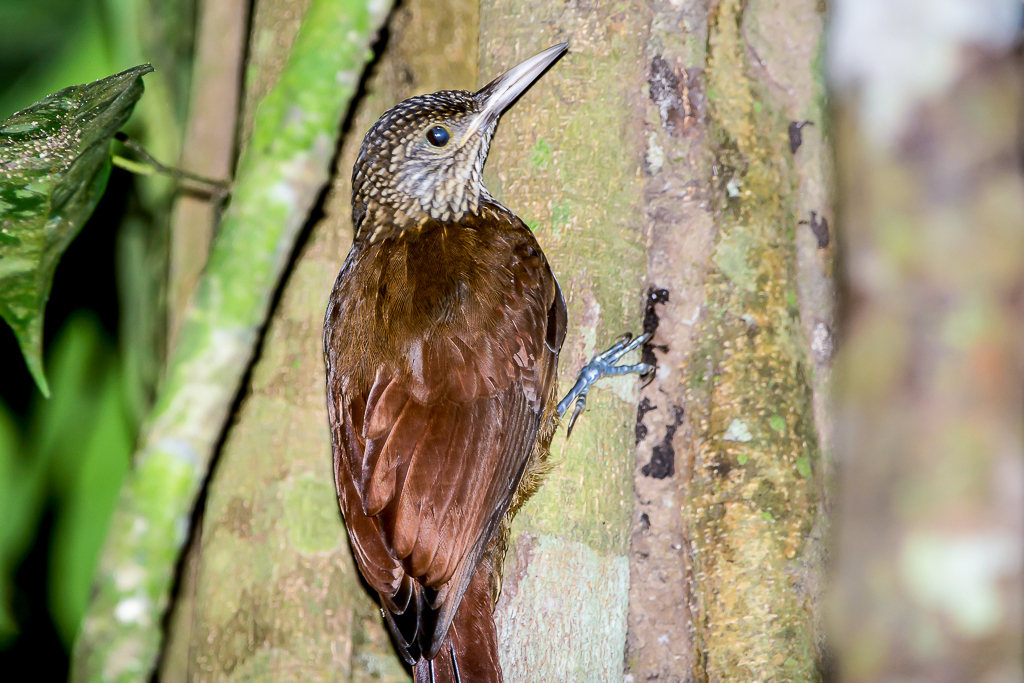
Zimmer's Woodcreeper is a woodcreeper of the flooded forests and river islands along the Amazon and its large tributaries. It resembles Straight-billed Woodcreeper, but has a slightly curved bill and buff rather than white breast streaks. The species occurs only in the Amazon basin, and the core of its range lies in the guide area.
Voice
The song, heard intermittently through the day, is a fast, high, almost level series of notes, ee-ee-ee-ee-ee. It resembles the song of Straight-billed Woodcreeper; a recording helps with the comparison.
Recording: Jerome Fischer — CC BY-NC-SA 4.0 · xeno-canto
Identification
21–24 cm, slender, with a short, slightly curved, greyish bill. The crown is grey-brown with pale streaks, the face streaked black and white with a whitish lores and supercilium. The back is rufous-brown and streaked only at the top; rump, tail and flight feathers are chestnut. The breast is cinnamon-brown with buff, black-edged streaks that fade towards the more rufous belly. The sexes are alike; juveniles are duller, with a blackish bill.
Confusion species
Straight-billed Woodcreeper Dendroplex picus lives in the same river forest and has a straight, pale, dagger-shaped bill, a whiter throat and white drops on the breast. Striped Woodcreeper Xiphorhynchus obsoletus of the same habitat is smaller, with a dark bill and a mantle streaked across the whole back. Buff-throated Woodcreeper Xiphorhynchus guttatus is larger, with a longer, heavier bill and a buff throat.
Habitat
Seasonally flooded forest (várzea and igapó) along large rivers and forest on river islands, also edges and older secondary forest, mostly below 200 m. It forages alone or in pairs on trunks and branches for insects and spiders, sometimes with mixed flocks. The nest is in a tree cavity.
Where the bird is most at home, classified by the vegetation units of Amazonia and the Guianas.




Range and movements
Brazil: along the Amazon (Solimões) from the border with Peru and Colombia east to near the mouth of the Tapajós, and along large tributaries such as the lower Rio Negro, the Japurá, the Purus and the Madeira, south into Rondônia. Absent from Venezuela, Guyana, Suriname and French Guiana. Outside the guide area only in north-eastern Peru and extreme south-eastern Colombia.
- Resident
- dark = core range, pale = thinly spread
How and when to look
Search by boat on vegetated river islands and in várzea forest, for example around Manaus and at the confluence of the Rio Negro and the Solimões. Compare every Straight-billed Woodcreeper with this species and check bill shape and the colour of the breast streaks.
Conservation status
Least Concern (IUCN); from 2012 to 2024 the species was listed as Near Threatened. The population is probably declining through clearance of flooded forest along the rivers, where most settlement and traffic in Amazonia is concentrated.
Scientific name
Dendroplex kienerii | (des Murs, 1856)
Des Murs described the species in 1856 as Dendrornis Kienerii; because it was later moved to another genus, the author and year stand in brackets. The genus Dendroplex was introduced in 1827 by Swainson. Dendroplex is Greek, from dendron 'tree' and plēssō 'to strike': 'tree-striker'. kienerii honours the French zoologist and conchologist Louis-Charles Kiener (1799–1881). The specimen the first description was based on came from Tefé (Ega), Rio Solimões, Amazonas, Brazil.