All species › Woodpeckers and allies › Woodpeckers › Acorn Woodpecker
Acorn Woodpecker | Melanerpes formicivorus
Eikelspecht | Carpintero bellotero | Pica-pau-das-bolotas
The Acorn Woodpecker is a medium-sized, boldly face-patterned woodpecker that lives in groups and is known in North and Central America for its granary trees full of acorns. In the guide area it occurs only in the Andes of Colombia, where it is tied to forests with Andean oak Quercus humboldtii. This is the southernmost part of its range.
Voice
Loud and nasal, often in groups: a repeated jaka-jaka-jaka and a rolling krrr. It drums in short rolls.
Recording: Scott Crabtree — CC BY-NC-SA 4.0 · xeno-canto
Identification
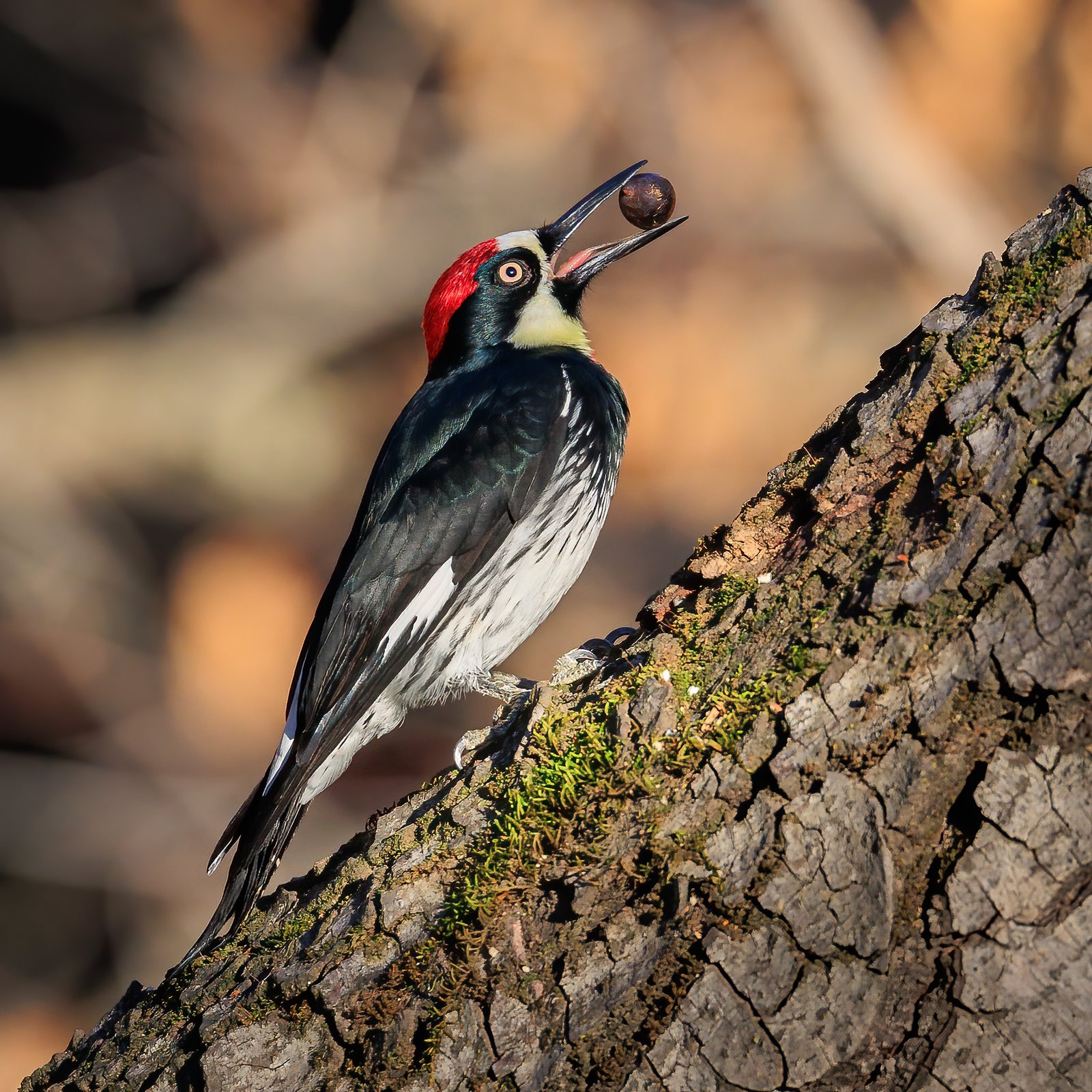
20–23 cm, with a straight, dark bill and a conspicuous pale eye. The back, wings and tail are glossy black, the rump is white, and in flight white patches at the base of the primaries stand out. The forehead is white and continues into a pale, in Colombia yellowish, throat and cheek, with a black mask around the eye between them. The crown is red. The breast is black with white streaks towards the white belly. In the male the red joins the white forehead directly; in the female a black band separates them.
Confusion species
Black-cheeked Woodpecker Melanerpes pucherani lives lower, in the humid forest west of the Andes, and has a black-and-white barred back and no white forehead. Golden-olive Woodpecker Colaptes rubiginosus has an olive-green back and barred underparts. No other woodpecker in the Colombian oak forests has the black, white and red face with the pale eye.
Habitat
Oak forest and semi-open woodland with oaks in the Andes, also forest edges and pasture with scattered oaks, in the guide area roughly between 1500 and 3000 m. It eats insects, which it also catches in flight, acorns and other fruit; locally it stores acorns in holes in trunks. It nests in a self-excavated cavity; several members of a group help to raise the young.
Where the bird is most at home, classified by the vegetation units of the Andes and the west coast.


Range and movements
In Colombia in all three Andean ranges, locally where oak forest remains. Absent from Ecuador, Peru, Bolivia and the Galápagos. Outside the guide area from the western United States through Mexico to western Panama.
- Resident
- dark = core range, pale = thinly spread
How and when to look
Search oak forests and pasture with old oaks in the Colombian Andes; groups often perch on dead branches at the top of a tree and are noisy.
Conservation status
Least Concern. In Colombia the species depends on oak forest, which has become fragmented through logging and clearance.
Scientific name
Melanerpes formicivorus | (Swainson, 1827)
Swainson described the species in 1827 as Picus formicivorus; because it was later moved to another genus, the author and year stand in brackets. The genus Melanerpes was introduced in 1832 by Swainson. The genus name comes from Greek melas, 'black', and herpēs, 'creeper', from herpō, 'to creep'. The species name comes from Latin formica, 'ant', and -vorus, 'eating': 'ant-eating'. The specimen the first description was based on came from Temascaltepec, Mexico.