All species › Woodpeckers and allies › Woodpeckers › White Woodpecker
White Woodpecker | Melanerpes candidus
Witte specht | Carpintero blanco | Pica-pau-branco
The White Woodpecker is a medium-sized white-and-black woodpecker of open, wooded country in central and eastern South America. It lives in small, noisy groups, flies across open ground from tree to tree and eats much fruit as well as insects. In the guide area it occurs mainly in the savannas and dry forests of the Bolivian lowlands.
Voice
Loud and shrill, often in chorus: a rolling kirr-kirr-kirr and fast, chattering series, especially in flight. It rarely drums.
Recording: JAYRSON ARAUJO DE OLIVEIRA — CC BY-NC-SA 4.0 · xeno-canto
Identification
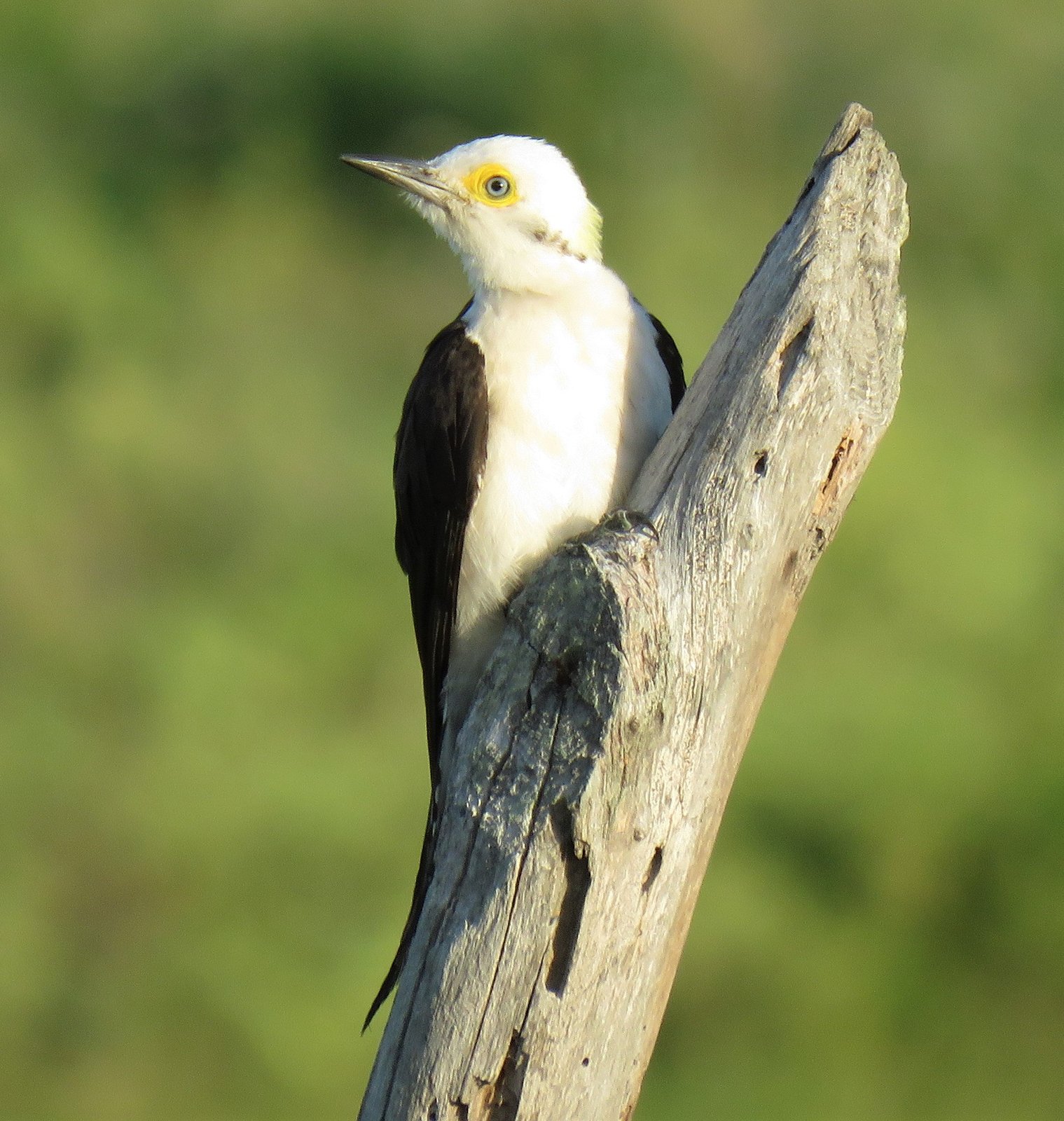
24–29 cm, with a straight, dark bill. The head, neck and underparts are white; the back, wings and tail are glossy black, and the rump is white. The pale eye is surrounded by a ring of bare yellow skin, and a narrow black line runs from the eye to the nape. There is a yellow patch in the centre of the belly. The male has a yellow patch on the nape, which the female lacks. Young birds are duller, with a greyer head.
Confusion species
White-fronted Woodpecker Melanerpes cactorum, in the Bolivian Chaco, is smaller, with a black-and-white barred back, a white forehead patch and a dark head. No other woodpecker in the guide area has a white head and a black back. In flight a group may recall corvids, but the undulating flight and the white rump are distinctive.
Habitat
Savanna with trees, cerrado, palm groves, dry Chaco forest, forest edges and pasture with scattered trees, in the guide area in the lowlands up to about 1000 m. It eats fruit, insects and their larvae, and also raids wasp and bee nests for larvae and honey. It nests in a self-excavated cavity in a tree or palm.
Where the bird is most at home, classified by the vegetation units of the Andes and the west coast.


Range and movements
In Bolivia in the lowlands of the north, east and south-east, including the Beni savannas and Santa Cruz. In Peru only rare in the savannas of the far south-east. Absent from Colombia, Ecuador and the Galápagos. Outside the guide area in central and eastern Brazil, Paraguay, Uruguay and northern Argentina, and locally along the coast of Suriname and French Guiana.
- Resident
- dark = core range, pale = thinly spread
How and when to look
Search open savanna and pasture with trees in the Bolivian lowlands; groups draw attention with their loud calls and by flying one after another across open ground.
Conservation status
Least Concern. The species locally benefits from open, cleared landscapes with scattered trees.
Scientific name
Melanerpes candidus | (Otto, 1796)
Otto described the species in 1796 as Picus candidus; because it was later moved to another genus, the author and year stand in brackets. The genus Melanerpes was introduced in 1832 by Swainson. The genus name comes from Greek melas, 'black', and herpēs, 'creeper', from herpō, 'to creep'. The species name comes from Latin candidus, 'shining white', for the largely white plumage. The specimen the first description was based on came from Cayenne, French Guiana.