All species › Woodpeckers and allies › Woodpeckers › Yellow-bellied Sapsucker
Yellow-bellied Sapsucker | Sphyrapicus varius
Geelbuiksapspecht | Chupasavia maculado | Chupa-seiva-de-barriga-amarela
The Yellow-bellied Sapsucker is a medium-sized, black-and-white woodpecker from North America that migrates as far as Central America and the Caribbean in the northern winter. It drills rows of small holes in bark and drinks the sap that flows out. The guide area lies at the very edge of the wintering range; the species is very rare here.
Voice
Mostly silent in winter. Sometimes a plaintive, mewing neeah. Drums irregularly, first fast and then in loose, stuttering taps.
Recording: Stanislas Wroza — CC BY-NC-SA 4.0 · xeno-canto
Identification
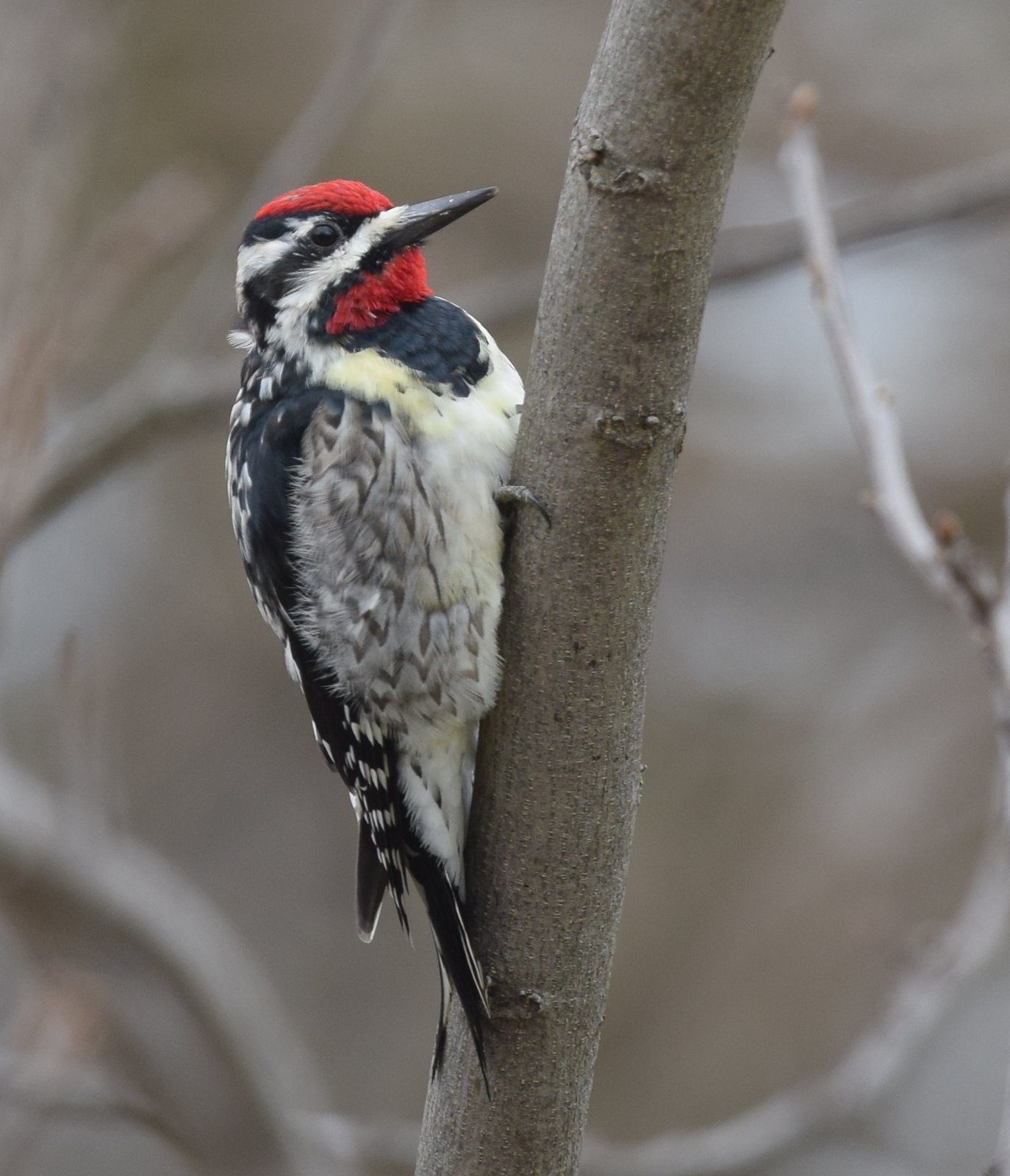
19–21 cm, with a short, straight bill. The head has a red crown, a black eye-stripe and white stripes above and below the eye. The back is black with white and pale yellow spots and bars; a long white wing patch is obvious both perched and in flight. There is a black patch on the breast, and the belly is dull yellowish white with dark streaks on the flanks. The male has a red throat, the female a white one. Young birds, often still seen in winter, have a brownish, mottled head without obvious red, but show the white wing patch.
Confusion species
Red-crowned Woodpecker Melanerpes rubricapillus and Black-cheeked Woodpecker Melanerpes pucherani also have a barred back, but lack the long white wing patch, the black breast patch and the striped head. The sapsucker is the only woodpecker in the guide area that drills rows of sap wells in bark.
Habitat
In the wintering range in semi-open woodland, forest edges, gardens, parks and plantations with scattered trees, mainly in the lowlands. It feeds on tree sap and on insects attracted to the sap, and also eats fruit. It breeds in North America in a self-excavated cavity in a tree.
Where the bird is most at home, classified by the vegetation units of the Andes and the west coast.


Range and movements
In Colombia a scarce winter visitor on San Andrés and Providencia; there are only very few records from the mainland. Absent from Ecuador, Peru, Bolivia and the Galápagos. Outside the guide area it breeds in Canada and the north-eastern United States and winters from the south-eastern United States to Central America and the Caribbean.
- Winter visitor (c. Oct–Mar)
- dark = core range, pale = thinly spread
How and when to look
On San Andrés and Providencia, from October to April, look for horizontal rows of small holes in the bark of trees in gardens and groves; the bird often returns to the same tree.
Conservation status
Least Concern. The North American population is large and stable.
Scientific name
Sphyrapicus varius | (Linnaeus, 1766)
Linnaeus described the species in 1766 as Picus varius; because it was later moved to another genus, the author and year stand in brackets. The genus Sphyrapicus was introduced in 1858 by Baird. The genus name comes from Greek sphura, 'hammer', and pikos, 'woodpecker'. The species name comes from Latin varius, 'variegated, many-coloured', for the black-and-white plumage. The specimen the first description was based on came from South Carolina, United States.